
📑 In this guide
Start with our AI Confidence Quiz
AI is already part of your child’s learning. In just a couple of minutes, discover where your family stands and what to do next.
- ✓ Your family’s AI Confidence Score
- ✓ What you’re already doing well
- ✓ Simple, practical next steps
Why this matters
AI is already part of many things children use.
It may:
- Recommend the next video to watch
- Change the difficulty of a learning activity
- Recognise a voice
- Suggest the next word in a message
- Answer a question
- Create a story, picture or piece of music
Your child may use something powered by AI without seeing the words “artificial intelligence”.
Chatbots and image-making tools have made AI easier to notice. These tools can produce impressive answers and pictures within seconds. This can make them seem clever, reliable and almost human.
A simple understanding of how AI works will help you explain why it can be useful and why its answers still need human judgement.
You do not need to understand computer code or how AI systems are built.
What does AI mean?
Artificial intelligence, often shortened to AI, is a name for computer technology that uses patterns to make predictions or produce a result.
AI systems learn from large amounts of information. They look for patterns within that information and use those patterns when responding to a new request.
For example, an AI system might use patterns to:
- Predict which video someone may choose next
- Recognise an object in a photograph
- Work out what word may come next in a sentence
- Adjust a learning activity
- Create an answer to a question
- Make a new picture from a written description
Different AI tools do different jobs. They share one basic skill: using patterns to produce a likely result.
A simple example
Imagine that you read this pattern:
Red, blue, red, blue, red...
You may predict that the next colour will be blue.
You noticed a pattern and made a sensible guess.
AI does something similar, although it can use far more information and much more complex patterns. Its speed and scale can make the result look like human knowledge or understanding.
It is still producing a result from patterns.
What is generative AI?
Generative AI is AI that creates new content after receiving an instruction.
The instruction is often called a prompt.
Generative AI can create:
- Answers
- Stories
- Poems
- Summaries
- Pictures
- Music
- Videos
- Computer code
A chatbot is one example. You enter a question or instruction, and the chatbot creates a response.
An image tool works in a similar way. You describe the picture you would like, and the AI creates an image based on patterns it has learned.
These tools do not usually search for one stored answer and copy it. They build a new response by predicting what content is likely to fit the prompt.
This is one reason the same prompt can produce different results each time.
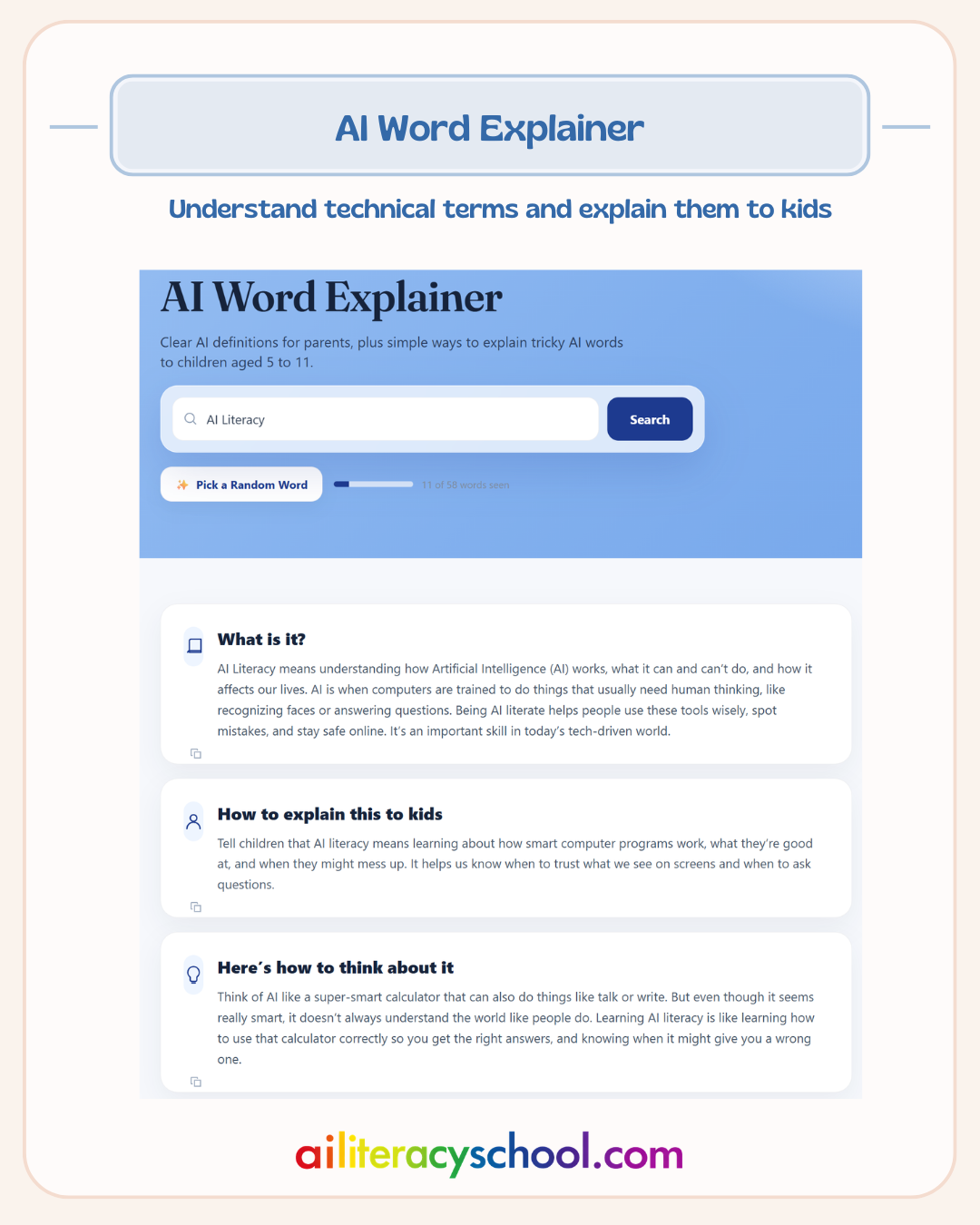
The AI Word Explainer will help you if you find any AI-related word confusing or difficult to explain to your children.
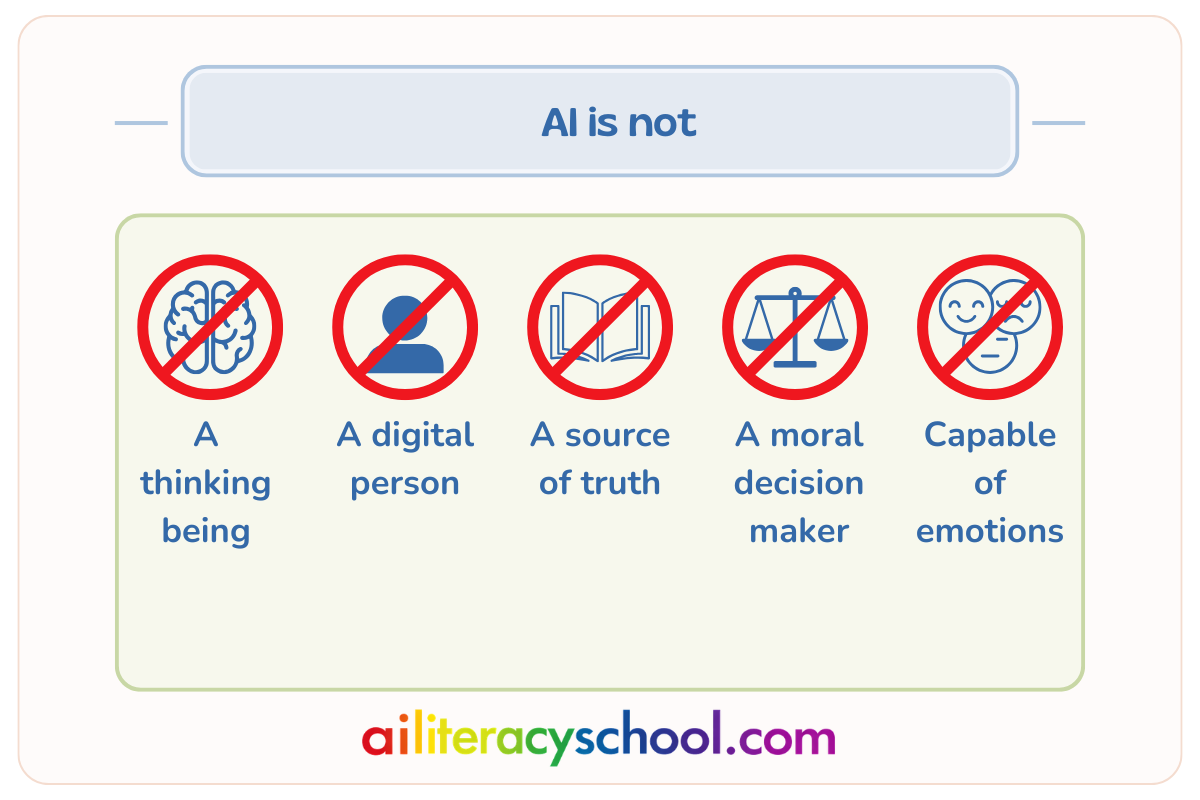
AI does not understand like a person
AI can use words that sound thoughtful, caring or certain. This does not mean it has a human mind.
AI does not:
- Think or feel
- Understand the world as a person does
- Care whether someone is happy, sad or frightened
- Know by itself whether an answer is true
- Know what is suitable for your child
- Understand your family’s values
- Take responsibility for what happens next
An AI may produce a useful answer. It may also produce an answer that is wrong, unfair, confusing or unsuitable.
It can make either type of answer sound equally confident.
Producing an answer is different from understanding it
A calculator can give the answer to a sum without understanding why a child finds maths difficult.
A weather app can show that rain is expected without understanding how it feels to have a picnic cancelled.
In the same way, a chatbot can create words about friendship, fear or kindness without feeling any of those things.
It may produce language that sounds caring because it has learned patterns from writing and conversations.
The care comes from the people reading, checking and responding to the situation. It does not come from the AI.
AI can be useful
AI’s limits do not make it useless.
AI may help an adult:
- Find a simpler way to explain an idea
- Create extra practice questions
- Suggest ideas for an activity
- Compare different ways of approaching a task
- Produce a first draft to check and improve
People still need to decide:
- Whether AI is the right tool
- What information to share
- Whether the answer is correct
- Whether the content is suitable
- What to do with the result
AI provides an output. People remain responsible for the decision.
What this means for children aged 7 to 12
Children are still learning which people and sources they can trust.
A quick and confident answer may feel more reliable than it is.
A child aged 7 or 8 may think:
“The computer said it, so it must be true.”
They may also talk about an AI as if it knows, wants or feels things.
A child aged 10 to 12 may understand that AI is a computer tool. Even so, they may trust a well-written answer because it sounds complete and certain.
They might think:
“It explained the answer clearly, so it probably knows.”
Your child does not need a technical lesson about how AI is built. They need a clear idea they can use:
AI can produce useful results, but it does not think or understand like a person. We still need to question and check what it gives us.
How to talk about AI at home
The way adults describe AI can affect how children see it.
Try to describe what the technology is doing rather than giving it human thoughts or feelings.
Instead of saying:
“The AI knows what you like.”
You could say:
“The AI noticed patterns in what you watched and predicted what you might choose next.”
Instead of saying:
“The chatbot understood your question.”
You could say:
“The chatbot used patterns to create an answer to your question.”
Instead of saying:
“The AI decided this was best for you.”
You could say:
“The AI made a suggestion. We need to decide whether it is useful.”
These small changes help your child see AI as a tool.
A simple way to explain AI to your child
For a child aged 7 or 8, you could say:
“AI is a computer tool that is good at finding patterns and making guesses. Some guesses are useful and some are wrong. It does not think or feel like a person.”
For a child aged 10 to 12, you could say:
“AI uses patterns from lots of information to predict answers or create things. It can make useful content, but it does not understand its answer in the way a person would. That is why people still need to think, check and decide.”
You do not need your child to remember every part of the explanation. Focus on one clear message:
AI can make things that look clever without understanding them.
Words that make AI sound human
You may hear people say that an AI:
- Knows
- Thinks
- Understands
- Wants
- Remembers
- Feels
- Decides
People often use these words because they make AI easier to talk about.
You do not need to correct every use of them. You can sometimes add a clearer explanation.
For example:
“People say the AI ‘knows’, but it is really using patterns to predict an answer.”
This helps your child build a more accurate picture without turning every conversation into a lesson.
If you find an AI word difficult to understand or explain, the AI Word Explainer can give you a simple parent and child definition.
What you can begin doing now
Try to build these three habits into family conversations.
Describe AI as a tool
Use phrases such as:
The AI tool made this.
The chatbot produced this answer.
The system predicted what might come next.
Notice human-sounding language
When an AI says “I think” or “I understand”, remind your child that these are words produced by the system. They do not prove that it has thoughts or feelings.
Keep human judgement in the conversation
Ask questions such as:
Does that answer make sense?
How could we check it?
What might the AI have missed?
Who could help us decide?
These questions show your child that thinking continues after an AI gives an answer.
Key takeaways
- AI is computer technology that uses patterns to make predictions or produce results.
- Generative AI creates content such as answers, stories, pictures and videos.
- AI can sound human without having human thoughts, feelings or understanding.
- A clear and confident answer may still be wrong.
- AI can be useful when people guide, question and check its work.
- Children need to see AI as a tool rather than a person or trusted authority.
- You do not need technical knowledge to start teaching your child about AI.
Try the activity next
The activity that follows will help you explain the difference between doing something that looks clever and understanding what it means.
You will not need to ask your child to use an AI tool.
Through examples and discussion, your child will practise deciding:
- What AI can do using patterns
- What AI cannot understand
- When a person needs to think, care or make the decision
Try the version that best fits your child’s age and confidence.
Was this guide helpful?
Let us know whether this article helped you.
Share this guide with other parents
Know a parent who would find this guide helpful? Enter their email address and we'll send them the Parent Conversation Guide directly.
