Why this is important
AI tools can answer questions quickly. Their answers often use clear sentences, a calm tone and helpful-sounding explanations.
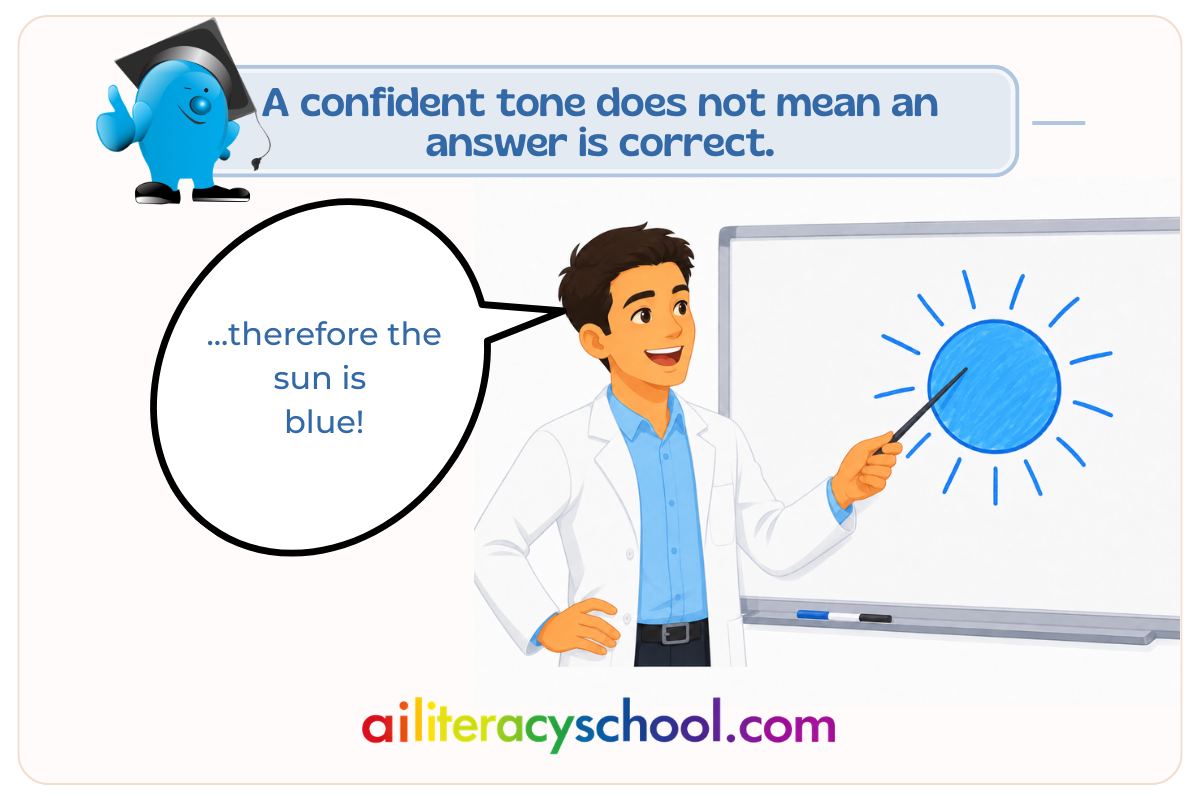
This can make the AI seem certain about what it is saying.
Some answers will be useful and correct. Others may be wrong, incomplete or unsuitable. The problem is that both types of answer can sound equally confident.
Children are still learning how to judge whether a source can be trusted. A clear answer may feel more reliable simply because it is easy to read and sounds sure of itself.
You can help your child build one useful habit:
Listen to the answer, then think about how you could check it.
How this lesson applies
Your child may come across AI in several ways.
They may use an AI-powered learning tool chosen by you or their school. A tool designed for children should have suitable safeguards, but it can still make mistakes or give an incomplete answer.
You may also decide to use a general-purpose chatbot together. Children aged 7 to 12 should not use these tools independently. You should stay involved, use your own account and enter the prompts.
Your child might also meet a chatbot or AI answer unexpectedly. An AI feature may appear in an app, or a friend or older sibling may show them one. They may also use a tool without permission.
Teaching your child to question confident answers prepares them for each of these situations. It does not change your family rules about which tools they may use.
How an answer sounds does not show whether it is right
AI systems are made to produce responses that sound useful and clear.
An answer may include:
- A direct response to the question
- A calm and friendly tone
- A full explanation
- Examples or reasons
- Words that suggest certainty
These features make an answer easier to use. They do not prove that it is correct.
An AI can use the same confident style when its answer is:
- Correct
- Wrong
- Missing an important detail
- Based on a misunderstanding
- Unsuitable for your child
- Too certain about something that is not settled
The wording may sound sure because the system is good at creating natural language. The tone does not show how much evidence supports the answer.
Why confidence can be persuasive
People often use clues to decide whether someone knows what they are talking about.
We may trust an answer because it is:
- Quick
- Clear
- Detailed
- Calm
- Easy to understand
- Given without hesitation
These clues can be useful when you are speaking to a person whose knowledge and experience you understand.
With AI, those clues can be misleading.
AI does not feel sure or unsure. It produces language that fits the question and the patterns it has learned.
A phrase such as:
“The answer is definitely…”
may sound confident, but the word “definitely” does not add evidence.
A person may say ‘definitely’ when they are wrong because they genuinely believe it to be correct. AI may use‘definitely’ just because it fits a pattern it has learned from how questions might be answered. It cannot feel confident.
A correct answer and a confident answer are different things
An answer can be:
- Correct and confident
- Correct but uncertain
- Wrong and confident
- Wrong and uncertain
- Partly correct but missing something
For example, an AI homework tool might use the right method and explain it clearly.
It might also make a mistake in the first step and then explain the wrong answer just as clearly.
A chatbot might give a useful summary of a topic.
It might also leave out an important point while making the summary sound complete.
Your child needs to learn that the style of an answer and the quality of an answer are separate.
What a confident answer may hide
A simple mistake
The answer may contain a wrong fact, date, name or calculation.
The rest of the response may still sound polished and sensible.
Missing information
The answer may give one part of the story and leave out something needed to understand the full picture. For example, it might say the cheetah is the fastest animal on Earth. It has left out the important distinction that it is the fastest land animal. Others move faster in the air.
A short answer can sound complete even when it is not.
A question understood in the wrong way
The AI may respond to a different meaning from the one your child intended.
Because the response is clear, your child may not notice that it answered the wrong question.
Advice that does not fit your child
An AI may describe an activity, book or learning method as ideal.
It does not know everything about your child, their schoolwork or the situation. You still need to decide whether the suggestion fits.
A kind tone without real understanding
An AI can produce warm and reassuring words.
It cannot understand how serious a problem is, notice everything your child is feeling or take action to help them.
Personal worries, safety concerns and important decisions need support from trusted people.
Three questions that help
When you look at an AI answer together, ask:
1. What is it claiming?
Try to put the main answer into one short sentence.
This makes it easier to see what needs checking.
For example:
“It is claiming that this animal is a reptile.”
2. How could we check it?
Choose a source that is separate from the AI conversation.
Depending on the question, you might use:
- A schoolbook
- Class notes
- A trusted reference book
- A reliable educational website
- An official source
- A teacher
- Another adult who knows the subject
Asking the same AI again may give you another confident answer. An independent check gives you better evidence.
3. What could happen if it is wrong?
The amount of checking should fit the possible harm.
A story idea may need very little checking.
A fact for homework should be checked before your child uses it.
Advice about health, safety, money or a serious personal problem should go to a trusted adult or qualified person.
You can highlight that this applies even to adults who should check health answers with a doctor or financial questions with an accountant,
Checking does not mean distrusting everything
Your child does not need to investigate every word an AI produces.
The aim is to help them notice when accuracy is important.
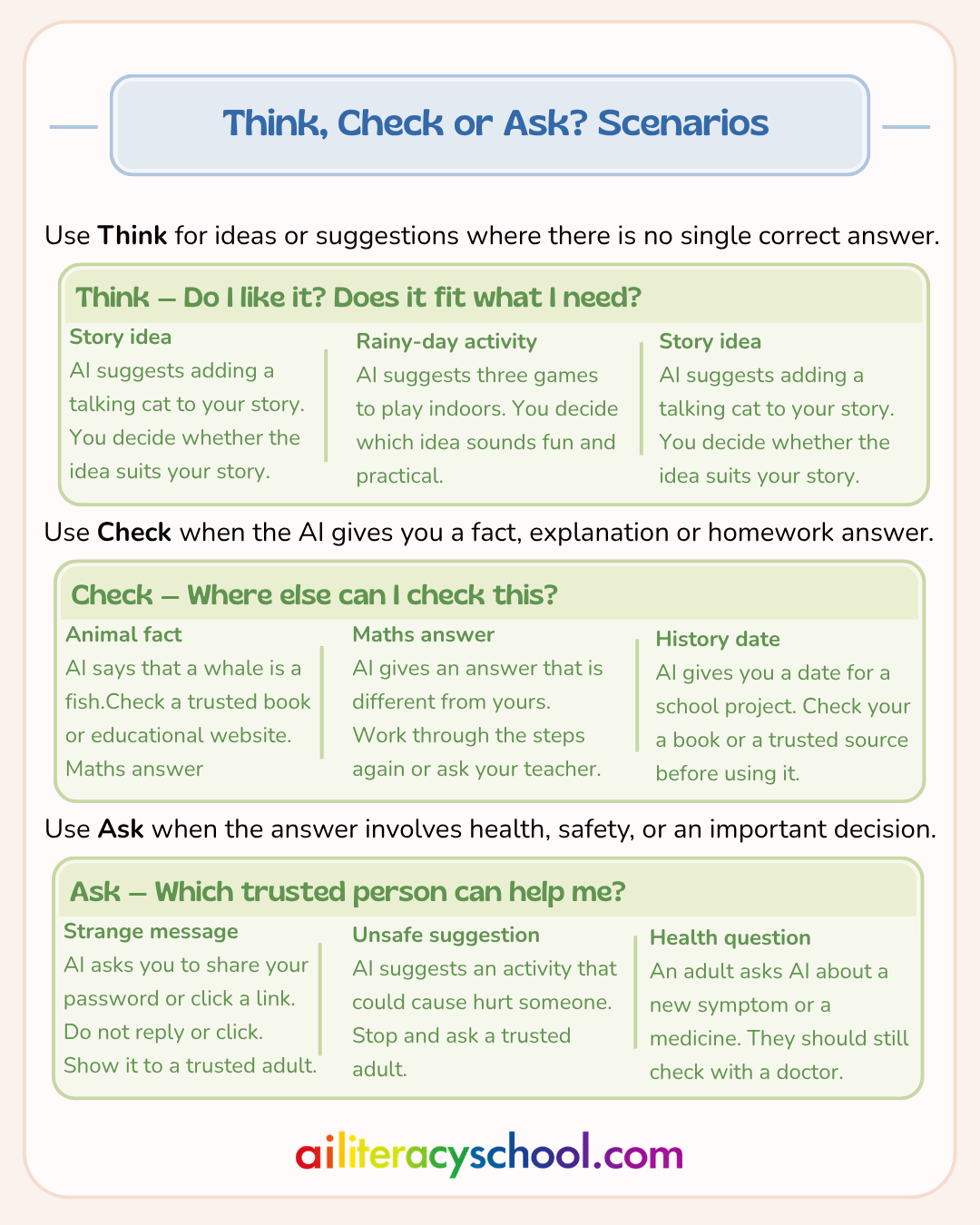
You might treat an AI answer as:
An idea
A suggestion for a story character or craft activity may simply give you somewhere to start.
You can decide whether you like it.
Information
A fact, explanation or homework answer should be checked against a trusted source.
Your child should also be able to explain the answer in their own words.
Advice
Advice that could affect health, safety, relationships or a serious decision should not be followed without help from a trusted person.
This approach helps your child use AI thoughtfully without treating every answer as dangerous or every answer as true.
What this means for children aged 7 to 12
Children aged 7 to 9
Your child may:
- Believe a computer would not give an answer if it were wrong
- Think quick answers come from knowledge
- Trust a friendly or teacher-like tone
- Copy an answer without stopping to think
- Feel reassured because the AI sounds calm
At this age, keep the message concrete:
“It can sound sure and still be wrong.”
Your child does not need to check facts alone. They need to know when to pause and ask you.
Children aged 10 to 12
Your child may understand that AI makes mistakes but still:
- Trust a detailed explanation
- Stop checking when an answer sounds right
- Use an answer in schoolwork without understanding it
- Treat a chatbot as an expert on many subjects
- Miss a detail that makes the answer incomplete
- Believe that a polite warning makes advice safe
At this age, help your child separate the claim from the presentation.
Ask them what the AI is saying, what evidence would support it and what may be missing.
For a nine-year-old, use the approach that best suits their confidence and understanding.
What you can do
Show your child that adults check too
When an answer sounds convincing, say:
“That sounds clear. Let’s see whether it is right.”
This shows your child that checking is a normal part of using information.
Praise the pause
If your child questions an answer, recognise the thinking involved.
You could say:
“Good spot. It sounded sure, but you still stopped to think.”
Ask about the evidence
Try asking:
- “How could we know?”
- “Where else could we check?”
- “Does this answer match what you already know?”
- “What might it have left out?”
- “How important is it to get this right?”
Let your child see you change your mind
You may believe an answer at first and then find better information.
Say so openly:
“I thought that was right, but this source shows something different. I’m glad we checked.”
This teaches your child that changing your mind after finding evidence is a strength.
Keep important questions with people
For schoolwork, check with class materials or a teacher.
For health, safety or serious personal issues, speak to a trusted adult or qualified person.
A clear AI answer should not replace human care or responsibility.
A simple way to explain this to your child
For a child aged 7 or 9, you could say:
“AI can sound very sure, even when it has made a mistake. A sure voice does not prove an answer is right. If the answer is important, we check it together.”
For a child aged 10 to 12, you could say:
“AI is good at writing clear and confident answers. The way an answer sounds does not show whether it is correct. Look at the claim, check it somewhere else and think about what may be missing.”
Focus on this sentence:
It sounds sure. We still check.
Key takeaways
- AI can sound confident when it is right, wrong or missing information.
- Clear language and a friendly tone do not count as evidence.
- Children may mistake a polished answer for an expert answer.
- Help your child identify the claim before checking it.
- Use a source outside the AI conversation.
- The more serious the decision, the more careful the check should be.
- General-purpose AI should only be used with your direct involvement.
- Your child should bring important questions to trusted people.
Try the activity next
The activity that follows will help your child decide how much checking an AI answer needs.
They will look at everyday examples and choose whether to:
- Think about whether an idea is useful
- Check a fact or explanation with another source
- Ask a trusted person when the answer involves health, safety, private information or an important decision
The aim is to show that not every AI answer needs the same response. Your child will learn to match the level of checking to what could happen if the answer is wrong.
Your child will not need to use an AI tool during the activity.