📑 In this guide
Start with our AI Confidence Quiz
AI is already part of your child’s learning. In just a couple of minutes, discover where your family stands and what to do next.
- ✓ Your family’s AI Confidence Score
- ✓ What you’re already doing well
- ✓ Simple, practical next steps
Summer learning does not have to mean worksheets, screens, or expensive days out.
Some of the best learning happens when children are curious, active, and noticing the world around them. A nature walk is a perfect example. It is free, healthy, flexible, and available to many families in some form, whether that means a park, street trees, a garden, a woodland path, or the route to the shops.
This is also a simple way to show how AI can support family learning without taking over.
The Summer Learning Pathway helps families create more personalised experiences like this. It shows parents how to use AI for preparation, ideas, and reflection, while keeping the real learning rooted in parent-child conversation, outdoor activity, and shared thinking.
Here is one example you can try.
The Activity: Become Tree Detectives
The aim is simple:
Go on a walk together, notice different trees, collect safe clues, and use AI before and after the walk to support learning.
The walk itself can be screen free. AI does not need to come with you. In fact, this is part of the point.
AI helps you prepare. You and your child do the real-world exploring and then you use AI afterwards to think more carefully about what you found.
Before the Walk: Use AI to Prepare
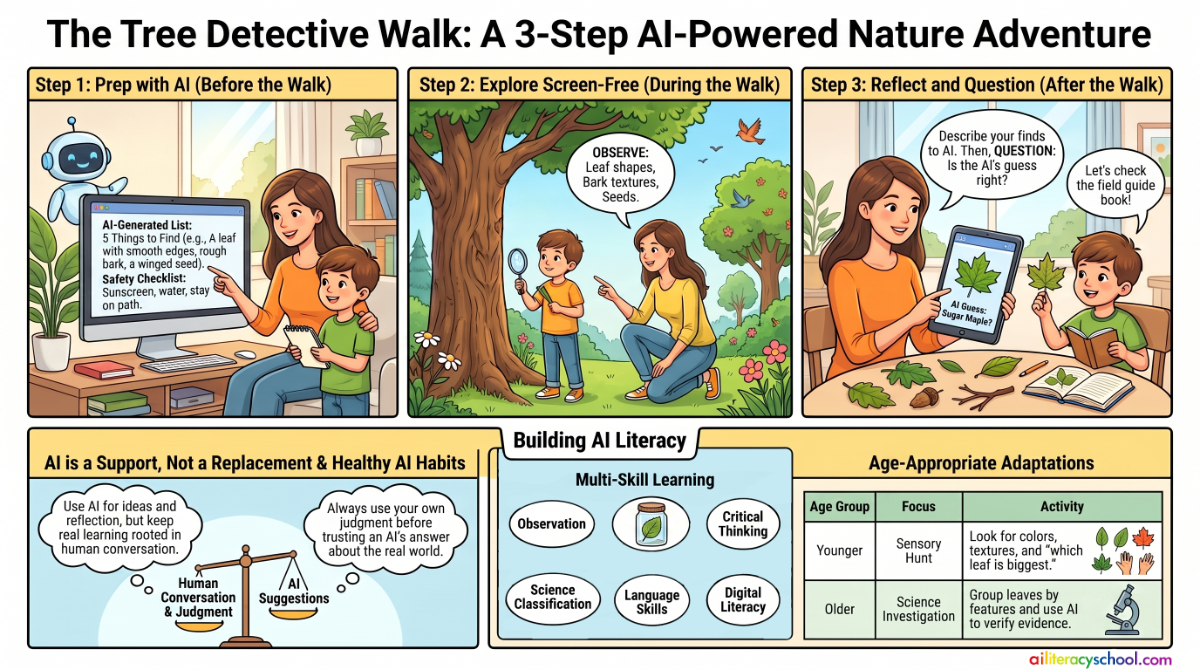
Before you go, you can ask AI to help you plan a simple tree detective activity.
For example:
Role: You are helping a parent plan a screen-free nature activity.
Instruction: Give me a simple tree detective activity for a child aged 7.
Context: We will walk in a local park and look at leaves, bark, shape, and seeds.
Output: Give me 5 things to look for and 3 questions to ask my child.
AI might suggest looking at:
- The shape of leaves
- Whether the leaf edges are smooth, jagged, or wavy
- The pattern of veins
- Bark colour and texture
- Seeds, berries, cones, or blossom
- The overall shape of the tree
This helps you go into the walk with a few simple things to notice.
You do not need to become a tree expert. You just need enough structure to help your child look more closely.
Add a Safety Check
AI can also help you think ahead about health and safety, but it should not be treated as the final judge of what is safe.
You could ask:
Role: You are helping a parent prepare for a child-friendly nature walk.
Instruction: List simple safety reminders for looking at trees, leaves, plants, and wildlife.
Context: The child should observe nature without harming themselves or disturbing animals.
Output: Give me a short parent checklist.
This might remind you to:
- Avoid touching unknown plants
- Wash hands after handling leaves or soil
- Avoid berries, mushrooms, or seeds unless an adult is certain they are safe
- Watch out for nettles, thorns, insects, snakes, or other local risks
- Avoid disturbing nests, eggs, burrows, or wildlife
- Stay on safe paths and respect local rules
This is an important AI literacy lesson too.
AI can help you think about possible risks, but it cannot promise that a plant, animal, path, or situation is safe. Parents still need to use local knowledge, common sense, and reliable guidance.
During the Walk: Keep It Real and Screen Free
On the walk, your child can become a tree detective.
You might say:
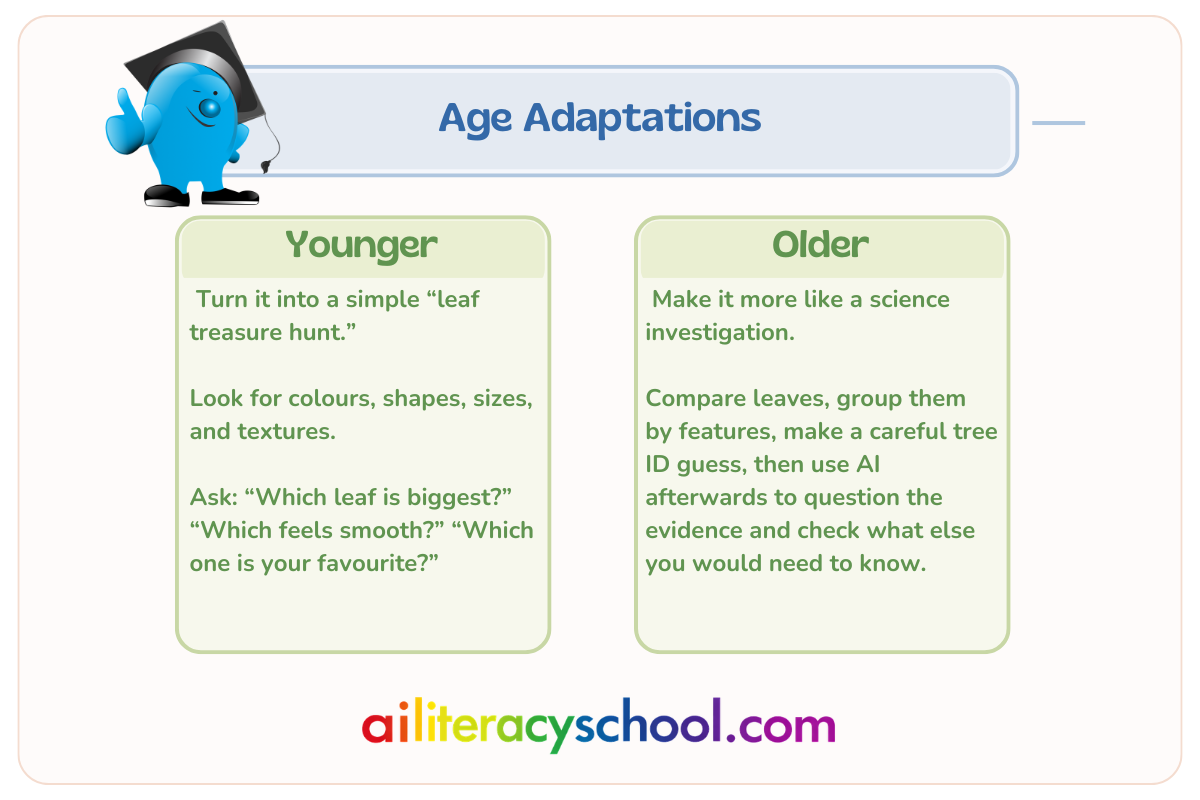
Let’s see how many different leaf shapes we can find.
Can you find two leaves that look similar but not exactly the same?
What clues could help us work out what tree this came from?
Your child could collect a few fallen leaves, take photos, or make quick sketches. Avoid picking leaves from living trees unless you know it is allowed and appropriate.
You can also encourage your child to notice:
- Big leaves and small leaves
- Simple leaves and leaves made of smaller leaflets
- Smooth, jagged, or lobed edges
- Different shades of green
- Bark that is rough, smooth, cracked, pale, or dark
- Seeds, cones, flowers, or fruit on the ground
The learning is not only about naming the tree. It is about noticing, comparing, describing, asking questions, and making careful guesses.
That is real thinking.
After the Walk: Use AI to Reflect
When you get home, AI can help you explore what you found.
You might describe the leaves together, upload a photo if you are comfortable doing so, or ask AI to help you compare features. Avoid sharing personal details, locations, or identifiable information about your child.
Here is a simple prompt:
Role: You are helping a parent and child think like nature detectives.
Instruction: Help us describe and compare these leaves before guessing what trees they might be from.
Context: We found them on the ground during a local walk.
Output: Give us questions to answer, possible tree ideas, and what to check next.
This keeps AI in the right role. It is not simply giving an answer. It is helping you and your child think more carefully.
You might ask your child:
What does AI notice that we noticed too?
What might AI have missed?
What would we need to check before trusting the answer?
Could two different trees have similar leaves?
This builds AI literacy in a natural way. Your child learns that AI can be useful, but it needs questioning. It can suggest ideas, but it can also be uncertain or wrong.
What Children Learn
This one activity can support several kinds of learning at once.
Children practise observation when they look closely at leaves, bark, seeds, and shapes.
They build language when they describe what they see.
They use science skills when they compare, sort, classify, and make careful guesses.
They develop confidence because the activity feels playful and achievable.
They build AI literacy because they see AI used as a support tool, not as a replacement for thinking.
And they spend time moving, talking, and learning with you.
What Parents Learn
This activity also shows how AI can support you without adding pressure.
You do not need to plan a full lesson.
You do not need to know all the answers.
You do not need to turn summer into school.
You can use AI to get ideas, prepare questions, think about safety, and reflect afterwards.
Then you can bring the learning back to what matters most: time together, curiosity, real-world experience, and thoughtful conversation.
The Key AI Literacy Message
AI is useful when it helps us prepare, notice, question, and reflect.
It is less useful when we treat it as always right.
For children, this distinction matters.
A healthy AI learning habit might look like this:
- Use AI for ideas.
- Go and experience the real world.
- Come back and question what AI says.
- Use your own judgement before trusting the answer.
That is the kind of AI literacy children need.
Want More Summer Learning Ideas Like This?
The Summer Learning Pathway helps families make the most of summer with simple, creative, parent-led learning activities.
Each week helps you use AI in a safe and practical way to support your child’s learning, while keeping real-world experiences, family conversation, and healthy routines at the centre.
It is designed to help prevent summer learning loss without making summer feel like school.
You will get practical ideas, parent guidance, child-friendly activities, and simple ways to build AI literacy as a family.
Make this summer a time for curiosity, confidence, and shared learning.
Explore the Summer Learning Pathway and start building your family’s AI literacy one enjoyable activity at a time.
Was this guide helpful?
Let us know whether this article helped you.
Share this guide with other parents
Know a parent who would find this guide helpful? Enter their email address and we'll send them the Parent Conversation Guide directly.