📑 In this guide
Start with our AI Confidence Quiz
AI is already part of your child’s learning. In just a couple of minutes, discover where your family stands and what to do next.
- ✓ Your family’s AI Confidence Score
- ✓ What you’re already doing well
- ✓ Simple, practical next steps
Preparing Children Aged 8 to 10 for AI
Children aged 8 to 10 are too young to be permitted to use most AI-based tools including ChatGPT and Claude.
These are examples of AI chatbots that can answer questions, explain ideas and produce written content. You can find simple explanations of both tools in our AI Word Explainer: ChatGPT, Claude.
But that does not mean AI is outside their world.
Children this age may hear older pupils talking about AI. They may see parents, teachers, friends, or siblings using it. They may come across AI features in apps, games, search tools, homework platforms, or creative tools made for children. AI is a growing presence in Google searches.
Some may even use AI without permission, perhaps with a friend, on a shared device, or through an older sibling’s account.
This does not mean parents should accept unsafe or underage use. Boundaries still matter. But it does mean children need guidance before they become independent users.
The goal is not to rush children into using AI. The goal is to help them build a healthy view of AI before they meet it more fully.
Learn more about the skills parents need to develop in their children to help them become safe and effective users of AI in this parent guide to AI and thinking skills.
Why this age matters
Children aged 8 to 10 are old enough to ask big questions. They are starting to form views about schoolwork, technology, fairness, privacy, truth, and friendship.
They can also begin to understand bias, which means an AI answer may sometimes be unfair or one-sided because of the examples it learned from. Our AI Word Explainer provides an age-appropriate way to introduce bias.
They are also still very shaped by what adults say and do.
That makes this a good age for effective and simple conversations about AI.
Children do not need advanced explanations. They do not need to know how AI systems are built. But they can begin to understand some important ideas:
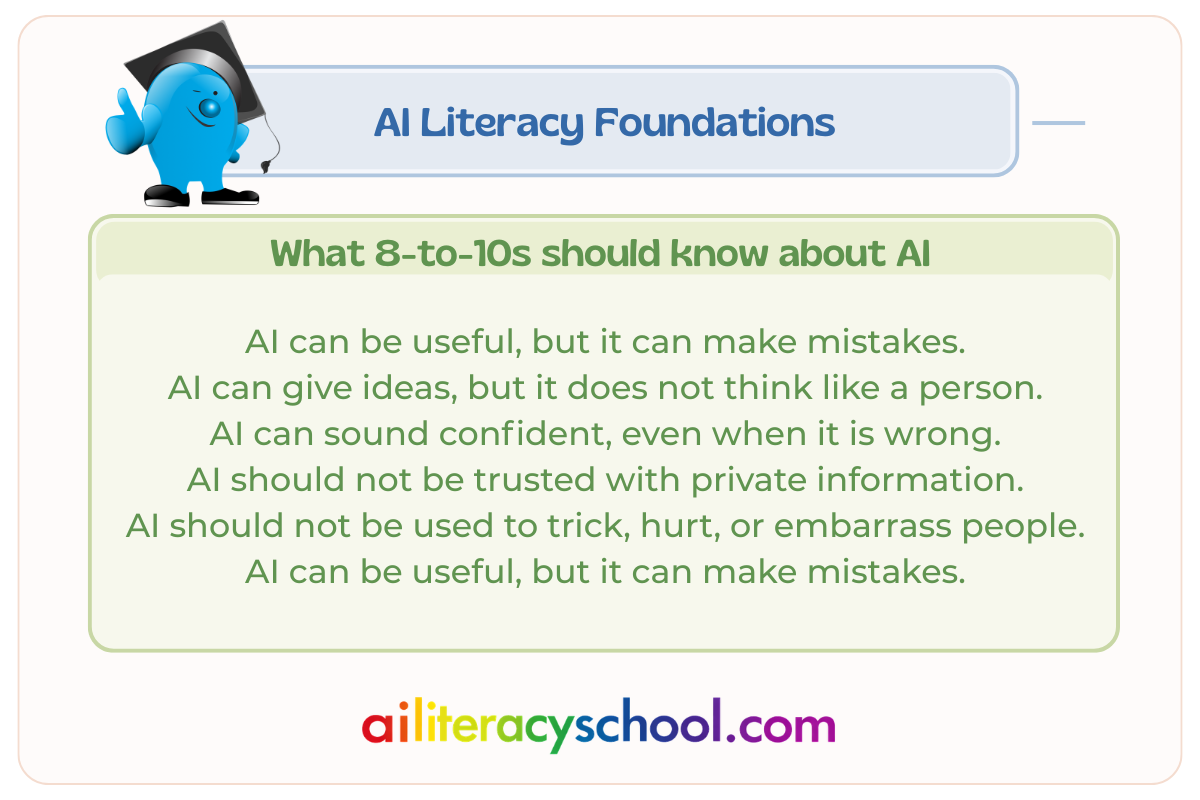
These ideas are simple, but they are powerful. They give children a foundation before AI becomes a bigger part of their lives.
Children are learning from what they see
Many children first learn about AI by watching adults use it.
They may see a parent ask AI for a recipe, a packing list, a birthday party idea, a work email, or help explaining a topic. They may hear adults say, “I’ll just ask AI,” or “AI gave me the answer.”
If children only see AI being treated as a magic answer machine, they may copy that view. They may think AI is always right, or that using AI means avoiding effort.
But if they see adults use AI thoughtfully, they learn something different.
They learn that AI is a tool to question, check, and use with care.
This is where parents can be powerful role models.
Being a good AI role model
You do not need to be an AI expert to model healthy AI use.
In fact, one of the best things parents can show children is that responsible adults ask questions, check answers, and think carefully.
For example, if you use AI to help plan a family day out, you might say:
AI gave us some ideas, but we still need to check the opening times.
If you use AI to explain a topic, you might say:
This is one explanation. Let’s see if it matches what your book or teacher says.
If you use AI to write a list, you might say:
This helped me get started, but I still need to decide what makes sense for our family.
If AI gives a strange or wrong answer, you can say:
That sounded confident, but it was not right. AI can make mistakes, so we do not just believe everything it says.
These simple comments help children build healthy habits.
They show that AI is not something to fear, worship, or blindly trust. It is something to use with judgement.
Using AI with children, not instead of them
Some parents may choose to use AI directly with their child. For children aged 8 to 10, this should usually mean shared, supervised use, led by the adult.
The parent stays in control. The child watches, asks questions, and joins the thinking.
For example, you might use AI together to:
- Generate silly story ideas.
- Make a quiz about a topic your child is learning.
- Create a list of questions to ask before a museum visit.
- Explain a tricky word in simpler language.
- Suggest ideas for a family project.
- Compare two possible answers and decide which is more useful.
The important thing is that the child is not being handed AI as a private tool. They are learning how to think around it.
What children need to understand
Children aged 8 to 10 need clear, concrete messages. They do not need long warnings or technical details.
Here are some simple ideas parents can repeat over time.
1. AI is not a person
Children may find AI chatbots friendly, funny, or helpful. Some AI tools are designed to feel warm and conversational.
That can be confusing for children.
They need to know that AI can use friendly words, but it does not have feelings. It does not know them. It does not care about them in the way a real person can.
You might say:
AI can chat, but it is not a real friend. For real worries, real people matter.
Some of these tools are known as AI companions because they are designed to chat in a friendly, personal or emotionally supportive way. Our AI Word Explainer explains why AI companions can seem human even though they do not have real feelings.
2. AI can be wrong
AI can make mistakes. It can miss details. It can even make things up.
Children should learn this early, before they become too trusting.
You might say:
AI can give us ideas, but we still need to check important things.
3. Private information stays private
Children should know not to share personal details with AI tools.
This includes their full name, address, school, passwords, private photos, family problems, or anything that would make them feel uncomfortable if other people saw it.
You might say:
Do not tell AI anything private. If you would not write it on a poster, do not type it into AI.
4. AI should not do your thinking for you
AI can help with ideas, explanations, and practice. But children still need to try, think, struggle, and learn.
This matters especially for homework.
You might say:
It is okay to get help understanding something. It is not okay to pretend AI’s work is your own.
5. AI should be used kindly
Children need to connect AI use with values they already understand: honesty, kindness, fairness, and respect.
This includes not using AI to make fake pictures of people, write mean messages, copy work, or trick others. Some convincing fake pictures or videos are called deepfakes. Find a child-friendly explanation of deepfake in our AI Word Explainer.
You might say:
If it would be unkind without AI, it is still unkind with AI.
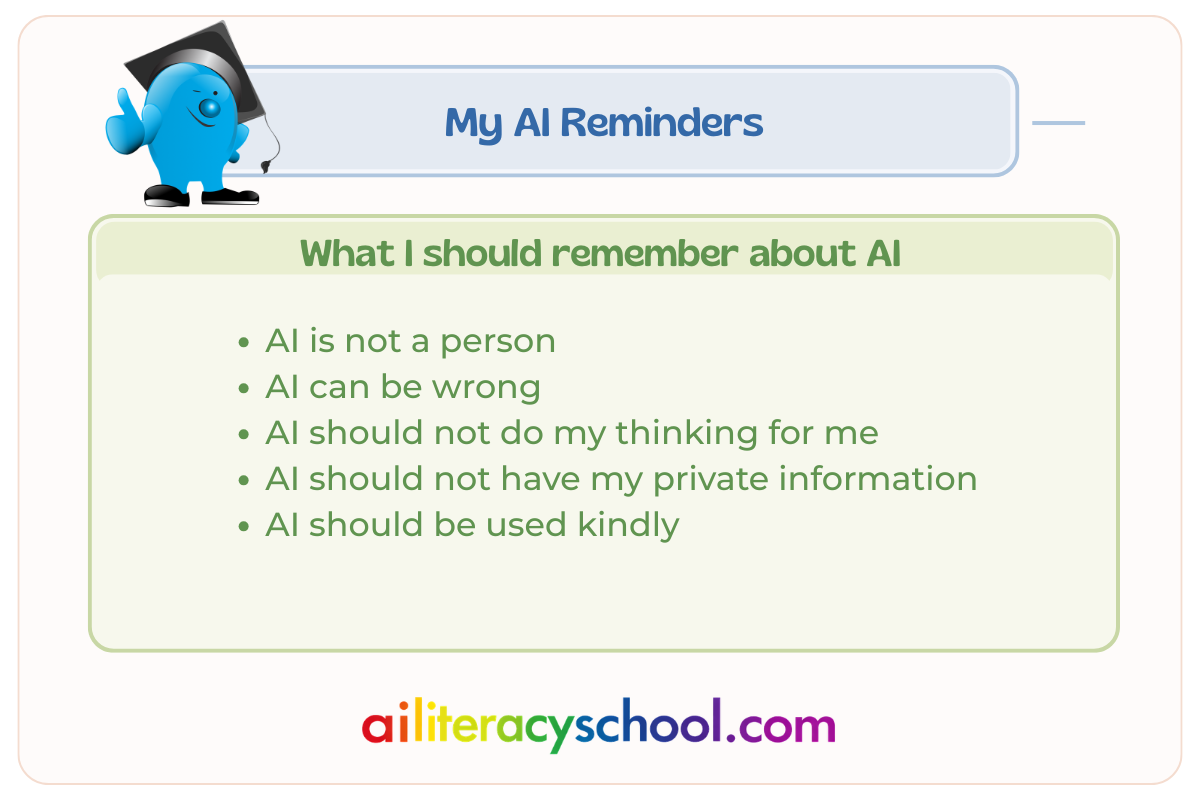
A printable AI reminder you can use
What about non-permitted use?
Many parents set clear rules about AI use, especially for younger children. That is sensible.
But rules do not remove every risk.
A child may see AI being used at a friend’s house. They may watch an older sibling using it. They may access a tool without understanding that it is not meant for them. They may not even realise that a feature inside an app is powered by AI.
Parents do not need to assume the worst. But they should keep the conversation open.
Instead of only saying, “You are not allowed to use AI,” it can help to say:
If you ever see an AI tool, or someone asks you to try one, you can always tell me. You will not be in trouble for asking questions.
This makes it easier for children to come to you if something happens.
The aim is not to condone underage or unsafe use. The aim is to make sure children are not left alone with confusing experiences.
Helpful questions to ask your child
You can learn a lot by asking gentle, open questions.
Try asking:
- “Have you heard anyone at school talk about AI?”
- “What do you think AI is?”
- “Have you seen an app or game that talks back to you?”
- “What would you do if a friend wanted to show you an AI chatbot?”
- “What kind of information should we never type into a computer or app?”
- “How could AI help someone learn?”
- “How could AI make learning harder?”
These questions do not need to become a lecture. They can be short conversations in the car, at the table, or while doing homework.
The goal is to make AI something your child can talk about with you.
A simple family rule for this age
For children aged 8 to 10, a simple family rule could be:
AI is something we use with an adult, not alone.
You can add:
We use it for ideas and learning, but we check it, question it, and never share private information.
This gives children a clear boundary without making AI feel mysterious or forbidden.
Why parents need AI literacy too
Children learn from the adults around them.
That means the best AI role model is not a parent who knows everything. It is a parent who is informed, thoughtful, and willing to guide.
Parents need to understand enough to answer questions, set boundaries, notice risks, and model healthy use. They do not need technical training. They need family-focused AI literacy.
That means understanding AI in the context of children’s learning, safety, habits, confidence, privacy, friendships, and wellbeing.
This is exactly what AI Literacy School is designed to support.
Our Learning Pathways help parents build the knowledge and confidence they need to guide children calmly and practically. They focus on what AI means for family life, schoolwork, safety, and healthy development.
The aim is not to turn parents into technology experts.
The aim is to help parents become steady, informed role models.
The parent takeaway
Children aged 8 to 10 may be a few years away from independent AI use, but they are not too young to begin learning healthy ideas about it.
They are listening. They are watching. They are forming opinions.
This is the moment to teach simple foundations: Preparing children for AI does not begin with giving them a chatbot. It begins with informed adults, calm conversations, and everyday role modelling.
Explore the AI Literacy School Learning Pathways to build your own confidence and help your child develop safe, thoughtful AI habits from the start: AI Literacy School Learning Pathways
You may find this guide helpful: Preparing for AI by age: Tweens
Was this guide helpful?
Let us know whether this article helped you.
Share this guide with other parents
Know a parent who would find this guide helpful? Enter their email address and we'll send them the Parent Conversation Guide directly.