📑 In this guide
Start with our AI Confidence Quiz
AI is already part of your child’s learning. In just a couple of minutes, discover where your family stands and what to do next.
- ✓ Your family’s AI Confidence Score
- ✓ What you’re already doing well
- ✓ Simple, practical next steps
Everyday AI for Parents
Did you know that parents are among the unexpected power users of AI, according to a 2025 report?
The study found that parents are using AI tools almost twice as often as non-parents, often to organise family life, help children learn, or manage the daily juggle of work and home.
The good news is simple: you do not need to be an AI expert.
This guide will help you understand what AI can do, where the limits are, and how to start learning about it together at home.
You Do Not Need to Be Technical
Many parents worry they are already behind.
You may hear about AI at work, in the news, or from your child’s school. It can feel as if everyone else understands it better than you do.
But using AI well at home does not start with technical knowledge.
It starts with simple habits:
- Asking clear questions.
- Checking answers.
- Talking about what might be missing.
- Protecting personal information.
- Helping your child use AI as support, not as a shortcut.
You do not need to know how AI is built to help your child think carefully about it.
A good starting phrase is:
AI can be useful, but we do not just copy or trust what it says. We check it, talk about it, and use our own judgment.
That one idea can guide many family conversations.
The AI Literacy School Learning Pathways and Guides can provide even more support.
Better Prompts Get Better Results
AI usually works better when you give it a clear job, not just a quick question.
A helpful prompt often includes four parts:
Role: Who should AI act as?
Instruction: What do you want it to do?
Context: Who is this for, and what should AI know?
Output: What should the answer look like?
You can learn more in our guide: Why Choosing a Role in Your Prompts Is Important for Parents.
What AI Can Help Families Do
AI is often explained in big, technical ways. But for parents, its value is easier to see in everyday moments.
Here are some ways AI can help when an adult is guiding the process.
When Your Child Says, “I Don’t Get It”
AI can explain a tricky topic in simpler words. It can give another example, break an idea into smaller steps, or create practice questions.
You might ask:
You are helping a parent explain fractions to a 9-year-old. Use pizza as the example. Keep it simple. End with two questions I can ask my child.
Then ask your child:
Does that make sense? What would you change? Can you explain it back in your own words?
The goal is not for AI to do the learning. The goal is to give your child another way to understand the topic.
When Homework Becomes a Battle
AI can help you create hints, examples, or revision questions without giving away the answer.
Instead of asking AI to complete the homework, you might ask:
You are helping a parent support a 10-year-old with maths homework. Give three hints, but do not give the answer. Use calm, simple language.
Or:
You are helping a parent create revision practice for a child aged [age]. The topic is [topic]. Give five questions, starting easy and getting harder. Put the answers at the end.
This keeps your child doing the thinking while giving you more ways to support them.
When Your Child Is Curious
Children ask brilliant questions.
Why do volcanoes erupt?
How do birds know where to fly?
Could robots ever have feelings?
What jobs will exist when I’m older?
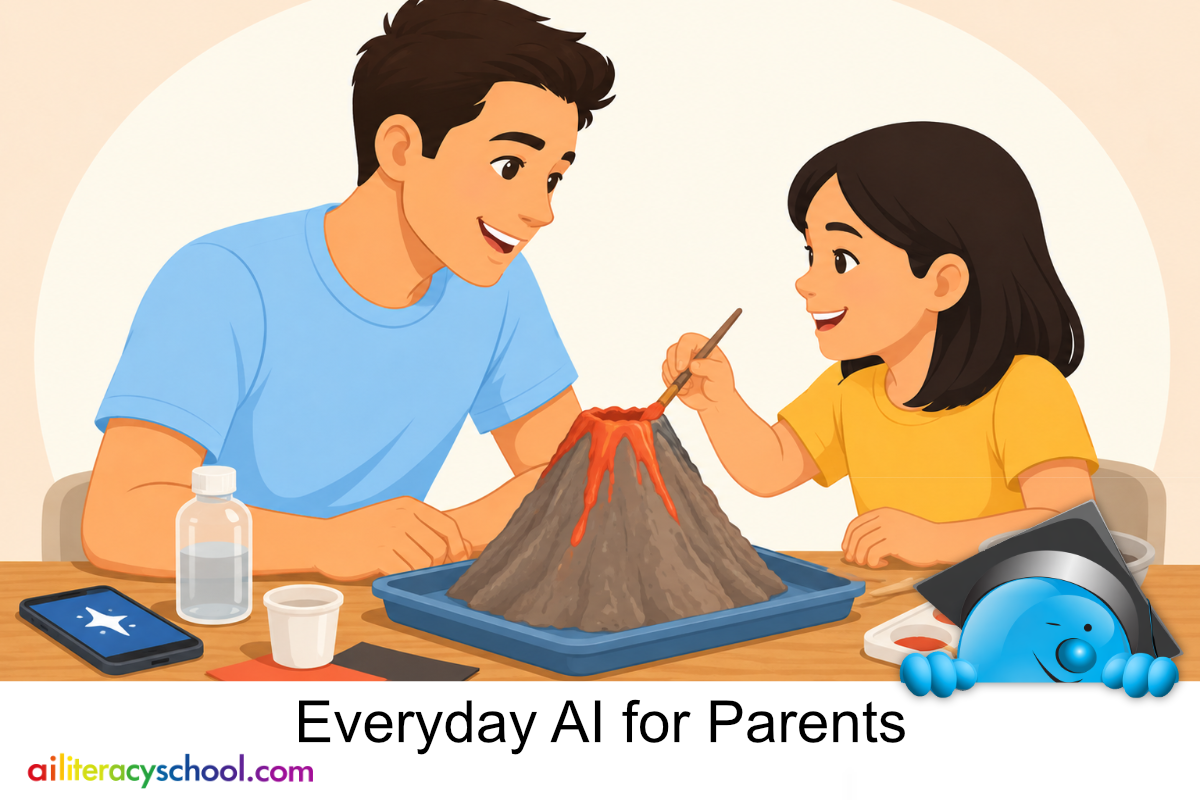
AI can help turn a question into a family investigation. It can suggest ideas, simple activities, books to look for, or new questions to explore.
You might ask:
You are helping a parent explore science with a curious 10-year-old. Give us three surprising facts about volcanoes and one question we should research together. Keep it simple and exciting.
Then talk about the answer.
Which parts sound right? Which parts should you check? What do you want to know next?
This builds curiosity and critical thinking at the same time.
When Your Family Is Busy
AI can also help with everyday planning.
Parents can use it to draft meal ideas, packing lists, routines, chore charts, party plans, travel lists, or kind words for tricky conversations.
For example:
You are helping a parent plan a calm weekday morning routine. The children are aged 7 and 10. Make it realistic, simple, and easy to follow.
Or:
You are helping a parent talk to a child about bedtime screen limits. Write a kind but firm explanation in simple language.
These uses may seem small. But they show children something important: AI is a tool for support, not just a place to get answers.
When Your Child Has Additional Needs
Some families may find AI useful for making things clearer.
It can help create simple routines, social stories, step-by-step instructions, or easier explanations.
For example:
You are helping a parent prepare a child for a new after-school club. Write a short social story in simple, calm language.
Or:
You are helping a parent support a child who finds changes hard. Break down getting ready for school into small steps.
Parents should always check and adapt anything AI creates. You know your child best. AI can offer a starting point, but your judgment matters most.
Our AI and Additional Needs Pathway offers more support for families.
When Your Child Wants to Create
AI can support creativity when it is used as a starting point.
It can help your child brainstorm story ideas, invent characters, plan a comic, think of science project topics, or imagine different endings to a story.
A useful prompt might be:
You are helping a child brainstorm story ideas. Give five ideas about a child who discovers a mysterious door. Do not write the story. End with three questions to help the child choose their favourite idea.
This keeps the creative work with your child. AI gives sparks. Your child brings the imagination, choices, and voice.
Keep People at the Centre
AI can be a useful family tool. It can help with ideas, explanations, planning, practice, and creativity. But it should not replace the things children need most: their own thinking, trusted adults, real friendships, teacher guidance, privacy, effort, and care.
A helpful family rule is:
AI can give us ideas, but it cannot care about us. That is why we go to real people for feelings, trust, and important decisions.
When your family uses AI, try to build one simple habit:
Ask, check, talk, improve.
Ask AI for a starting point. Check whether the answer could be wrong or incomplete. Talk about it with your child. Then improve it using your own judgment.
This turns AI from a shortcut into a shared learning tool. It helps children see that AI can be useful, but people are still responsible for the final decision.
For more help with these conversations, see our guide to talking to your child about AI.
Was this guide helpful?
Let us know whether this article helped you.
Share this guide with other parents
Know a parent who would find this guide helpful? Enter their email address and we'll send them the Parent Conversation Guide directly.