
📑 In this guide
Start with our AI Confidence Quiz
AI is already part of your child’s learning. In just a couple of minutes, discover where your family stands and what to do next.
- ✓ Your family’s AI Confidence Score
- ✓ What you’re already doing well
- ✓ Simple, practical next steps
Families are busy, and children’s questions move quickly.
One day it is volcanoes, the next day it is sharks, the next day it is why the moon looks different tonight. Parents often tell us that they want to explore AI with their children, but they do not want another curriculum or another pressure point in the week.
This repeatable weekly kids' AI course introduces a simple rhythm that works with almost any family routine. It folds AI literacy into your child’s natural curiosity and gives you a small structure you can rely on. It does not require a paid tool and works well with any free AI chatbot you already use: ChatGPT, Gemini, or Claude all work well.
This quick activity is light, flexible, and designed to help families learn together without adding more to the to-do list.
Why a Weekly Routine Helps
Parents benefit from a predictable rhythm. Children benefit from knowing when learning moments will happen. When both align, you have a sustainable family habit. Many parents also want to explore AI in a calm, purposeful way without it becoming screen-led or overwhelming. A weekly structure makes this easier.
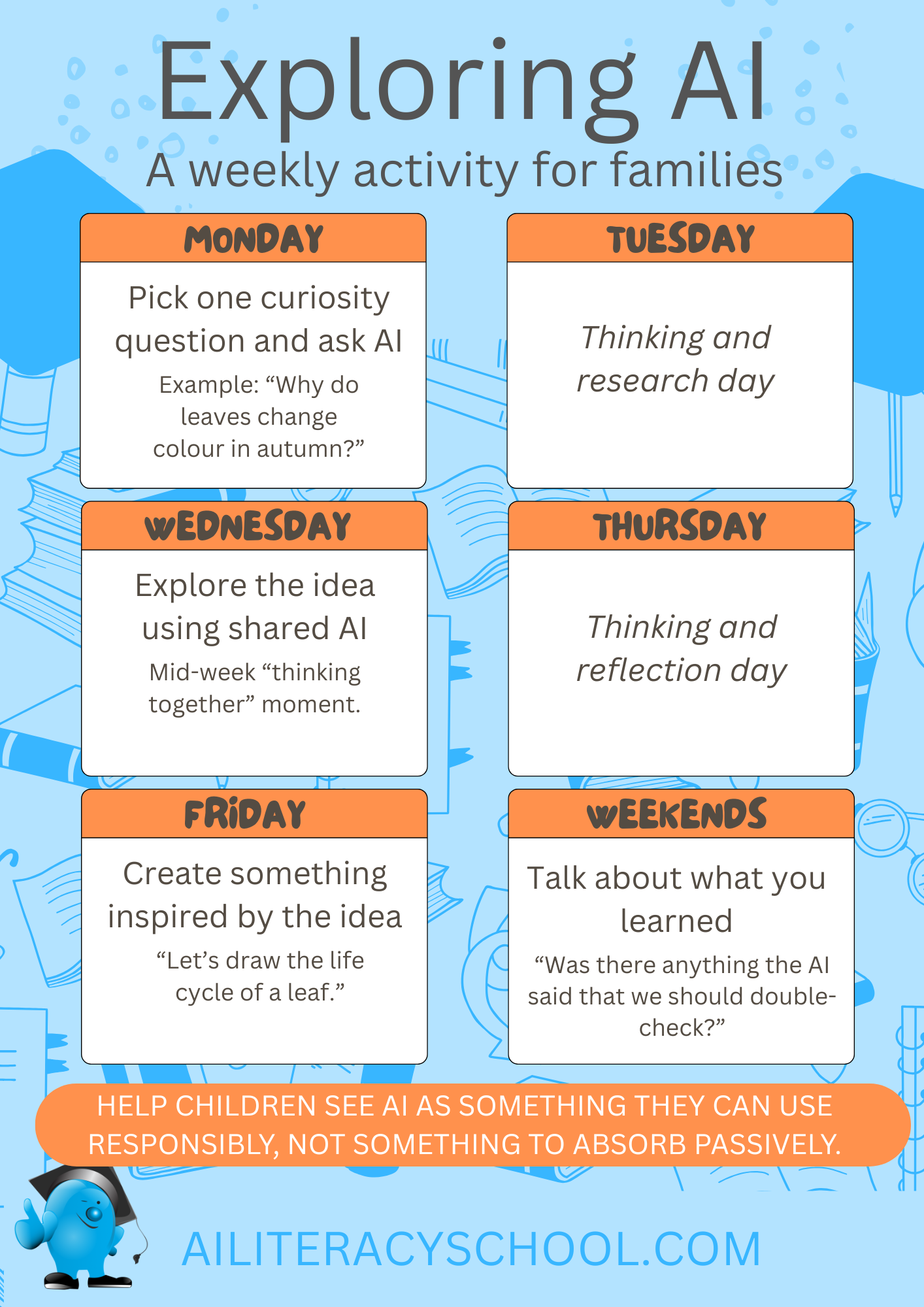
This four-step pattern supports the core goals of AI Literacy School: helping families build confidence, think about technology thoughtfully, and explore learning safely and together.
The Weekly Course
Monday: Pick one curiosity question
What you do: Invite one question from your child.
Why it works: Children already lead with curiosity. You are simply giving their question a place in the week.
Examples of Monday questions:
- “Why do dogs tilt their heads?”
- “How do rockets turn in space?”
- “Why do people cheer in stadiums?”
- “What makes a story scary?”
- “Why do leaves change colour in fall?”
Give your child advanced notice the first time you do this, so that they can come up with a good question.
This is also the moment to add a small AI-literacy step. Ask the chatbot, “Explain this to a seven-year-old” or “Give me two ways to explore this with my child.” Parents do the asking; children observe or join in if appropriate.
Over the next couple of days, kids can think about the question and look up some information.
Wednesday: Explore the idea using Shared AI
This is your mid-week “thinking together” moment. Keep it short, warm, and conversational.
What you do:
- Use a free AI chatbot to look at the idea from one new angle.
- Model safe and calm behaviour: reading output together, checking for accuracy, and thinking aloud. (This is where having done some earlier thinking and reading helps check that the AI response makes sense).
- Show your child how to ask clear questions in their prompts.
Example Wednesday prompts (parents type, children choose the direction):
- “Explain this idea in three simple steps.”
- “Show us a picture-free description we can try to draw.”
- “Give us two experiments we can do with kitchen materials.”
- “Compare this idea with something familiar to us both.”
Keep a light focus on literacy: clarity, safety, and thinking skills.
Friday: Create something inspired by the idea
Families tell us this is the moment the week comes alive. Children enjoy finishing the week with something they can show, build, or explain.
You choose the medium. It can be creative, physical, or practical.
Examples:
- A drawing. “Let’s draw the life cycle of a star.”
- A Lego build. “Build the moment the football enters the goal.”
- A short story. “Write two paragraphs about a heroic mushroom.”
- A tiny science model. “Make a paper volcano with labels.”
- A real-life test. “Measure how far you can jump and make a prediction chart.”
If you want, use AI for a nudge:
- “Help us outline a small project we can finish in 20 minutes.”
- “Give my child two creative options and let them pick one.”
The focus is not on perfection. It is on expression, understanding, and confidence.
Weekend: Talk about what you learned
This final step supports healthy learning habits. Parents model reflection, curiosity, and checking understanding.
It can be as short as a two-minute conversation at breakfast.
Helpful questions:
- “What surprised you this week?”
- “What do you think you understand better now?”
- “Was there anything the AI said that we should double-check?”
- “What would you like to explore next week?”
Over time, this weekend moment helps children understand that tools are helpers, not authorities, and that learning is a shared family activity.
How This Course Builds AI Literacy
This routine quietly supports key skills we teach across AI Literacy School courses: understanding tools, using them thoughtfully, asking good questions, and involving children in safe, supervised exploration.
It also develops transferable skills such as:
- curiosity and explanation
- Independent learning
- checking and verifying information
- communicating clearly
Children begin to see AI as something they can use responsibly, not something to absorb passively.
Ideas for Using the Framework Across Interests
Below are easy ways to adapt the four-step rhythm to different themes your child may already enjoy.
If your child loves sport
Monday: “How do athletes stay balanced when running?”
Wednesday: Ask the chatbot for two physical demonstrations you can safely try at home.
Friday: Create a mini-poster with three facts your child found interesting.
Weekend: Talk about how athletes use information and coaching to improve.
If your child enjoys science
Monday: “Why does soap remove germs?”
Wednesday: Ask the chatbot for a simple, safe kitchen observation.
Friday: Build a labelled diagram together.
Weekend: Discuss how scientists check their ideas and repeat experiments.
If your child is into stories or characters
Monday: “What makes a hero interesting?”
Wednesday: Ask for three story ingredients and let your child pick one to explore.
Friday: Write or draw a short scene.
Weekend: Reflect on how different choices change a story.
If your child asks big-thinking questions
Monday: “Why do people have traditions?”
Wednesday: Ask the chatbot for child-friendly explanations from two cultural perspectives.
Friday: Make a collage or family-tradition timeline.
Weekend: Talk about how different people see the world.
Tips for Parents New to AI
Use any free chatbot. The framework works with whichever tool you already have.
Keep sessions short. Ten minutes is enough.
Stay present and read outputs together. This models healthy, safe AI use.
Include checks. “Does this seem right? How can we double-check?”
Keep your child’s question at the centre.
Was this guide helpful?
Let us know whether this article helped you.
Share this guide with other parents
Know a parent who would find this guide helpful? Enter their email address and we'll send them the Parent Conversation Guide directly.