📑 In this guide
Start with our AI Confidence Quiz
AI is already part of your child’s learning. In just a couple of minutes, discover where your family stands and what to do next.
- ✓ Your family’s AI Confidence Score
- ✓ What you’re already doing well
- ✓ Simple, practical next steps
In short
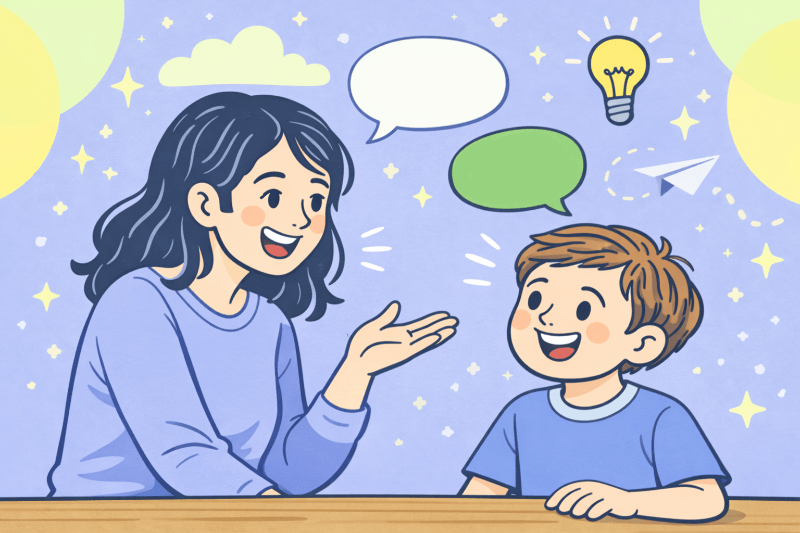
This guide is for parents (or any trusted grown-up) to use with kids aged 7–12 in a 5-minute, low-pressure chat. It helps you gently check what they think AI is, where they’ve seen or used it (including unsupervised use), and how they feel.
With the resulting awareness, you can build trust, spot confusion, and add a few simple safety rules without testing or shaming.
Ages 7–9
What this 5-minute chat is for
A quick, easy chat to find out what your child already thinks AI is, where they’ve seen it, and how they feel about it. No wrong answers. You are just learning what’s in their head.
Quick parent prep
- Stay curious, not “teacher-y.”
- Try to learn two things: what they think AI does, and where they’ve bumped into it.
- If you hear something surprising (like they tried something alone), stay calm. The goal is safety and trust.
Easy ways to start (choose one)
- “I keep hearing people say ‘AI.’ What do you think it means?”
- “Have you noticed anything that feels like AI in games, videos, or apps?”
- “Can I ask you a quick curiosity question about AI?”
Gentle check-in (feelings + confidence)
Pick one:
- “Does AI feel fun, confusing, or a bit of both?”
- “How sure do you feel you understand AI: not much, a bit, or a lot?”
- “If a friend asked you what AI is, would you know what to say?”
Optional follow-up (keeps it non-test-like): “What makes you say that?”
Quiet assessment (what they know, what they’ve tried)
Where they’ve seen it
- “Where do you think AI shows up: in games, videos, school, or somewhere else?”
- “Have you ever seen a chatbot where you type and it talks back (like ChatGPT or Gemini)?”
What they think it is
- “What do you think it’s doing when it answers?”
- “Do you think it’s a person, or a computer tool?”
A gentle real-usage check
- “Sometimes kids try things before telling parents. Have you ever used something AI-ish when I wasn’t right there?”
- “You’re not in trouble for telling me. I just want to keep you safe.”
Talking points (kid-friendly, minimal)
Use only what you need.
- “AI is a computer tool that makes smart guesses.”
- “It can sound like a person, but it isn’t a person.”
- “We use AI with a grown-up, and we keep private info private.”
If they say X, try Y
If they say: “AI is alive.”
Try: “It can sound human, but it’s not alive. It doesn’t have feelings. It’s a tool.”
If they say: “AI is always right.”
Try: “It can be helpful, but it can also be wrong. What do you think makes something trustworthy?”
If they say: “I used it alone.”
Try: “Thanks for telling me. That helps me keep you safe. What were you trying to do?”
Then: “Did it ask for anything private? Next time we’ll do it together.”
If they say: “I don’t know.”
Try: “That’s completely fine. This is just a curiosity chat.”
Optional 2-minute curiosity activity (choose one)
These are designed to help your child share their ideas, not to teach a lesson.
- Teach-me version: “Pretend I’m new to this. What is AI, in your words?”
- AI-in-the-wild version: “Where do you think you’ve seen AI this week?”
- Good-at / not-good-at sorting (quick): Ask: “Do you think AI is good at making up stories? What about knowing how someone feels?” (You can add one or two more examples if they’re into it.)
Safety nudges
- “No private info: full name, address, school, passwords, photos.”
- “If something feels weird or scary, pause and tell a grown-up.”
- “Some tools have age rules. We follow them.”
Wrap-up and pick-up-later
“Thanks for telling me what you think. I like hearing your ideas.”
Pick-up-later prompt: “This week, let’s each notice one place AI shows up and tell each other.”
Ages 10–12
What this 5-minute chat is for
A quick check-in to understand what your child believes about AI, how confident they feel, and where they’ve encountered it. No grading. You’re learning how they think.
Quick parent prep
- Your goal is their mental model: “What is it?” “Where is it?” “How do you feel about it?”
- If they admit unsupervised use, treat it as a safety moment, not a discipline moment.
Easy ways to start (choose one)
- “AI is everywhere now. I’m curious what you think it is and where you’ve seen it.”
- “When you hear ‘AI,’ what comes to mind first?”
- “I’m doing an AI confidence check for myself. Want to compare notes?”
Gentle check-in (feelings + confidence)
Pick one:
- “From 1 to 5, how confident do you feel about understanding AI?”
- “What’s one AI thing you feel confident about, and one thing you’re unsure about?”
- “Does AI feel mostly helpful, mostly annoying, or mixed?”
Quiet assessment (what they know, what they’ve tried)
Where they’ve seen it
- “Where do you run into AI: school tools, chatbots like ChatGPT or Gemini, image tools, games, social apps?”
- “Have you heard of AI companion apps that feel like chatting with a character? What do you think those are for?”
How they think it works
- “What do you think AI is doing when it writes an answer?”
- “Do you think it ‘knows’ facts, or is it predicting what sounds right?”
What they use it for (without accusation)
- “If you were going to use an AI tool, what would you use it for: ideas, practice, explaining, creating, something else?”
- “What do you think is a fair way to use it for school?”
A gentle real-usage check
- “A lot of kids end up trying AI tools on their own. Have you ever used one when I wasn’t there?”
- “You won’t be in trouble for telling me. I’d rather know so we can keep things safe.”
Talking points (kid-friendly, minimal but accurate)
- “AI can be useful, but it’s still a tool. It doesn’t think or feel like a person.”
- “Different tools do different things: some chat, some make images, some recommend videos.”
- “We protect privacy, and we follow age rules for tools.”
If they say X, try Y
If they say: “It’s basically like Google.”
Try: “It can feel that way. One difference is it can also make things up or phrase guesses confidently. So it’s a helper, not the final judge.”
If they say: “It’s always right because it’s smart.”
Try: “It can be smart and still mistaken. What do you do when you’re unsure something online is true?”
If they say: “I used it for homework.”
Try: “What part did you use it for: understanding, ideas, or answers?”
Then: “How do you think your teacher would want it used?”
If they say: “I used it alone.”
Try: “Thank you for being honest. What tool was it, and what did it ask you for?”
Then: “Let’s make a safer plan together: privacy first, and use it with a parent.”
Optional 2-minute curiosity activity (choose one)
These are meant to surface their thinking, not steer them toward a specific “lesson.”
- Teach-me version: “Explain AI to me like I’m new. What is it, and what isn’t it?”
- AI sightings: “Where has AI shown up in your week, even in small ways?”
- Good-at / not-good-at sorting (quick): Ask them to sort 4 tasks into “good at,” “maybe,” “not good at,” “depends.” Examples: making up a story, summarizing a page, knowing what your friend feels, giving medical advice.
Safety nudges
- “Don’t share personal info. Assume chats can be saved.”
- “If a tool asks for private details or gets intense, pause and tell a grown-up.”
- “Follow age rules and use general-purpose chatbots with a parent.”
Wrap-up and pick-up-later
“I like how you think about this. Thanks for being open.”
Pick-up-later prompt: “Next time, let’s each bring one ‘AI sighting’ and compare what we think it was doing.”
Was this guide helpful?
Let us know whether this article helped you.
Share this guide with other parents
Know a parent who would find this guide helpful? Enter their email address and we'll send them the Parent Conversation Guide directly.