📑 In this guide
Start with our AI Confidence Quiz
AI is already part of your child’s learning. In just a couple of minutes, discover where your family stands and what to do next.
- ✓ Your family’s AI Confidence Score
- ✓ What you’re already doing well
- ✓ Simple, practical next steps
Children aged 5–11 often know the rules but forget them in the moment. When something feels fast, friendly, or exciting, there is rarely time for a long explanation. A short rhyme can act like a mental “pause button” your child can reach quickly, even when you are not nearby.
In this guide, AI is the helper for drafting ideas and practising. Parents stay in charge of the message, the boundary, and what “ask an adult” means in your family.
How AI Can Help
Coming up with a good rhyme on the spot can be surprisingly hard. This technique works best when you’ve got a few options ready to choose from.
AI helps by:
- creating several example rhymes quickly, so you’re not starting from zero
- offering extra ideas (different wordings, rhythms, or themes) if none feel quite right
- giving you a simple draft your child can then personalise with their own words
AI is the idea-starter. You and your child still choose the message and make it feel like yours.
A simple “pause button” rhyme (the core technique)
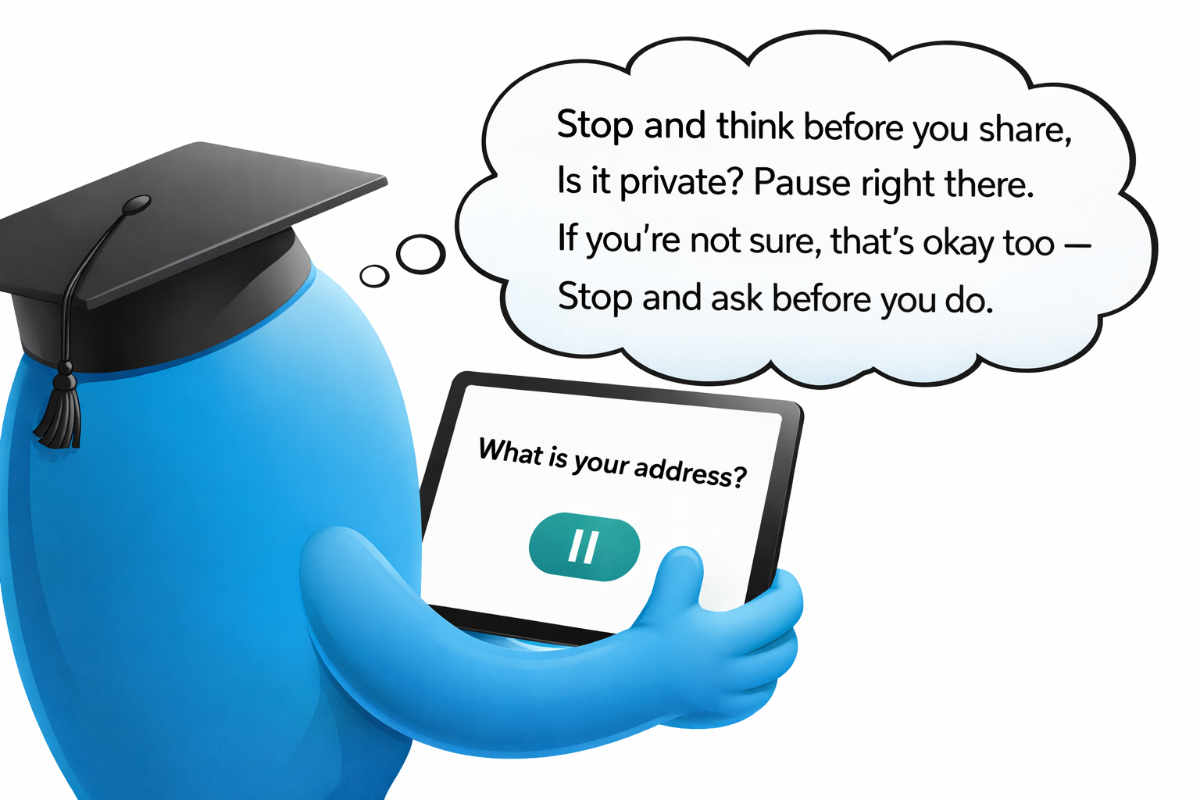
This is the technique we use in our Safe AI Step-by-Step Learning Plan to help children remember to think before sharing private information online or with AI:
Stop and think before you share,
Is it private? Pause right there.
If you’re not sure, that’s okay too —
Stop and ask before you do.
The rhyme is not meant to replace conversations or family boundaries. It is a memory tool that makes the next safe step easier to access in real life.
Quick AI helper: Ask AI for a few alternative versions so your child can choose what feels most natural to them.
Why co-creating the rhyme with your child works even better
Delivering a rule as a top-down instruction can create compliance, but it does not always create recall.
Creating the rhyme with your child is often more effective because:
It creates reflection.
When children help choose the words, they are rehearsing the judgment you want them to use. Even if the exact words fade, the thinking has already happened.
It creates ownership.
A rhyme they helped make feels like their tool, not your lecture. Children are more likely to use language they helped create.
It teaches the habit in a calm moment.
You are building the “pause and choose” skill when everyone is relaxed, making it easier to access later when emotions or excitement are high.
A good family rhyme is not about being clever. It is about making a helpful decision process memorable: pause → check → accept uncertainty → ask for help.
What makes a “sticky” family reminder rhyme
A useful rhyme usually:
- is 2 to 4 short lines
- uses simple, everyday language
- is easy to say out loud (natural rhythm)
- focuses on a habit, not a warning
- ends with support, not consequences
The best rhymes do not list rules. They create a moment of judgment and a next step.
Quick AI helper: If your drafts feel clunky, ask AI to make the language simpler and the rhythm smoother (without adding threats, consequences, or scary tone).
A simple family process (with AI as a helper, not the parent)
Use this as a repeatable “mini workshop”. It works well in 10–15 minutes.
Step 1: Warm up with a rhyme on a different topic
Start with something light, so it feels playful rather than serious. You can create this with AI and say you use it to help you remember.
Ideas:
- Brushing teeth
- Getting ready to leave the house
- Packing a school bag
- Feeding a pet
Quick AI helper: Ask AI for three silly warm-up rhymes and let your child pick a favourite.
Step 2: Choose the message you actually want your child to remember
Keep it specific and tied to a real moment.
Examples:
- “Pause before sharing anything online.”
- “Slow down before replying when you’re angry.”
- “Ask for help if something feels confusing.”
Quick AI helper: Ask AI to rewrite your message into a single clear sentence in child-friendly language.
Step 3: Create the rhyme together (AI provides drafts, your child personalises)
Ask AI for 5–10 drafts, then choose and edit together.
You and your child each have an important role here:
- You (parent): protect the message and boundary
- Your child (learner): personalise the words so they stick
Let your child:
- Swap in a silly word or animal
- Choose a rhythm they like
- Add a familiar setting (“on the iPad”, “at school”, “when I’m gaming”)
Quick AI helper: Ask AI for versions in different styles (calm, funny, superhero, animal-themed), then let your child “remix” the best one.
Step 4: Read it together out loud
Rhymes are sound-based memory. Try:
- A fun voice once
- A calm voice once
- The everyday voice you want them to hear in their head later
Quick AI helper: Ask AI for a simple call-and-response version (parent says line 1, child says line 2).
Step 5: Make a poster and place it where the moment happens
This is what turns a rhyme into a habit.
Place it:
- Near the family tablet/computer
- By the homework space
- On the wall near where devices charge
- Somewhere visible during the routine you are supporting
Even a hand-drawn poster works better than a perfect printout, because your child will remember making it.
Quick AI helper: Ask AI to format the rhyme for a poster (big text, one short line per row).
Copy-and-paste AI prompt for parents
Use this to create your example rhyme or one you can modify together. This structured prompt helps the AI produce relevant and age-appropriate drafts.
Role
You are a supportive children’s educator who helps parents create simple, memorable rhymes for children. You understand child development for ages [AGE RANGE, e.g. 5–11] and know how to communicate important habits in a calm, reassuring way.
Instruction
Create a short, child-friendly rhyme that helps a child remember to [CORE HABIT OR VALUE, e.g. think before sharing information / be kind online / pause before reacting / ask for help when unsure].
The rhyme should act as a gentle pause or reminder, not a rule or warning.
Context
- The rhyme is for a child aged [AGE RANGE]
- It may be used at home, not in a formal school setting
- The goal is to help the child slow down and think before acting
- The rhyme should normalise uncertainty and encourage asking a trusted adult for help
- The child may need to remember this rhyme even when an adult is not present
Tone and constraints
- Calm and reassuring
- Friendly and encouraging
- Not scary, threatening, or moralising
- No consequences or punishments
- No technical terms, brand names, or apps
Output format
- A rhyme of 2 to 4 short lines
- Simple, everyday language
- Easy to say out loud and remember
- Natural rhythm and clear rhyme
- Suitable for printing as a small poster or reminder
- The rhyme should feel like a friendly family reminder that helps the child pause, think, and make a thoughtful choice
Where this approach helps most: real scenarios
1) Safety scenarios (fast, exciting, easy to forget)
Use rhymes when the moment is quick and your child is likely to act without thinking.
Examples:
- Sharing personal info (name, school, photos, address, phone number)
- posting pictures
- Clicking links, pop-ups, downloads
- Replying to messages from unknown people
- Using AI that asks personal questions
Why it helps: a rhyme creates a tiny delay before action, which is often all a child needs to choose a safer next step.
2) Behaviour scenarios (emotional, reactive, regret later)
Use rhymes when your child’s thinking brain disappears under big feelings.
Examples:
- Snapping at a sibling
- Replying angrily in a group chat
- Reacting to teasing
- Getting defensive when corrected
- “Must win” moments in games
Why it helps: a rhyme gives a script when emotions are high and words are hard.
3) Learning scenarios (remembering steps or key facts)
Use rhymes when you want recall and routine rather than deep explanation.
Examples:
- A homework routine (“read it again, try one step, then ask”)
- Punctuation reminders
- Spelling patterns
- Times tables or topic sequences (planets, water cycle steps, etc.)
Why it helps: a rhyme turns “what do I do again?” into a familiar next step.
A quick parent script for co-writing (four questions)
If you are not sure what to say, ask:
- “When is it hardest to remember?”
- “What question should we ask ourselves?”
- “What should we do if we’re not sure?”
- “Who can we ask for help in our family?”
Those four answers become your rhyme.
Going forward
Use this technique selectively. If everything becomes a rhyme, the most important messages lose their weight.
Save rhymes for habits that truly matter, such as safety reminders, or for repeat problem areas where your child benefits from a quick mental prompt (like remembering a key method in maths).
If your child forgets the rhyme, that is normal. The goal is not perfect recall. The goal is that, over time, the pause becomes easier and more automatic. Even remembering one line can be enough to slow things down and open the door to a better choice.
This “pause button” approach is a core part of how AI Literacy School supports families to build calm, practical AI safety at home.
We show you another creative use of AI to support your children in the following AI How ToO:
Using AI-created stories to understand what might be going on beneath the surface
Was this guide helpful?
Let us know whether this article helped you.
Share this guide with other parents
Know a parent who would find this guide helpful? Enter their email address and we'll send them the Parent Conversation Guide directly.