📑 In this guide
Start with our AI Confidence Quiz
AI is already part of your child’s learning. In just a couple of minutes, discover where your family stands and what to do next.
- ✓ Your family’s AI Confidence Score
- ✓ What you’re already doing well
- ✓ Simple, practical next steps
Homeschooling is not just one thing.
Some children are educated entirely at home. Others go to school but also learn at the kitchen table, in the car, at bedtime, in the garden, during homework, through hobbies, or while working on a science project at the weekend.
In that sense, home learning is a spectrum. If you read with your child, help them practise spellings, answer their big questions, play learning games, support school projects, or help them understand homework, you are already part of their learning team.
AI can help parents make more of those moments.
You can learn how to prepare your child for middle school in this guide.
Challenge
Parents know their children in a way no tool or textbook can. You notice when your child is tired, curious, frustrated, rushing, guessing, avoiding something, or suddenly ready for a new challenge.
Teachers bring training, experience, subject knowledge, and classroom strategies. Parents may not always have those things to hand, especially when a child asks a tricky question or gets stuck on something you have not thought about for years.
AI can help fill part of that gap.
Used carefully, it can be an always-available listener, idea generator, explainer, planner, and guide. It can help you find another way to explain fractions, turn a history topic into a game, suggest questions for a reading discussion, or break a science project into manageable steps.
But AI should not take over the learning relationship. It works best when it supports your judgment, your knowledge of your child, and your role as the adult guiding the learning.
How this might show up in real life
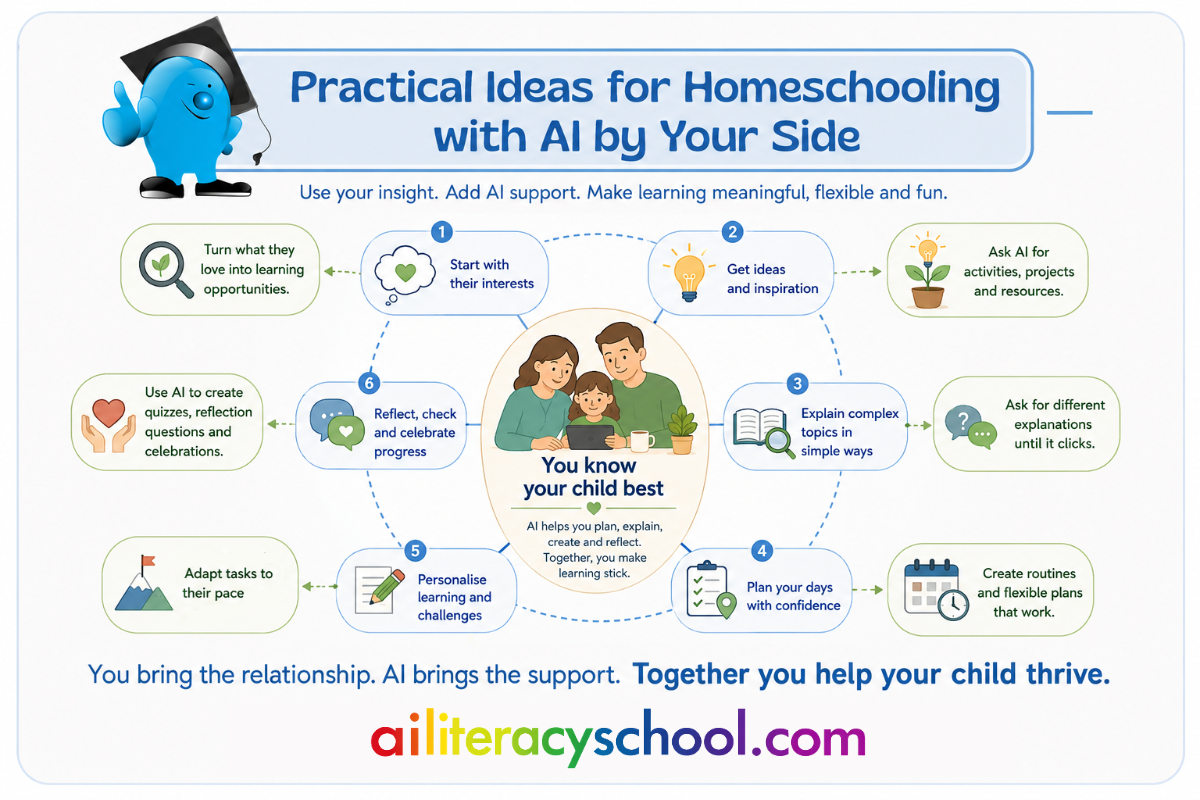
You might ask AI to explain a maths idea in three different ways because your child did not understand the first one.
You might use it to create a short quiz after reading a book together, then talk through the answers with your child.
You might ask it for five simple science activities using things you already have at home.
You might use it to plan a calm homework routine for a child who finds transitions difficult.
You might ask it to help you turn your child’s interests, such as football, animals, space, cooking, or gaming, into learning activities.
In each case, AI is not replacing you. It is helping you use what you already know about your child more effectively.
Try saying
AI is great for preparing for learning ‘behind the scenes’, but you can also use this process to demonstrate to your children how to use AI sensibly and responsibly, so they get a bonus AI Literacy lesson.
Let’s use AI to give us some ideas, but we will decide which ones are useful.
I know how you learn best, so I’m going to ask for an explanation that fits you.
AI can help us get started, but we still need to think, check, and make it our own.
Talk About It
- What helps you learn something new: examples, pictures, practice, stories, or talking it through?
- When AI gives us an answer, how could we check whether it makes sense?
- What would make this explanation easier for you to understand?
- How could we use AI for ideas without letting it do the learning for us?
- When should we ask a person instead of relying on AI?
- What do you think makes a good question to ask AI?
Tip for Parents
Start with your own insight.
A useful AI prompt does not need to be long, but it does help to give it structure. One simple way to do this is to include four parts: Role, Instruction, Context, and Output.
For example:
Role: You are a calm, practical learning coach helping a parent support their child at home.
Instruction: Explain how to help a child understand comparing fractions.
Context: My 9-year-old understands halves and quarters but gets confused when deciding which fraction is larger. They learn best with simple examples, pictures, and hands-on activities. Do not use any personal information about my child.
Output: Give me three simple ways to explain this: one using food, one using drawings, and one using a number line. Include questions I can ask my child instead of just telling them the answer.
This kind of prompt keeps you in charge. You bring the knowledge of your child. AI brings options, examples, and fresh approaches.
You can also use the same structure when you want AI to adjust its answer:
Role: You are a patient homework helper supporting a parent.
Instruction: Make this explanation easier for a child to understand.
Context: My child is feeling frustrated and needs a shorter explanation with less technical language.
Output: Rewrite the explanation in three short steps and add one encouraging question I can ask at the end.
That last part matters. Good learning is not just about getting the answer quickly. It is about helping your child think, try, explain, and grow in confidence.
Why This Is Important
AI can make home learning feel less lonely for parents.
You do not have to be an expert in every subject to support your child well. You need curiosity, care, patience, and the ability to guide learning safely. AI can help with explanations, ideas, structure, and encouragement when you are not sure what to do next.
It can also help parents respond to the child in front of them, not just follow a fixed worksheet or generic lesson plan. A parent who knows their child loves dinosaurs, struggles with writing, enjoys drawing, or needs movement breaks can use AI to shape learning around those needs.
That is powerful.
But children also learn from watching how adults use technology. If you copy and paste without checking, they notice. If you treat AI as always right, they may do the same. If you use it thoughtfully, question it, adapt it, and talk about its limits, you model healthy AI habits.
Growing your own AI literacy helps you support your child’s learning now and prepare them for a future where AI will be part of school, work, and everyday life.
Quick Tip
Use AI as a learning partner for you, not as a replacement teacher for your child.
To build confidence, start by exploring the AI and Healthy Learning Pathway or the AI Learning Pathway. They can help you understand how to use AI in ways that support real thinking, safe habits, and stronger learning at home.
Was this guide helpful?
Let us know whether this article helped you.
Share this guide with other parents
Know a parent who would find this guide helpful? Enter their email address and we'll send them the Parent Conversation Guide directly.