

📑 In this guide
Start with our AI Confidence Quiz
AI is already part of your child’s learning. In just a couple of minutes, discover where your family stands and what to do next.
- ✓ Your family’s AI Confidence Score
- ✓ What you’re already doing well
- ✓ Simple, practical next steps
How your prompting will improve in this how-to
Most parents begin by asking AI questions like:
“Help me fix bedtime,” or
“How do I make my child go to sleep earlier?”
These questions are understandable, but they rarely lead to helpful, tailored guidance.
This lesson helps you move from those broad prompts to clear, confident requests using a simple structure called RICO.
Before this lesson (Novice stage)
Parents often:
- ask broad or unfocused questions about bedtime struggles
- receive generic suggestions that don’t fit their child’s temperament
- feel unsure what details are safe to include
- accept the first answer even when it isn’t realistic
- feel pressured to create a “perfect” routine
- overlook ways to guide the AI toward the tone they want
After this lesson (Skilled beginner using RICO)
Parents will be able to:
- guide AI by setting a supportive Role for bedtime planning
- give clear, essential, safe Context that shapes workable routines
- write a direct Instruction that matches their needs
- request the specific Output they want—steps, scripts, or ideas
- refine any prompt until the tone, pacing, and expectations feel right for their child
This is the shift from hoping AI understands your bedtime challenges to directing it clearly and safely.
What is RICO? (A simple structure for better prompting)
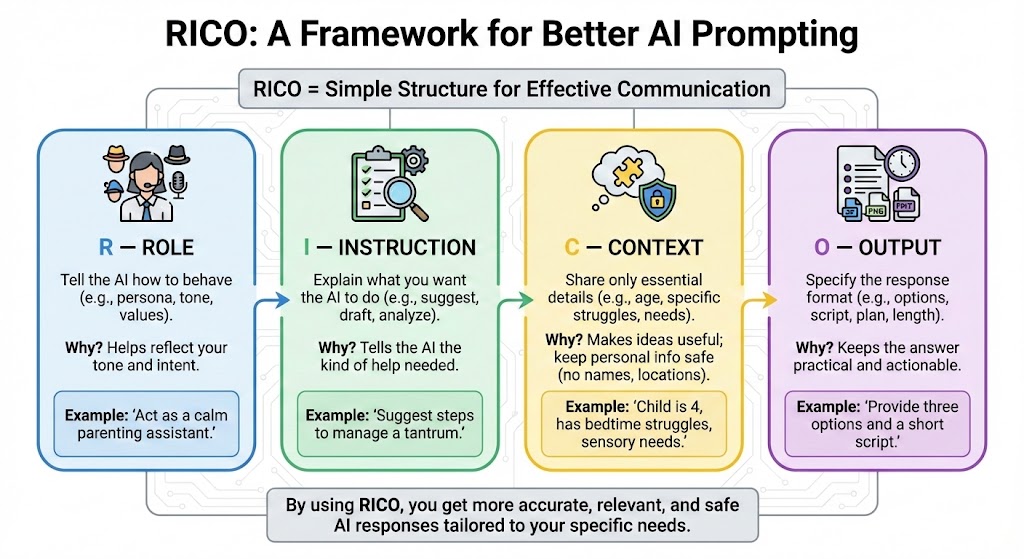
Why this matters
Bedtime can be one of the most emotionally charged parts of the day for families.
AI can help you think through calmer routines, create gentle scripts, or offer ideas when you’re too tired to brainstorm.
You don’t need technical skills—just a simple structure that keeps the AI focused and safe.
You bring judgement, empathy, and knowledge of your child.
AI brings drafts, structure, and fresh possibilities when your mental load is high.
RICO helps those strengths work together without replacing your instincts.
Try this: Start with a real parenting task

Choose one real bedtime task, such as:
- reducing evening battles
- introducing predictable steps before sleep
- creating calming language for transitions
- adjusting bedtime after a change in schedule
A typical novice prompt:
“Help me fix bedtime.”
A RICO version:
Role: You are a calm, supportive parenting assistant.
Instruction: Suggest simple steps for a smoother bedtime routine.
Context: My 5-year-old gets restless at night and resists stopping play. We aim for lights out at 7:45.
Output: Give me a short, realistic 15-minute wind-down plan.
This small amount of structure makes the response far more useful.
How AI can help — with RICO examples
1. Calming the transition to bedtime
Novice:
“How do I get my child to calm down at night?”
RICO:
Role: You are a calm parenting assistant.
Instruction: Suggest gentle ways to ease the transition from play to bedtime.
Context: My 4-year-old struggles with stopping imaginative play and gets louder as bedtime approaches.
Output: Provide two calming transition ideas I can try tonight.
2. Creating a predictable bedtime routine
Novice:
“Give me a bedtime routine.”
RICO:
Role: You are a practical routine-planning assistant.
Instruction: Create a simple, predictable bedtime routine with clear steps.
Context: My 7-year-old does best with visual cues and short instructions. We start at 7:00.
Output: Give me a 5-step routine with one sentence for each step.
3. Drafting a bedtime script
Novice:
“What should I say at bedtime?”
RICO:
Role: You are a gentle communication assistant.
Instruction: Draft a calming script I can use when my child stalls or asks for “one more thing.”
Context: My 6-year-old feels anxious if I sound rushed.
Output: Provide a short script I can say out loud.
4. Supporting bedtime after a stressful day
Novice:
“Bedtime is a disaster after bad days. Help.”
RICO:
Role: You are a steady, supportive parenting companion.
Instruction: Suggest grounding strategies for parents and simple adjustments for kids on hard days.
Context: My child is 8 and melts down easily when overtired.
Output: Give me three practical adjustments for those nights.
How to refine a prompt
Learning to adjust a prompt helps you shape responses until they truly work for your family.
First attempt:
Role: You are a supportive parenting assistant.
Instruction: Suggest a bedtime routine.
Context: My 5-year-old resists going to bed.
Output: Give me a routine.
If the answer feels unrealistic:
“Make the routine shorter and more practical for a tired family at the end of the day.”
If the tone feels too strict or too soft:
“Rewrite this with a calmer, more encouraging tone.”
If you want something you can say aloud:
“Turn this into a brief bedtime script with simple phrasing.”
You can keep refining until it feels right and doable.
Using Your Judgement
AI can offer helpful structure, but it does not know your child’s temperament, your evenings, or the emotional energy in your home.
AI may:
- miss emotional nuance
- suggest routines that look ideal but aren’t realistic
- assume children can self-regulate more than they can
- offer scripts that don’t sound like your voice
- create plans that place extra demands on caregivers or siblings
As you review suggestions, ask:
- Does this feel respectful and kind?
- Is this realistic for my child’s age and energy level?
- Is this workable on a typical night, not just a perfect one?
- Does this match our family values and rhythms?
AI supports your thinking. You decide what fits your home.
Talking about this with your child
If your child is old enough, you might say:
- “I asked a chatbot for some bedtime ideas — want to hear them?”
- “Let’s see if it has suggestions that might make nights feel easier for us.”
This helps your child see AI as a thinking tool, not a rulemaker.
Tip for parents
AI is here to support your instincts, not replace them.
You know your child’s rhythms, fears, and strengths.
Clear routines come from calm direction, not perfection.
Use AI the way you’d use a practical parenting book: helpful but never in charge.
You remain the steady centre of your child’s bedtime: always.
Prompt Coach
The Prompt Coach is there to help you practise RICO prompting through quick, supportive feedback — not to shortcut the process. Each time you enter a prompt, the Coach will highlight what’s working, suggest small improvements, and help you try again so you can see how changes in role, instruction, context, or output make responses more useful. Treat it as a space to refine your thinking step by step until the prompt feels right for your family; these small iterations build real confidence and long-term skill. Use the Coach as a practice partner, not a replacement for your learning.
Was this guide helpful?
Let us know whether this article helped you.
Share this guide with other parents
Know a parent who would find this guide helpful? Enter their email address and we'll send them the Parent Conversation Guide directly.