📑 In this guide
Start with our AI Confidence Quiz
AI is already part of your child’s learning. In just a couple of minutes, discover where your family stands and what to do next.
- ✓ Your family’s AI Confidence Score
- ✓ What you’re already doing well
- ✓ Simple, practical next steps
How your prompting will improve in this lesson
This lesson helps you use AI as a quiet thinking partner — not to “fix” your child, but to help you find steadier, more helpful language in the moments when your child feels they cannot progress.
Before this lesson (Novice stage)
Parents often find themselves:
- Reacting quickly with phrases like “That’s not true” or “Just try harder”
- Offering praise that feels encouraging but doesn’t actually help (“You’re so smart!”)
- Feeling unsure how to respond without dismissing feelings
- Getting stuck repeating the same reassurance that no longer works
- Worrying that frustration means their child lacks confidence or ability
After this lesson (Skilled beginner)
Parents are able to:
- Notice fixed-mindset phrases without panic or overcorrection
- Use AI to rephrase responses that sound calm, neutral, and supportive
- Separate feelings from ability when talking with their child
- Encourage effort and strategies without pressure or exaggerated praise
- Feel more confident choosing words that reduce stress and keep learning safe
Why this matters
Children regularly test out phrases like “I’m bad at this” when learning feels hard. These moments are not failures — they are signals.
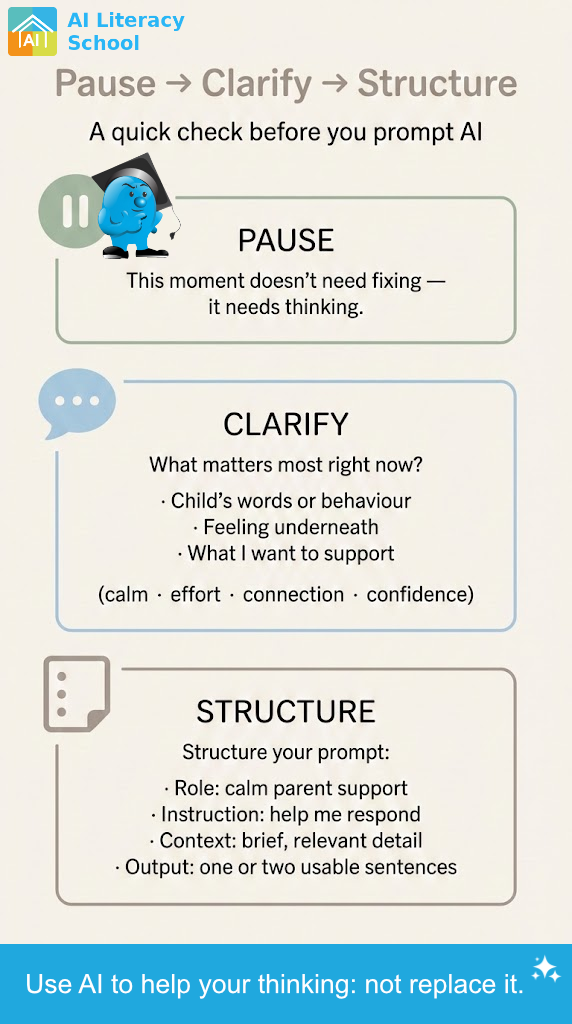
As parents, our words shape whether frustration turns into shame, avoidance, or curiosity. This doesn’t require expert knowledge or perfect phrasing. It requires pause, structure, and judgement.
AI can help you slow down, reflect on language, and practise responses, but you decide what fits your child, your values, and the situation. The goal is not to sound impressive. It’s to sound steady.
Start with a real parenting task
Here are common moments where this shows up:
- Homework that feels too hard
- Learning a new sport or instrument
- Reading aloud
- Problem-solving or puzzles
A common first try
“What should I say when my child says they’re bad at something?”
A clearer, more helpful version
Role: Act as a calm parenting language coach
Instruction: Help me respond to a child who says, “I’m just not good at this”
Context: My child is frustrated and starting to shut down
Output: Give 3 neutral, supportive responses that don’t dismiss feelings or overpraise
How AI can help — with well structured prompts
Understanding the phrase
A common first try
“Why do kids say they’re bad at things?”
A clearer, more helpful version
Role: Child development-informed parenting assistant
Instruction: Explain what a child might mean when they say “I’m not good at this”
Context: Elementary-aged child, learning something new
Output: Short explanation for a parent, using plain language
Practising what to say
A common first try
“Give me something encouraging to say to my child.”
A clearer, more helpful version
Role: Calm communication coach for parents
Instruction: Rewrite my response so it acknowledges frustration and encourages effort
Context: Child feels stuck and upset; I don’t want to argue or inflate praise
Output: 3 short sentences I could say out loud
Aoiding praise inflation
A common first try
“How do I motivate my child?”
A clearer, more helpful version
Role: Parent support assistant
Instruction: Help me talk about effort and strategies without saying “You’re amazing” or “You’re so smart”
Context: Child gives up quickly when work feels hard
Output: Example phrases that sound realistic and calm
Reflecting after the moment
A common first try
“Was I too hard on my child when I said (...)?”
A clearer, more helpful version
Role: Reflective parenting coach
Instruction: Help me review a conversation and suggest gentler wording
Context: I felt rushed, and my child shut down
Output: One alternative response and one reflection question for me
How to refine a prompt
Let the conversation evolve
Using AI works best when you treat it like a thoughtful conversation, not a one-off web search. Just as you wouldn’t expect another adult to give the perfect response without a little back-and-forth, AI often needs a few gentle clarifications to be genuinely helpful.
Ask the AI to help shape the conversation with you:
- “What other information would help you give a better suggestion?”
- “What are three follow-up questions I could reflect on before responding to my child?”
- “What haven’t I asked that could provide me with useful ideas?”
These prompts shift AI from answering at you to thinking with you.
Each refinement mirrors real human conversation: listening, clarifying, adjusting. When parents allow the exchange to unfold, AI becomes less of a shortcut and more of a supportive thinking partner, helping you find words that truly fit your child and the moment.
Talking about this with your child
Encourage your child to consider how their words can influence our thoughts.
“Sometimes we say things when we’re frustrated which don’t reflect reality. We can talk about those thoughts together.”
“Being stuck doesn’t mean you’re not good at something. It means you’re learning.”
Do you really mean, “I can’t do this yet,” rather than “I can’t do this”?
These are invitations, not lectures.
Tip for parents
Use AI for moments that feel important or stuck, not to replay every interaction or second-guess yourself. Parenting happens in real time, with emotions, fatigue, and competing demands. No one responds perfectly in the moment, and children do not need perfection to feel safe or supported.
Reflection, with or without AI, is valuable when it helps you learn and move forward. It becomes unhelpful when it turns into constant self-criticism.
Clarity and calm matter more than flawless wording.
Repair, presence, and consistency matter more than getting it “right” every time.
Was this guide helpful?
Let us know whether this article helped you.
Share this guide with other parents
Know a parent who would find this guide helpful? Enter their email address and we'll send them the Parent Conversation Guide directly.