
📑 In this guide
Start with our AI Confidence Quiz
AI is already part of your child’s learning. In just a couple of minutes, discover where your family stands and what to do next.
- ✓ Your family’s AI Confidence Score
- ✓ What you’re already doing well
- ✓ Simple, practical next steps
How your prompting will improve in this lesson
You can use your preferred chatbot, such as ChatGPT or Gemini.
This lesson will help you use AI to create thoughtful, engaging stories that do more than “teach a lesson”. These stories are designed to help children reflect, recognise feelings, and talk even when the reasons behind a behaviour are not yet clear.
Before this lesson (Novice stage)
Parents often:
- Look for children’s books that don’t quite match what’s happening
- Feel stuck when behaviour is worrying but the cause isn’t obvious
- Avoid certain topics because they fear blame, shame, or confrontation
- Assume they need to understand the problem fully before talking about it
- Ask AI for a story and receive something moralising or unrealistic
After this lesson (Skilled beginner using well-structured prompts)
Parents will be able to:
- Create stories that invite curiosity rather than judgment
- Use stories as a starting point for conversation, not a conclusion
- Help children talk about feelings indirectly, through characters
- Notice patterns in what children respond to, question, or relate to
- Use AI confidently to explore possibilities while staying emotionally safe
Why this matters
Some parenting challenges come with plenty of guidance. Others come with silence. This is where AI can provide much-needed support.
For example, when a child is bullying, parents often find themselves searching for relevant support that doesn’t exist. Most resources focus on the victim’s journey, not on how a child who has caused harm can reflect, rebuild trust, and grow.
Yet bullying behaviour is often rooted in personal challenges such as confidence, boundaries, and emotional regulation. These are exactly the kinds of complex, individual situations where personalised support can make a difference.
Children often lack the language or confidence to articulate why they behave in certain ways.
Direct questions like:
“Why did you do that?”
“What’s wrong with you today?”
can feel confronting, even when asked in a kind manner.
Stories offer a different path. When children hear about someone else, they can:
- Project safely onto a character
- Recognise feelings without having to own them immediately
- Correct the story, question it, or expand on it
- Rreveal worries, misunderstandings, or needs indirectly
AI is especially powerful here because it allows you to create stories that are close enough to resonate without being too close to feel exposed.
You don’t need to diagnose or label anything. The goal is understanding, not certainty.
Try this: Start with a real parenting task
AI can help when you want to:
- Open a conversation about difficult behaviour
- Understand what a child might be struggling with
- Reflect together after a school incident
- Listen more than lecture
A typical novice prompt:
“Write a story about a child who is bullying.”
A well-structured version:
Role: Act as a creative children’s storyteller.
Instruction: Write a story that explores a tricky situation without explaining the reasons too clearly.
Context: The character behaves in a way that causes problems at school, but their feelings are shown gradually. No names or identifying details.
Output: A short story with a few open-ended questions at the end.
This approach allows the child to help uncover what might be going on.
How AI can help
Each example below shows how stories can be used to discover, not assume, underlying challenges.
When a child has been bullying others
Novice:
“Write a story about a bully learning to be nice.”
Well-structured prompt:
Role: Be an empathetic children’s storyteller.
Instruction: Create a story where the main character’s behaviour causes problems, but the reasons are unclear at first.
Context: The story should show moments of frustration, confusion, or loneliness without explaining them outright.
Output: A short story followed by three gentle discussion prompts.
Purpose:
To see which parts your child relates to, questions, or corrects.
Difficulty with social boundaries
Novice:
“Write a story about personal space.”
Well-structured prompt:
Role: Be a calm, age-appropriate storyteller.
Instruction: Write a story where a character wants friends but keeps misreading situations.
Context: The character isn’t trying to be unkind, just unsure.
Output: A simple story suitable for shared reading, with pauses for conversation.
Purpose:
To notice whether the child focuses on intentions, reactions, or consequences.
Strong reactions or outbursts
Novice:
“Write a story about anger.”
Well-structured prompt:
Role: Act as a supportive emotional guide.
Instruction: Create a story that shows big reactions without labelling them as bad.
Context: The character’s feelings build up over time.
Output: A story with optional reflection questions.
Purpose:
To help a child recognise emotional build-up that they may not yet notice in themselves.
Ongoing school difficulties with unclear causes
Novice:
“Write a story about a child who keeps getting into trouble.”
Well-structured prompt:
Role: Be a non-judgmental storyteller.
Instruction: Write a story that presents several possible explanations without choosing one.
Context: The character struggles in different situations.
Output: A story plus prompts like “What do you think is hardest for this character?”
Purpose:
To invite the child’s interpretation, which often reveals their own experience.
How to refine a prompt
If your first prompt doesn’t produce a result that feels right. Tell the AI what is wrong. If you can’t quite put your finger on the problem, ask it to suggest three ways it could vary the story. These might trigger your thinking.
Using Your Judgement
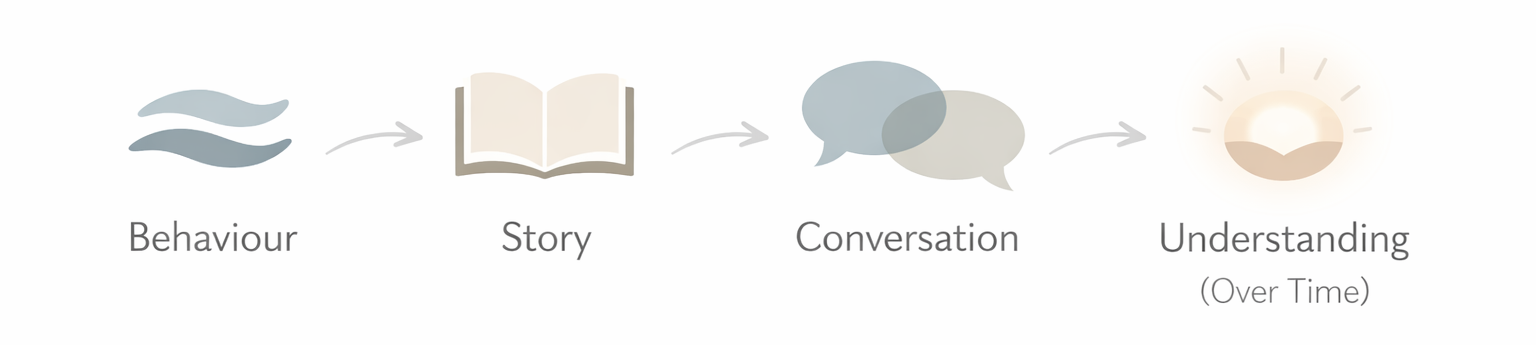
AI’s suggested stories are starting points, not keys to unlock the whole problem. It may take more time to reflect or a different story to resonate.
Keep in mind:
- Children may relate to unexpected parts of a story
- Silence or disagreement can be meaningful
- What a child changes in the story can be revealing
- Understanding often unfolds over time, not in one conversation
Avoid asking AI to assess, diagnose, or judge your child.
Avoid sharing identifying details or diagnoses.
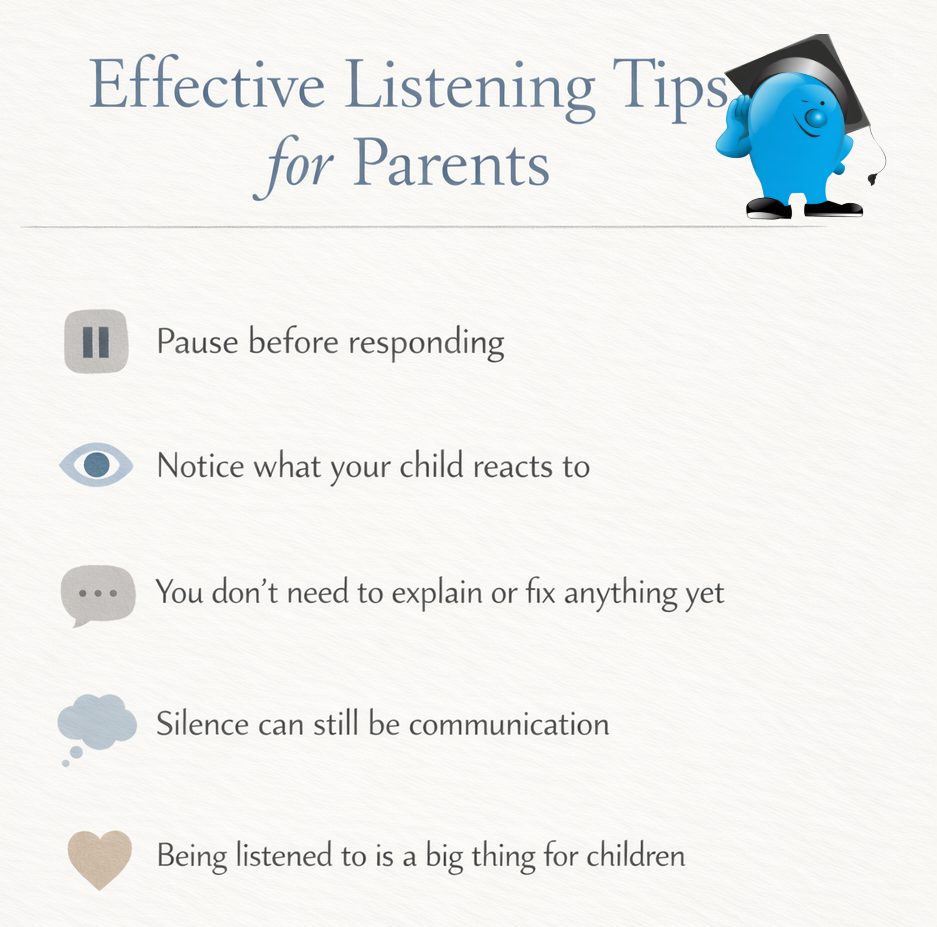
Your role is to listen, notice, and reflect.
Talking about this with your child
You might gently say:
“I wonder what you think about this character.”
“Does any part of this story feel familiar, or not at all?”
There is no need to push for answers.
Tip for parents
See this exercise as the starting point. Use it to get your child to open up and for you to notice their thoughts and feelings. The next guide in this series will help you employ AI to think through all the different interpretations of what you discover and begin to resolve the challenges.
Was this guide helpful?
Let us know whether this article helped you.
Share this guide with other parents
Know a parent who would find this guide helpful? Enter their email address and we'll send them the Parent Conversation Guide directly.