Start with our AI Readiness Checker
AI is already part of your child’s learning. In just a couple of minutes, discover where your family stands and what to do next.
- ✓ Your family’s AI Confidence Score
- ✓ What you’re already doing well
- ✓ Simple, practical next steps
Here's the AI Literacy School guide for parents dealing with anxiety about AI.
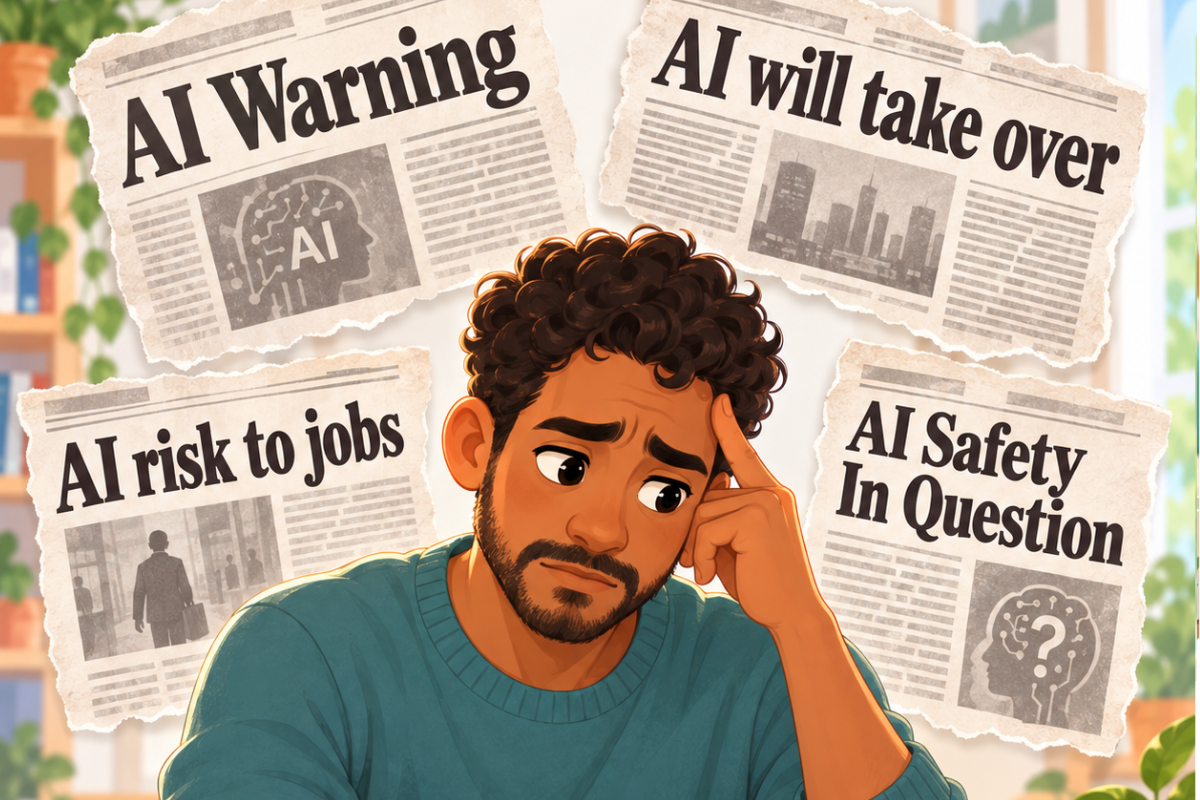
One week the news is about children becoming too dependent on AI for schoolwork. The next it is about false information, disappearing jobs, privacy, AI companions or people being influenced by chatbots in harmful ways.
If you are a parent, it is reasonable to have anxiety about where this is heading and what it could mean for your child.
There are real concerns. There are also useful ways AI can support learning, creativity and everyday family life when it is used carefully.
Parents do not need to choose between ignoring the risks and fearing the technology. A more useful starting point is to focus on the things you can influence.
Put simply, you can only control what you can control.
You cannot keep up with everything
AI is developing quickly. New tools appear, existing products change, and children may encounter AI through school, apps, games, search engines and other services.
No parent can track every development. No one person can change how AI will impact society in the future.
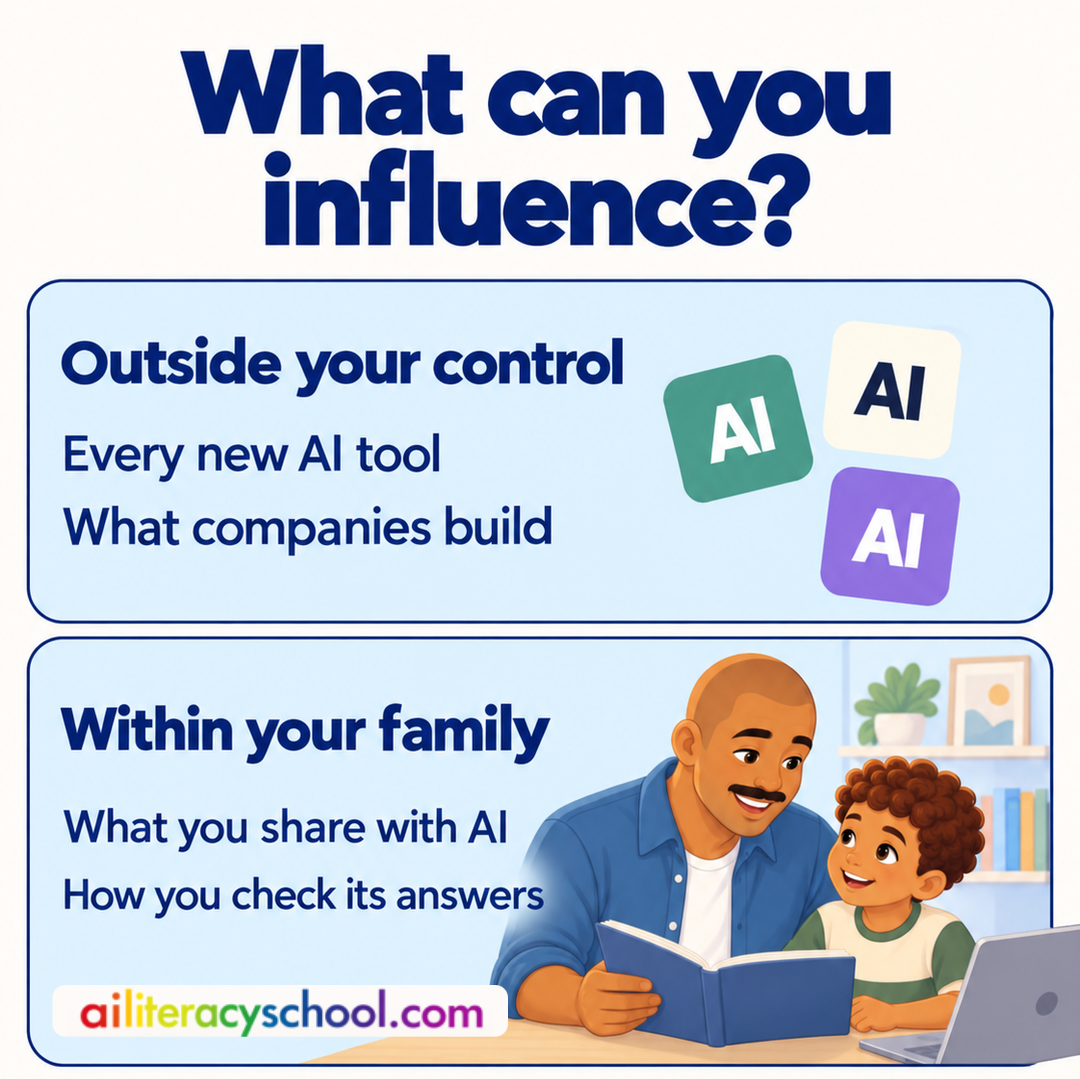
You cannot control what every company builds, what other children use or how AI will change over the next few years.
You can, however, build the knowledge and habits that help your family respond well.
That starts with your own AI literacy. Our own education is under our control.
You do not need to understand how AI is built. You need enough knowledge to ask useful questions, spot possible problems and make informed decisions for your family.
For example:
- AI can be wrong. Treat confident answers as something that may need checking.
- Private information needs protecting. Avoid putting identifying or sensitive details about your child into AI tools.
- AI should support learning. Children still need to think, practise, solve problems and explain their own work.
- Age limits and supervision count. Younger children should not independently use general-purpose chatbots. Any use should be parent-led, on an adult's account, with the adult present.
- People come first. Children should turn to trusted adults for personal worries, important decisions and emotional support.
These are simple ideas, but they give children a useful foundation as AI becomes more common.
Your own AI literacy helps your child
Children learn a great deal from watching how adults use technology.
A parent who checks an AI answer teaches that AI should not automatically be trusted.
A parent who leaves names and private details out of a prompt teaches good privacy habits.
A parent who uses AI to get ideas and then makes their own decision shows that the person remains in charge.
You do not need perfect knowledge to model these behaviours. In fact, saying, "I'm not sure. Let's find out," can be useful in itself.
If you want to build that understanding gradually, the AI Literacy School Learning Pathways are designed around short, practical lessons for parents. The AI Safety Pathway covers issues such as trust, mistakes, privacy and safer family habits, while the AI and Learning Pathway helps parents think about when AI supports learning and when it starts doing too much.
Help your child understand what AI is
One of the most useful things you can do is help your child form a sensible picture of AI before they start relying on it.
AI can produce impressive answers. It can also make mistakes.
It can use friendly, caring language. That does not make it a friend.
It can help explain an idea. That does not mean your child should hand over the thinking.
These distinctions become easier to understand when families talk about them early.
The AI Literacy School guide How Can Families Start Learning About AI Together At Home? gives parents simple ways to begin these conversations without turning them into a lesson or a warning.
Protect the thinking that children still need to do
AI can make many tasks easier. That makes independent thinking more valuable.
If a child becomes used to receiving an instant answer whenever something feels difficult, they can miss the practice involved in remembering, reasoning, trying another approach and learning from mistakes.
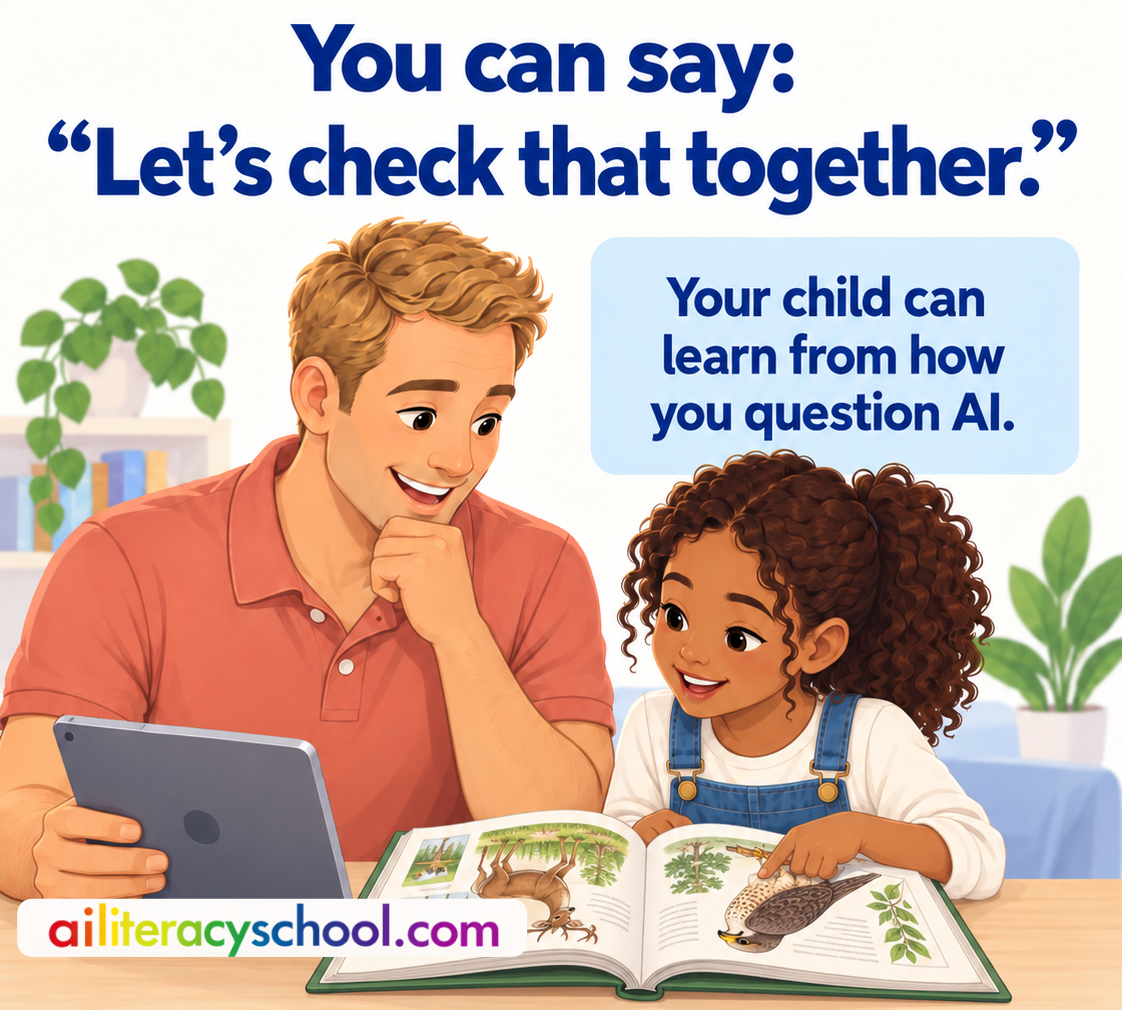
Parents can help by asking simple questions:
"Does that answer make sense?"
"How could we check it?"
"What do you think before we ask AI?"
"Could AI give us a hint instead of the answer?"
The aim is to keep your child involved in the thinking.
The guide The Thinking Skills Your Child Needs as AI Does More explores how skills such as critical thinking, problem-solving and checking information can help children both with AI and in everyday learning.
Keep human relationships at the centre
Some AI tools are designed to hold long conversations and respond in warm, personal ways.
Children need a clear distinction between something that can produce human-like conversation and a person who knows them, cares about them and can take responsibility for helping them.
A simple family message can be:
AI can give you information or ideas. People are who you come to for care, worries and important decisions.
Keeping that boundary clear can help children develop a healthier relationship with these tools as they grow.
Make room for the benefits too
Being cautious about AI does not mean overlooking what it can do well.
Parents can use AI themselves to explain an unfamiliar school topic, create practice questions, suggest activities, make instructions easier to understand or come up with ideas based on a child's interests.
Age-appropriate educational apps may also use AI to adjust activities, provide feedback or give children extra practice.
The useful question is always the same: Is this helping my child learn, create or understand something while keeping them safe and involved?
The AI Literacy School guide How to Choose Safe, Useful AI Apps for Elementary-Aged Children can help if you are deciding whether a particular type of AI learning tool is suitable.
You do not have to solve AI
Parents have always had to help children deal with things they cannot completely control. A generation ago, the internet gave parents sleepless night, before that television, and before that comic books.
AI adds some new questions, but your role remains familiar. Learn enough to make sensible decisions. Set boundaries that fit your family. Stay interested in what your child is doing. Keep conversations open.
Your child does not need you to predict what AI will look like in five years.
They need an adult who is prepared to keep learning alongside them.
That is something you can control.
If you would like help building that confidence, AI Literacy School gives parents short pathways, guides and practical activities covering AI safety, privacy, learning and healthy use. You can start with the area that concerns you most and build your understanding from there.
Was this guide helpful?
Let us know whether this article helped you.
Share this guide with other parents
Know a parent who would find this guide helpful? Enter their email address and we'll send them the Parent Conversation Guide directly.