Start with our AI Readiness Checker
AI is already part of your child’s learning. In just a couple of minutes, discover where your family stands and what to do next.
- ✓ Your family’s AI Confidence Score
- ✓ What you’re already doing well
- ✓ Simple, practical next steps
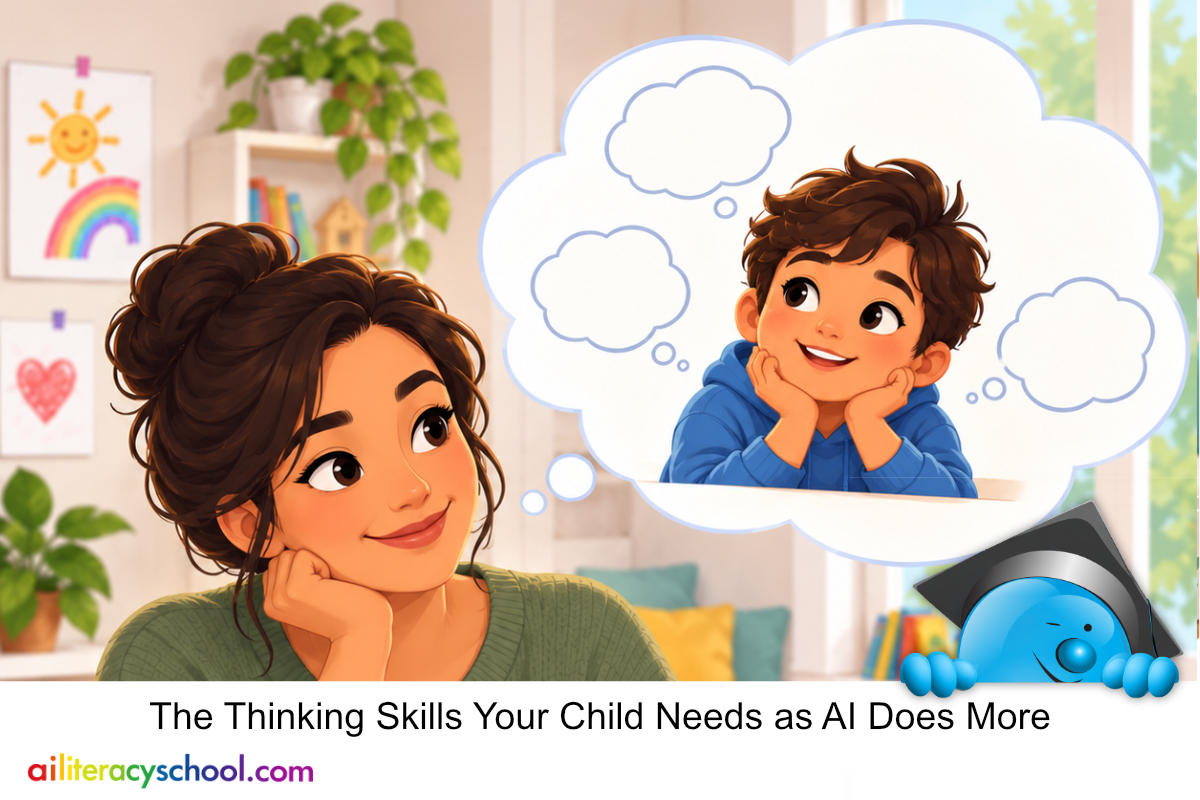
AI can find information, explain ideas and suggest solutions in seconds. Children still need to understand what they are doing, judge whether an answer is useful and know when they need to think for themselves.
The thinking skills that help children around AI are also useful throughout everyday life. Critical thinking helps them judge information. Knowledge helps them spot mistakes. Problem-solving helps them deal with new situations. Learning how to plan, try and check their own work helps them become more independent.
As AI develops, these skills give children more control over how they respond to it.
For children under 13, learning about AI does not mean using general-purpose chatbots independently. Tools such as ChatGPT or Gemini should be used only with a parent or other responsible adult present and leading the activity. Children may also encounter AI in products made specifically for their age group.
Parents should check that these are suitable for their child and that they are comfortable with the safety, privacy and parental controls provided.
Why is critical thinking important when children encounter AI?
Critical thinking helps your child judge AI-generated information, whether they encounter it in a learning tool, online or while exploring AI with you.
AI can give a confident answer that contains mistakes or leaves out useful information. Children need to get used to asking questions such as:
- Does this make sense?
- How could I check it?
- What might be missing?
- Is there another explanation?
These are useful questions even when AI is absent. Children need the same skills when they watch a video, read something online, hear a claim from a friend or work with information at school.
Try this at home
When your child tells you an interesting fact, ask:
“How could we find out if that's right?”
You are helping them build the habit of checking information instead of accepting the first answer they receive.
Does my child still need knowledge if AI can look things up?
Yes. Children need knowledge of their own so they can understand new information and judge whether it makes sense.
Imagine an AI gives your child an incorrect explanation of a topic they know well. There is a good chance they will notice something is wrong.
Now imagine the same thing happens with a subject they know nothing about. The incorrect explanation can be much harder to spot.
Reading, learning vocabulary, practising maths and building knowledge about the world give children a base from which to judge new information.
The same knowledge helps when AI is absent. It supports conversations, reading comprehension, schoolwork and everyday decisions.
Try this at home
Keep asking your child what they already know before looking something up.
Try:
“What do you already know about this?”
Then find out more together.
Why does problem-solving still count if AI can suggest solutions?
AI can suggest a solution. Your child still has to understand the problem, choose an approach, test it and decide what to do when the first idea fails.
Suppose your child is building a model bridge. An AI tool could suggest ways to make it stronger. Your child still has to work out which idea fits the materials they have, try it and see what happens.
Children practise the same skill when they work out how to fix something, organise a task, deal with a disagreement or change their plans when something goes wrong.
Problem-solving grows through experience. Children need chances to get stuck, try something and adjust their approach.
Try this at home
When your child asks you to solve something for them, start with:
“What have you tried so far?”
Follow it with:
“What could you try next?”
Give them time to come up with an idea before stepping in.
How can children avoid becoming too dependent on AI?
Children are less likely to depend on AI when they learn to plan, attempt and check their own work before asking for help.
One useful habit is to separate thinking help from answer help.
Thinking help moves the child forward while leaving them with something to work out. It might explain an unfamiliar word, give a clue or ask a useful question.
Answer help completes the thinking for them.
Before you use AI together, or before your child asks another person or tool for help, encourage them to ask:
- What am I trying to do?
- What have I tried?
- Where am I stuck?
- What sort of help would let me continue?
These questions work with homework, hobbies, projects and everyday problems as well as AI.
Should children learn how to ask AI good questions?
Yes, but children this age do not need independent access to general-purpose chatbots to learn this skill. You can model how questions affect AI answers while using an adult account together.
A clear question can give useful information. The next step is judging that information.
For children aged 7–11, any use of general-purpose AI should be parent-led and directly supervised. If you are using a tool designed specifically for children, check its recommended age, privacy arrangements and safety controls before deciding whether it is suitable.
For example, you might ask an AI to explain why leaves change colour. Then ask your child:
“Which part would you want to check?”
or:
“What question could we ask next?”
This turns shared AI use into an opportunity to practise thinking.
How can I build these thinking skills at home?
You do not need special AI lessons. Many ordinary family activities develop the same abilities.
Encourage your child to:
- Explain how they reached an answer.
- Look for evidence before accepting a claim.
- Try a solution before asking someone else to fix the problem.
- Read and learn about subjects that interest them.
- Think about what worked after completing a difficult task.
- Come up with their own answer before seeing what AI suggests during a shared activity.
The aim is to help your child use assistance without handing over their thinking.
What thinking skills will children need as AI develops?
Children need to be able to think critically, build knowledge, solve problems and manage their own learning.
AI may make many tasks faster. These skills help children decide whether the result is good, understand what it means and choose what to do next.
They also help children at school, at home and whenever they face something unfamiliar.
AI gives parents another reason to develop skills that were already valuable.
Was this guide helpful?
Let us know whether this article helped you.
Share this guide with other parents
Know a parent who would find this guide helpful? Enter their email address and we'll send them the Parent Conversation Guide directly.