Start with our AI Readiness Checker
AI is already part of your child’s learning. In just a couple of minutes, discover where your family stands and what to do next.
- ✓ Your family’s AI Confidence Score
- ✓ What you’re already doing well
- ✓ Simple, practical next steps
Quick answer: Start small. Talk about where your child already sees AI, agree on one simple safety rule, and then try one useful AI activity together. You can build from there by checking AI answers, protecting private information and learning how to choose suitable tools.
You do not need to understand every AI tool before you can guide your child. For families with children aged 7 to 12, learning together can begin with a few short conversations and shared activities at home.
Here is a simple way to get started.
1. Start by finding out what your child already knows about AI
Your child may already have ideas about AI from school, YouTube, games, apps or conversations with friends. Finding out what they think gives you a much better starting point than trying to explain everything yourself.
Try asking:
Where have you seen or heard about AI? What do you think it can do? Is there anything you think AI might get wrong?
Your immediate gain: In a few minutes, you can find out what your child already understands, where they may be confused and whether they have already encountered AI without you knowing.
Use AI Conversation: What Does AI Mean to Your Child? to guide this first conversation. The AI Safety Pathway can then help you build the basic knowledge and family habits that sit behind safer AI use.
2. Agree on one simple AI safety rule
Children remember a clear rule more easily than a long talk about risks.
For children in this age group, keep general-purpose chatbot use adult-led. Check the provider’s age rules, use your adult account where appropriate, stay with your child and remain in control of the interaction.
A simple family rule could be:
If you want to use or try an AI chatbot, ask me first and we will look at it together.
You can also agree that if an AI app, chat or answer ever feels strange, upsetting or unsafe, your child should stop and tell you.
Your immediate gain: Your child knows what to do before an unexpected AI situation happens, and you have a clear boundary you can use at home.
Read Talking To Children About AI Safety: When Something Feels Wrong for wording you can use with your child. The AI Safety Pathway covers AI mistakes, privacy, trust, supervision and other safety issues in more depth.
3. Try one useful AI activity together
Your first family AI activity does not need to be impressive. Pick something that solves a small problem you already have.
For example, you could use your adult AI account to ask for another way to explain a difficult homework idea, create a few practice questions or suggest questions your child can use when researching a topic.
Keep your child involved. Let them think, choose, explain and answer. The AI provides support while your child continues doing the learning.
Your immediate gain: You see what AI can actually do for your family, and your child sees an example of using it with an adult for a clear purpose.
For practical examples, read 5 Ways AI Can Help Parents With Homework. The AI Learning Pathway will help you judge when AI supports understanding and when it starts doing too much of the work.
4. Check one AI answer together
Children need to learn early that a confident AI answer can still be wrong.
You can teach this without a lesson on how AI works. Ask AI a question about something you and your child can check elsewhere. Read the answer together and then ask:
How could we check whether this is right?
Look at a trusted website, school resource, book or another suitable source. If you find a mistake or missing detail, show your child. That experience is often more memorable than simply telling them that AI makes errors.
Your immediate gain: Your child begins building the habit of checking AI instead of accepting an answer because it sounds convincing.
Use Talking to Children About AI: AI Mistakes and Hallucinations to continue the conversation. The AI Learning Pathway gives parents more help with AI answers, learning, shortcuts and independent thinking.
5. Protect private information from your first AI activity
Good privacy habits are easier to build before sharing information with AI becomes normal.
Teach your child that an AI tool does not need their full name, home address, school, passwords or private family details. Parents should also be careful about entering identifying information about their children when using AI themselves.
You can usually describe the situation without identifying the child. For example, “a 9-year-old who finds long writing tasks difficult” may give you enough context for a useful response without adding a name, school or personal record.
Your immediate gain: Your family starts using AI with a privacy habit already in place, instead of trying to correct unsafe sharing later.
Read Simple Steps to Keep Your Child’s Data Safe for practical privacy guidance. The AI Safety Pathway also covers what children should never share and how families can set privacy boundaries.
6. Check an AI app before giving it to your child
Learning about AI together does not mean giving your child access to every AI product they hear about.
If your child asks to try an AI learning app, check it first. Look at who it is designed for, its age requirements, what information it collects and what it actually asks the child to do.
Then watch what happens during use. A useful learning tool should leave your child able to explain, practise or do something themselves. Be cautious if the tool supplies finished work so quickly that your child has little thinking left to do.
Your immediate gain: You have a practical way to decide whether a new AI app deserves a place in your home before you sign up or pay for it.
Read AI Educational Apps for Kids: How to Choose Safe, Useful AI Apps for a parent-friendly starting point. The Choosing AI Tools Pathway gives you a repeatable process for checking age suitability, privacy, learning value and longer-term use.
7. Turn AI learning into a small family habit
You do not need a separate AI lesson every week. Use the AI moments that already happen.
If your child mentions an AI feature at school, asks about ChatGPT, sees an AI-generated picture or wants to try a new app, spend a few minutes talking about it. Ask what the AI was being used for, who was making the decisions and whether anything needed checking.
You could also choose one short family AI activity every week or two. Keep it connected to something your family already wants to do, such as homework, planning, learning a fact, creating ideas or comparing information.
Your immediate gain: AI literacy becomes part of normal family conversation, so you do not have to cover everything in one big talk.
The 30-Minute Back-to-School AI Setup for Families gives you a practical family setup you can adapt at any time of year. The Healthy Learning Pathway helps you build small learning habits that fit your child and your home.
What if my child needs a different approach to learning?
AI can also help parents adapt activities, organise observations, understand school information and prepare questions. In many cases, the parent can use AI without the child needing to use a chatbot at all.
Keep descriptions general and protect private information. AI can suggest ideas and help organise your thinking, while decisions about your child stay with you and the appropriate teachers or professionals.
Your immediate gain: You can use AI to prepare more efficiently and find ideas that fit your child without handing the learning process over to a chatbot.
Start with Five Ways AI Can Support Your Child With Additional Needs. For practical parent skills, explore the Additional Needs Pathway.
What should families learn about AI first?
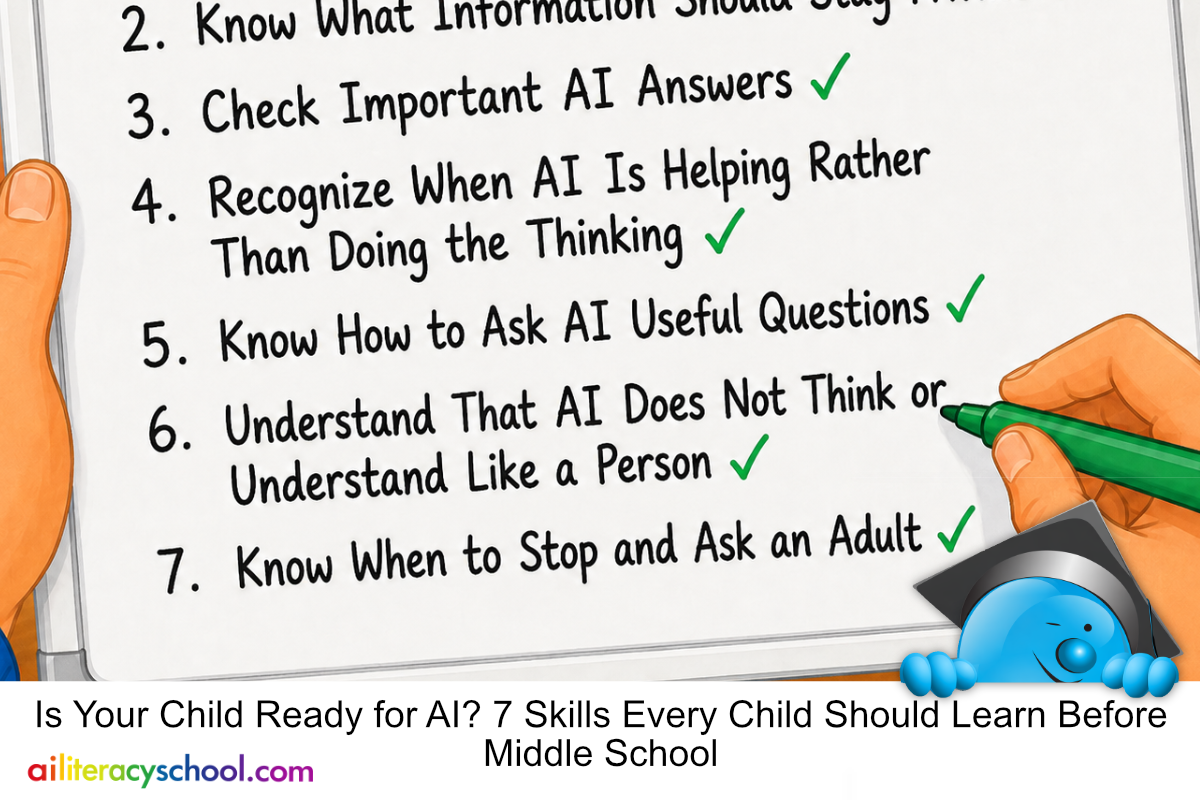
Start with the things your child can use straight away: when they need an adult, what information should stay private, why AI answers need checking and how AI can help with learning without doing the work for them.
The Why Parents Should Talk to Their Children About AI guide can help you begin these conversations. The AI Safety Pathway is a useful first pathway if you want to build these foundations in a clear order.
Do parents need to understand AI before teaching their children?
No. You need enough knowledge to ask sensible questions, set boundaries and model good habits. You can learn the rest alongside your child.
If you want a simple introduction, read Artificial Intelligence (AI) for Kids. The AI Learning Pathway then explains how AI affects schoolwork and learning in practical parent-friendly terms.
How much time does a family need to spend learning about AI?
A few useful minutes on a regular basis can be enough to get started. One conversation, one shared activity or one new family rule gives you something you can use straight away.
You can then build your knowledge when a new question comes up. The aim is to make good decisions as AI becomes part of your child’s life, rather than trying to learn everything in advance.
The 30-Minute Back-to-School AI Setup for Families shows how much you can put in place in a short session. The Healthy Learning Pathway is designed around small changes that can fit into normal family life.
Where should our family start?
Pick the question you need help with now.
If safety is your main concern, start with the AI Safety Pathway. If homework and learning are the priority, choose the AI Learning Pathway. If you are deciding which apps your child should use, try the Choosing AI Tools Pathway. For family learning habits, explore the Healthy Learning Pathway. Parents looking for more individualised support can use the Additional Needs Pathway.
You can start with one question today and add the rest as your family needs it.
Was this guide helpful?
Let us know whether this article helped you.
Share this guide with other parents
Know a parent who would find this guide helpful? Enter their email address and we'll send them the Parent Conversation Guide directly.