Start with our AI Readiness Checker
AI is already part of your child’s learning. In just a couple of minutes, discover where your family stands and what to do next.
- ✓ Your family’s AI Confidence Score
- ✓ What you’re already doing well
- ✓ Simple, practical next steps
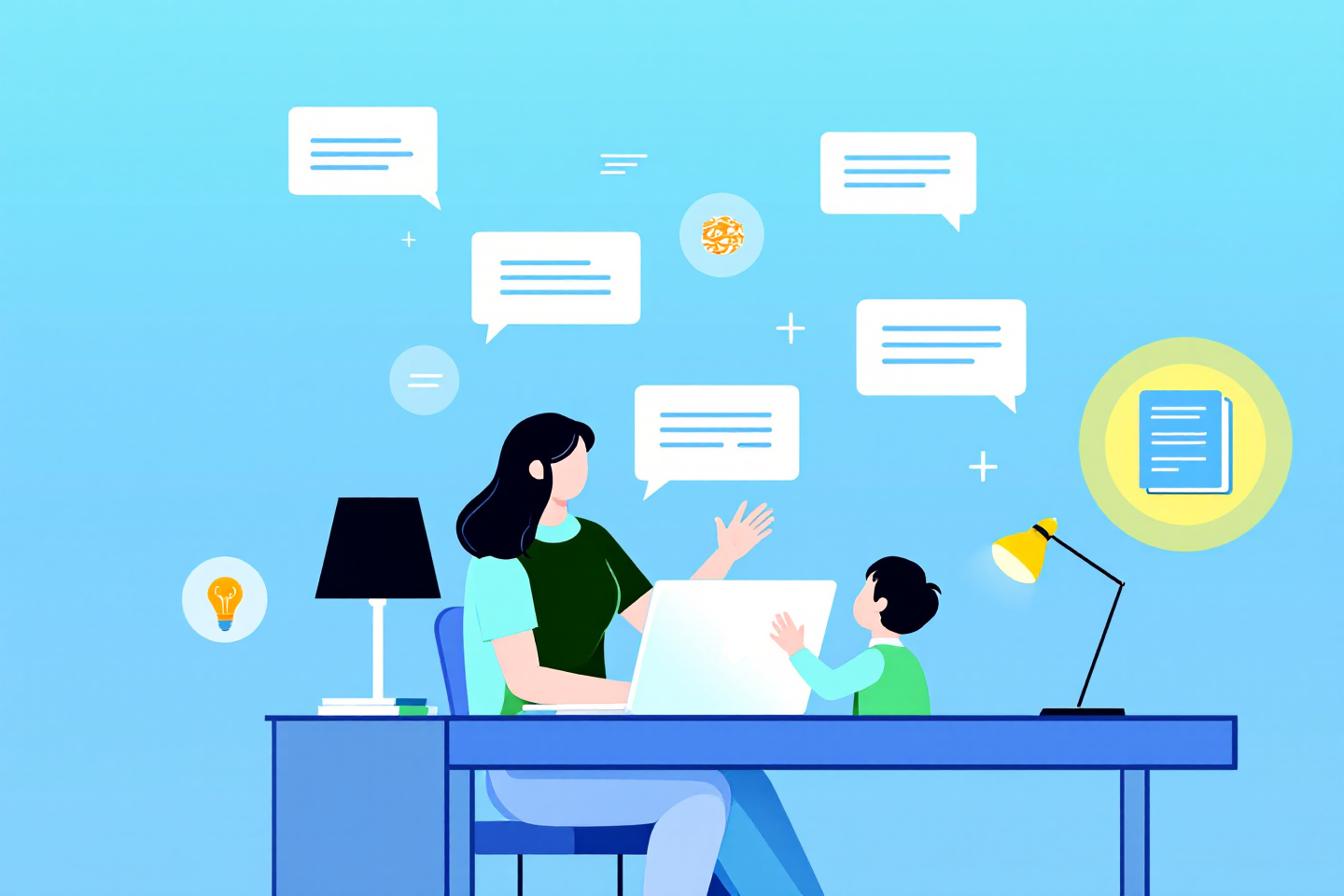
When you talk to ChatGPT, the way you phrase your message makes all the difference.
A simple question like “How do I help my child focus?” can bring a vague answer — but a well-built prompt can lead to specific, balanced, and even tone-matched guidance.
This lesson shows you how to shape your questions so ChatGPT becomes a supportive thinking partner, not a confusing wall of text.
You’ll learn a clear, repeatable structure called RCIO: Role, Context, Instructions, and Output.
Why Prompts Matter
ChatGPT doesn’t think like a person — it predicts words based on patterns.
That means it relies on your clues to decide:
- What “role” it’s playing,
- How detailed to be,
- What tone to use, and
- What kind of result you want.
If you give those clues clearly, you’ll almost always get better, more useful replies.
The RCIO Framework
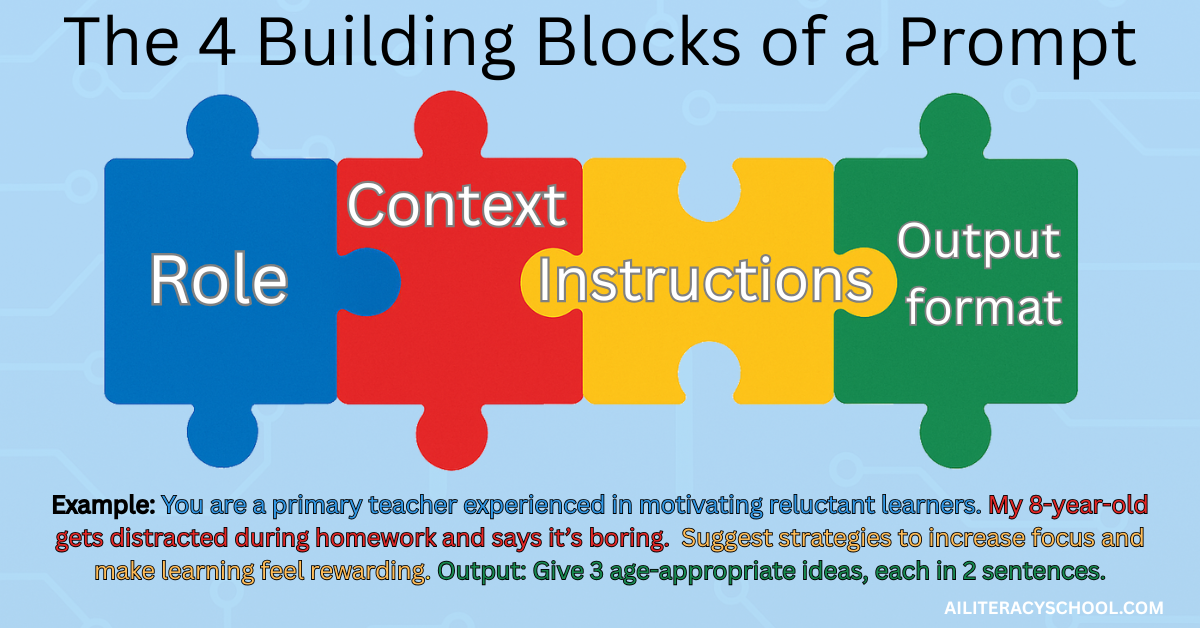
| Element | What It Does | Parenting Example |
|---|---|---|
| R — Role | Tells ChatGPT who it should act as. | “You are a calm parenting coach who supports gentle routines.” |
| C — Context | Explains the situation or background. | “My 7-year-old struggles to get ready for school on time.” |
| I — Instructions | Says exactly what you’d like ChatGPT to do. | “Suggest three strategies that build independence without nagging.” |
| O — Output | Defines the format or style you want. | “Use short bullet points I can print and stick on the fridge.” |
When you put these together, ChatGPT can respond in a focused, relevant way that feels personal to you, and you have not shared private data.
Example: Before and After
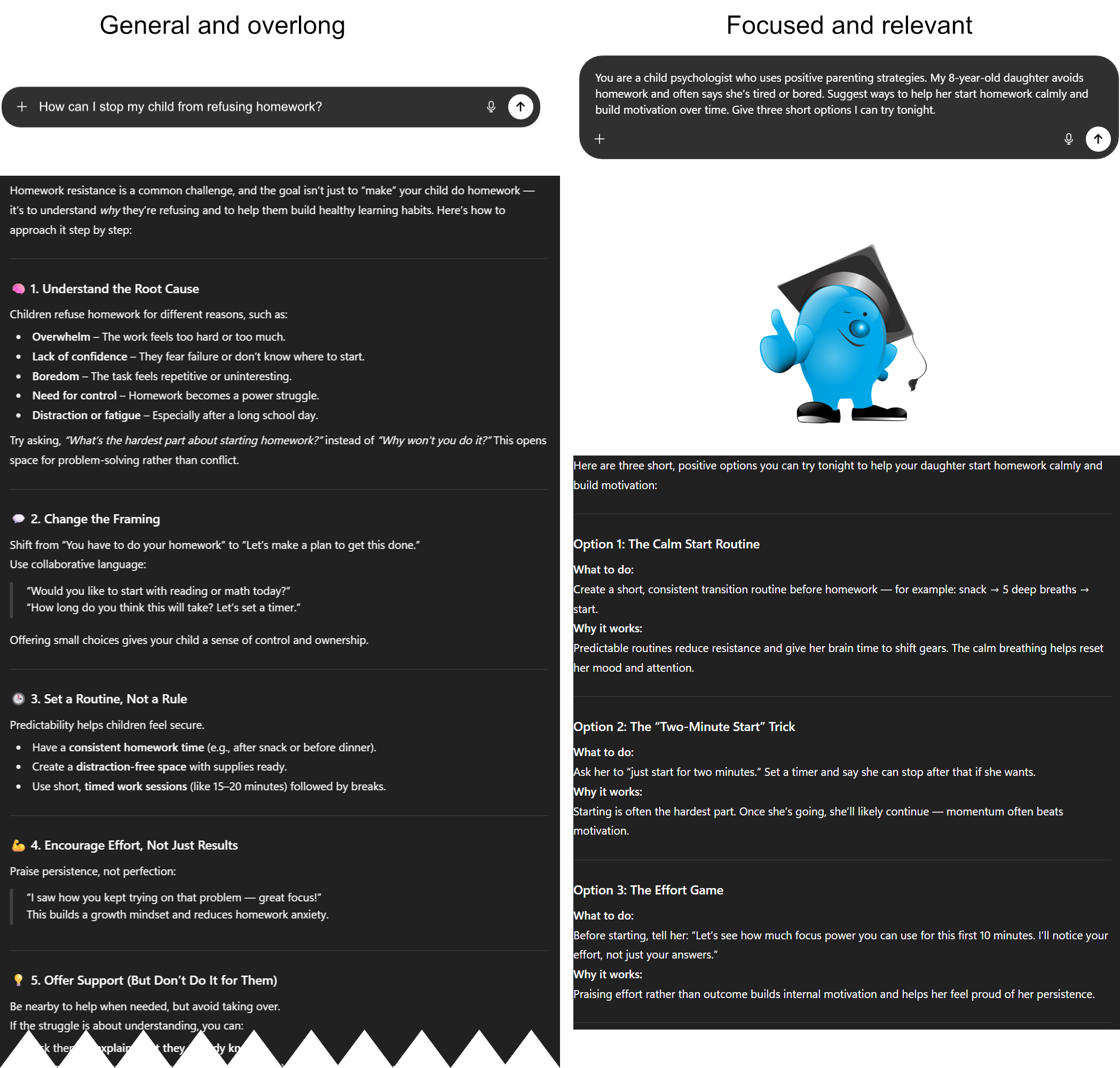
Basic Prompt:

Improved RCIO Prompt:
Role: You are a child psychologist who uses positive parenting strategies.
Context: My 8-year-old daughter avoids homework and often says she’s tired or bored.
Instructions: Suggest ways to help her start homework calmly and build motivation over time.
Output: Give three short options I can try tonight.

What Happens:
The improved prompt produces realistic, age-sensitive ideas, a calm tone, and an action plan instead of general advice.
Hands-On Exercise
Choose a parenting or learning topic that matters to you this week — for example:
- morning routines
- sibling conflict
- helping a child focus
- creating screen-free time
Step 1: Write a quick question as you normally would.
Step 2: Re-write it using the RCIO structure.
Step 3: Compare the two results.
Ask yourself:
- Which answer felt more practical?
- Did the tone match how you like to parent?
- What extra clues helped most?
You can record your two prompts and ChatGPT’s replies in a simple “Prompt Journal” to track progress. Any simple text editor/notepad will work.
Reflection
- How did adding Role or Context change the response?
- Did ChatGPT echo your parenting values or tone more closely?
- What might you adjust next time?
Key Takeaways
- ChatGPT responds best when you tell it who, what, and how.
- The RCIO method works for any topic — parenting, work, or personal learning.
- Better prompts lead to calmer, clearer, more practical conversations.
- You are always in charge of the conversation — ChatGPT follows your lead.
Reference Material
Suggested Roles for Parenting Questions
| Parenting Situation or Goal | Suggested ChatGPT Role | Why This Role Works | Example Prompt Starter |
|---|---|---|---|
| Supporting good routines (morning, bedtime, chores) | Family routine coach or child behavior specialist | Helps you get practical, step-by-step guidance | “You are a family routine coach helping parents build calm morning routines…” |
| Managing challenging behaviour (tantrums, defiance, emotions) | Positive parenting coach or child psychologist using gentle discipline | Produces advice that balances empathy and structure | “You are a child psychologist who teaches parents positive discipline…” |
| Helping with learning or homework | Learning coach for primary-age children or teacher experienced in motivation and focus | Encourages practical, age-appropriate learning ideas | “You are a primary teacher who helps children stay focused on homework…” |
| Supporting gifted or curious learners | Enrichment teacher or creative learning mentor | Offers extension ideas and deeper questions to sustain curiosity | “You are a learning mentor who helps gifted children stay motivated through curiosity-based projects…” |
| Preparing for parent–teacher meetings | Educational consultant or school communication coach | Produces structured discussion points and questions | “You are a school communication coach helping parents prepare for parent–teacher conferences…” |
| Supporting emotional development (confidence, kindness, resilience) | Child development psychologist or social–emotional learning specialist | Keeps tone balanced and emotionally sensitive | “You are a child development psychologist helping parents build children’s confidence…” |
| Managing sibling relationships | Family therapist specialising in sibling dynamics | Encourages empathy, fairness, and practical strategies | “You are a family therapist helping parents guide positive sibling relationships…” |
| Screen time and digital balance | Digital wellbeing educator or family media specialist | Offers age-appropriate strategies rooted in digital wellbeing | “You are a digital wellbeing educator helping parents manage screen time calmly…” |
| Nutrition, sleep, and daily wellbeing | Pediatric health educator or sleep consultant | Provides balanced, routine-focused advice (but not medical) | “You are a family wellbeing coach helping parents create better sleep routines…” |
| Organising home life and mental load | Family systems coach or time management consultant | Generates planning systems and checklists | “You are a family systems coach helping parents share household tasks more smoothly…” |
| Discussing family values and culture | Parenting coach familiar with multicultural family life | Encourages inclusive, values-based communication | “You are a parenting coach who helps multicultural families teach kindness and respect…” |
| Helping children manage big emotions | Child emotion coach or therapist using co-regulation techniques | Offers calm scripts and co-regulation steps | “You are a child emotion coach helping parents guide 6-year-olds through frustration…” |
| Talking about AI and technology at home | AI literacy educator for families | Helps you model healthy curiosity and balanced use | “You are an AI literacy educator helping parents talk about technology with young children…” |
How to Shape ChatGPT’s Tone and Instructions
| When You Want the Response To Feel… | Add a Tone Instruction Like… | Add an Output Instruction Like… | Example Combined Prompt Snippet |
|---|---|---|---|
| Warm and supportive | “Use a calm, reassuring tone as if talking to a tired parent.” | “Give 3 short suggestions I can try today.” | “You are a gentle parenting coach. Use a calm, supportive tone. Suggest 3 small ways to make bedtime more peaceful.” |
| Professional and research-based | “Sound evidence-informed and neutral.” | “Include 2–3 sources or summarize relevant research briefly.” | “You are a child development researcher. Provide evidence-informed advice with brief references.” |
| Creative and fun (for learning or play) | “Use a playful, imaginative tone.” | “Include ideas that involve drawing or storytelling.” | “You are a creative learning mentor. Use a fun tone and give playful reading activities for a 6-year-old.” |
| Calm and reflective (for emotional topics) | “Use a gentle, empathetic tone.” | “Offer questions I can reflect on, not direct instructions.” | “You are a family therapist. Speak gently and suggest reflection questions about managing frustration.” |
| Structured and organized | “Use a practical, step-by-step tone.” | “Present information in a numbered list or daily schedule.” | “You are a family systems coach. Give a 5-step plan for smoother mornings.” |
| Short and to the point | “Be concise.” | “Answer in bullet points of 1–2 lines each.” | “You are a digital wellbeing coach. Be concise and list 3 screen-time rules.” |
| Conversational and friendly | “Write as if chatting to a parent over coffee.” | “Keep sentences short and relaxed.” | “You are a parenting coach. Speak like a friendly conversation over coffee about sibling rivalry.” |
| Analytical and detailed | “Be thorough and structured.” | “Explain the reasoning behind each suggestion.” | “You are a child psychologist. Provide detailed reasoning for each strategy.” |
| Encouraging self-reflection | “Ask me questions to guide my thinking.” | “Respond with one question and one idea per reply.” | “You are a coaching-style parenting mentor. Ask reflective questions about my communication style.” |
| Action-oriented | “Be motivational and forward-looking.” | “Summarize actions in a simple checklist.” | “You are a family productivity coach. Motivate me to try a new bedtime routine and give a checklist.” |
Sample Full RCIO Prompts for Common Parenting Scenarios
| Parenting Challenge | Full RCIO Example Prompt | What Makes It Work |
|---|---|---|
| Morning Routines | Role: You are a family routine coach who helps parents create calm, predictable mornings. Context: My 6-year-old often delays getting dressed and we end up rushing. Instructions: Suggest a short morning routine that builds independence without nagging. Output: Use 5 short bullet points I can post on the fridge. | Defines expert role, keeps emotional tone calm, and asks for usable format. |
| Homework Motivation | Role: You are a primary teacher experienced in motivating reluctant learners. Context: My 8-year-old gets distracted during homework and says it’s boring. Instructions: Suggest strategies to increase focus and make learning feel rewarding. Output: Give 3 age-appropriate ideas, each in 2 sentences. | Focuses ChatGPT on motivation strategies and age-fit examples. |
| Managing Tantrums | Role: You are a child psychologist who teaches gentle discipline. Context: My 4-year-old has tantrums when told “no” in shops. Instructions: Explain what’s happening emotionally and give practical, calm responses I can use. Output: Write in a warm tone, with numbered steps. | Blends emotional understanding with action steps; keeps tone empathetic. |
| Sibling Conflict | Role: You are a family therapist specialising in sibling dynamics. Context: My 9-year-old and 6-year-old argue over toys daily. Instructions: Provide strategies to teach sharing and cooperation. Output: Give a short paragraph for parents and a short script I can say to the children. | Adds a realistic parent–child dialogue, showing how to apply advice. |
| Screen-Time Limits | Role: You are a digital wellbeing educator. Context: I’m trying to set screen-time rules that feel fair for both my children (ages 7 and 10). Instructions: Suggest a balanced daily limit and alternative non-screen activities. Output: Present in a simple table: Rule / Reason / Alternative Activity. | Uses a clear output format for easy use at home. |
| Encouraging Reading | Role: You are a creative literacy coach. Context: My 6-year-old loves stories but resists reading alone. Instructions: Suggest fun ways to build independent reading confidence. Output: Provide 3 ideas that combine play, imagination, and books. | Invites creative ideas suited to a playful learner. |
| Parent–Teacher Meeting Prep | Role: You are a school communication coach. Context: I have a meeting tomorrow about my 8-year-old’s concentration at school. Instructions: Help me prepare questions that show I’m supportive and want to collaborate. Output: List 5 concise questions under the heading “Meeting Notes.” | Keeps focus professional, collaborative, and printable. |
| Building Confidence | Role: You are a child development psychologist. Context: My 10-year-old gets anxious about new situations. Instructions: Suggest activities that build confidence gently over time. Output: Give a 4-week mini-plan with weekly goals. | Introduces time-based structure, showing how to plan gradual progress. |
| Family Organisation | Role: You are a family systems coach. Context: I feel overwhelmed managing chores and appointments. Instructions: Help me design a weekly schedule that shares tasks fairly. Output: Create a simple table with days, main tasks, and who’s responsible. | Turns advice into a reusable planner format. |
| Introducing AI to Children | Role: You are an AI literacy educator for families. Context: I want to introduce my 9-year-old to ChatGPT safely. Instructions: Suggest a supervised activity that shows how AI can help with learning without replacing effort. Output: Give a step-by-step plan with a short safety checklist for parents. | Models healthy AI use and supervision. |
Was this guide helpful?
Let us know whether this article helped you.
Share this guide with other parents
Know a parent who would find this guide helpful? Enter their email address and we'll send them the Parent Conversation Guide directly.