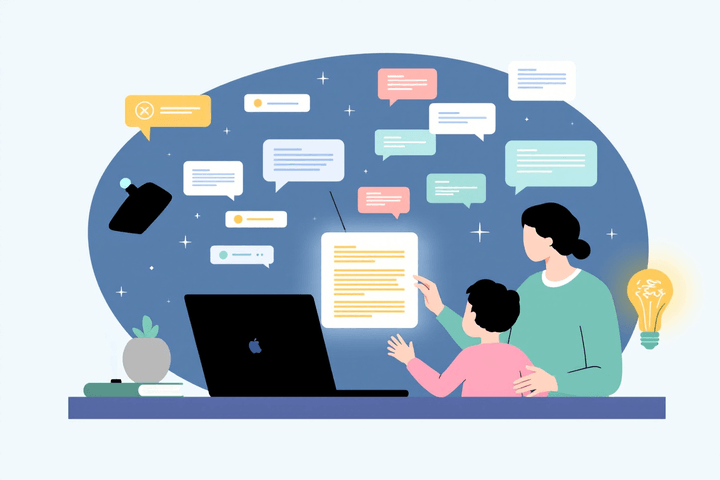
Start with our AI Readiness Checker
AI is already part of your child’s learning. In just a couple of minutes, discover where your family stands and what to do next.
- ✓ Your family’s AI Confidence Score
- ✓ What you’re already doing well
- ✓ Simple, practical next steps
Generative text refers to AI's ability to produce written content from minimal inputs, such as keywords or prompts. AI models, particularly those trained on vast amounts of data, can now generate coherent essays, stories, or articles in a matter of seconds.
This content creation capability is used across industries, from content creation to customer service, where AI can draft emails, marketing copy, or even entire books based on a given prompt.
What risks does generative text pose to kids?
Generative text poses several risks for children, especially concerning misinformation and plagiarism. Children might use AI to generate school assignments or essays, bypassing the learning process and stunting their critical thinking and writing skills.
Moreover, generative text can create content that appears factual but is inaccurate or biased, leading children to accept false information. There's also the potential exposure to inappropriate or harmful content, as AI sometimes generates material that isn't always suitable for young audiences.
How can we minimize the risk?
It's important to guide kids in using AI responsibly to minimize these risks. Teach them that while generative text can be useful, it shouldn't replace learning or critical thinking.
Encourage them to always verify information they come across and cross-check sources when using AI-generated text for research. Implement plagiarism checks for school assignments and emphasize the importance of original thought in their writing. Parents and educators should also monitor kids' platforms and tools to ensure they're appropriate for their age.
AI in Creative Writing
Generative text is a valuable resource for creative writing, allowing users to craft poems, stories, and even scripts with the help of AI. This technology can suggest plot ideas, write entire paragraphs, or assist with world-building, sparking inspiration for writers and easing the burden of writer’s block. For budding authors, generative text can offer a way to explore storytelling and develop their craft by experimenting with different styles and genres.
What risks does AI in creative writing pose to kids?
While generative text can inspire creativity, it also poses risks related to over-reliance. Kids might become dependent on AI for ideas, losing the opportunity to develop their imagination and narrative skills naturally. Additionally, AI-generated creative content might lead children to replicate or publish inappropriate material, given that the AI doesn’t always understand age-appropriate content. There’s also a risk that children may use AI to do the bulk of the work, leading to a lack of personal investment in their creative projects.
How can we minimize the risk?
To mitigate these risks, balance is key. Encourage kids to use AI as a brainstorming tool rather than as a replacement for their own ideas. Emphasize the importance of personal expression and original storytelling in creative writing. Guide them in editing and refining AI-generated content to make it their own, fostering critical thinking about what works and what doesn’t. Regularly reviewing the content kids are producing or consuming with AI tools can ensure it remains appropriate and beneficial to their development.
AI-Assisted Writing Tools
AI-assisted writing tools have emerged as helpful resources for students, providing suggestions for grammar, style, and structure. These tools can support kids in improving their writing skills, offering instant feedback and encouragement. However, they can also create a dependency on technology for completing assignments.
What risks do AI-assisted writing tools pose to kids?
Overreliance on these tools can hinder the development of independent writing skills. Kids may struggle to express their ideas without technological support and may become less confident in their writing abilities. Additionally, these tools may inadvertently encourage shortcuts that undermine the learning process.
How can we minimize the risk?
Encourage balanced use of AI-assisted writing tools as a complement to traditional writing practices.
Teach kids to use the corrections provided by these tools as learning opportunities. They should never accept a correction unthinkingly, as even a human editor does not know what is in the writer's mind. A small change based on an assumption could change the entire meaning of a sentence.
So, in the process of checking, they should look at why the AI made its suggestion. Is it a spelling mistake they frequently make, do they misunderstand a word’s meaning, or do they have a fundamental misunderstanding of a point of grammar?
Seeing the same sort of suggestions should indicate to learners that they need to address the issue.
Was this guide helpful?
Let us know whether this article helped you.
Share this guide with other parents
Know a parent who would find this guide helpful? Enter their email address and we'll send them the Parent Conversation Guide directly.