
📑 In this guide
Start with our AI Confidence Quiz
AI is already part of your child’s learning. In just a couple of minutes, discover where your family stands and what to do next.
- ✓ Your family’s AI Confidence Score
- ✓ What you’re already doing well
- ✓ Simple, practical next steps
AI is becoming part of everyday family life, and many parents are starting to ask the same question: can it actually help children learn to read?
The answer is yes, with the right approach.
For most families, the best use of AI for literacy is not giving a child a general chatbot and hoping it helps. It is using AI as a parent tool. AI can help you adapt reading materials, explain tricky words, create comprehension questions, and build simple activities around your child’s interests. Used well, it can save time and make learning feel more personal.
What matters most is keeping the adult in control. Reading still grows through books, conversation, repetition, and encouragement. AI works best when it helps you support those things more easily.
This guide will help you understand how to use AI to support your child as they learn to read.
How can AI tools support learning to read?
AI can be useful in literacy because it helps parents prepare, adapt, and extend learning at home.
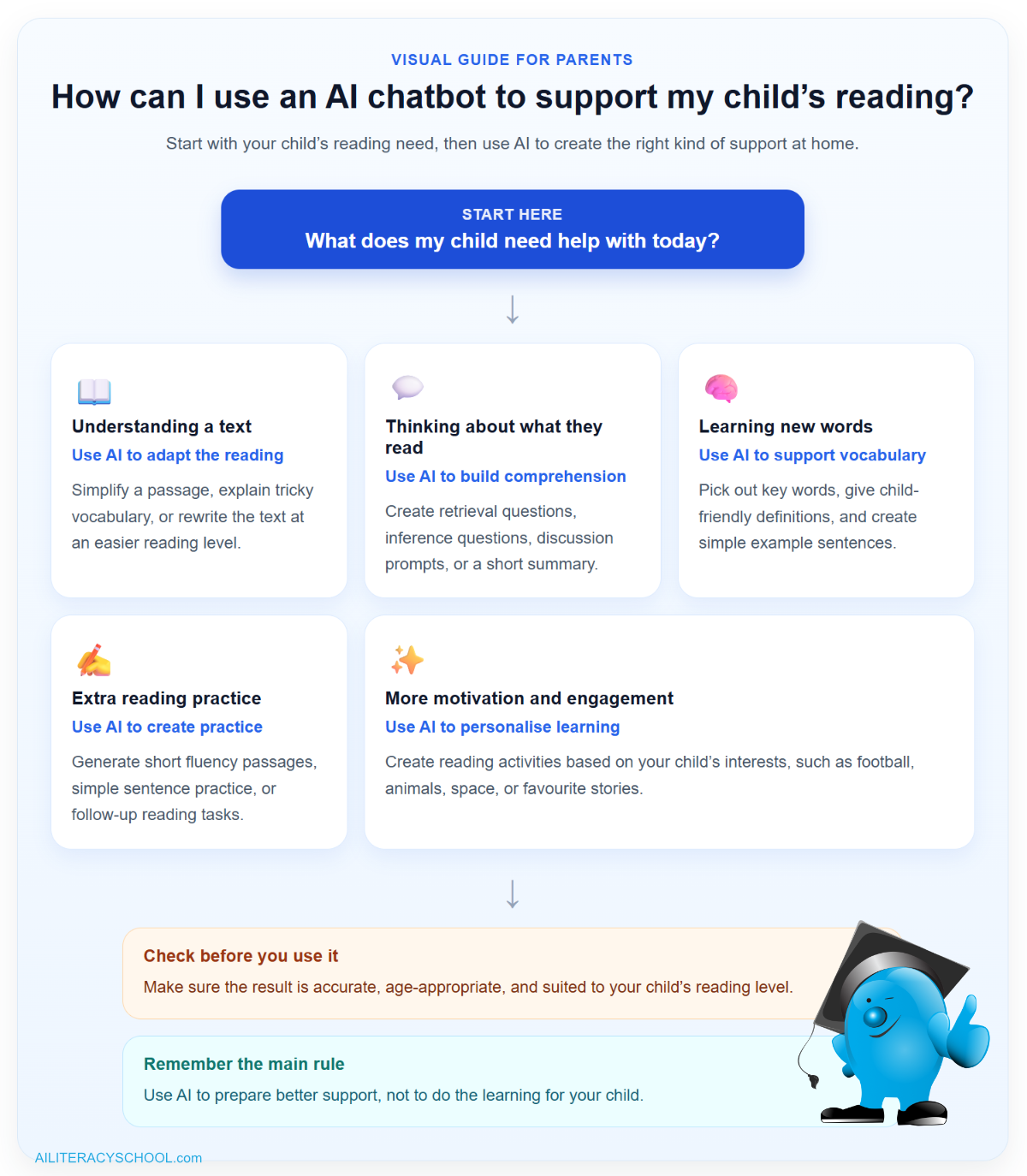
Adapting reading materials
One of the most practical uses of AI for learning is making texts easier to access.
You can use AI to simplify a passage, shorten a long article, explain difficult vocabulary, or rewrite a text at a different reading level. This can be especially helpful when your child is interested in a topic, but the available reading material is slightly too advanced.
Supporting reading comprehension
AI can also help you turn reading into a more active experience.
You can ask it to create retrieval questions, inference questions, discussion prompts, or a short summary of a chapter. That gives you a quick way to check understanding without having to prepare everything from scratch.
Building vocabulary
Vocabulary is a key part of literacy development. AI can help you spot important words in a text and turn them into manageable learning points.
For example, you can ask AI to pick out useful words, explain them in child-friendly language, suggest synonyms and antonyms, or create simple example sentences. This can make it easier to revisit new language after reading.
Creating extra reading practice
AI can help parents create more practice at the right level.
That might include short fluency passages, sentence practice, themed reading tasks, or follow-up writing prompts. The advantage is that you can make the work more relevant to your child’s age, stage, and interests.
Making reading feel more personal
Children often respond well when learning feels connected to what they already love.
AI can help you create reading activities around football, animals, space, fairy tales, or any other topic your child enjoys. It can also help you make personalised stories, discussion questions, or simple games that encourage more reading.
A simple rule for parents
A helpful way to think about AI for reading is this:
Use AI to prepare better support, not to remove the learning.
AI is useful when it helps you save time, adapt materials, and create better questions or activities. It is less useful when it does the thinking for the child or replaces shared reading altogether.
Children still need to read, think, talk, and practise. AI should support that process, not take it over.
Simple ways parents can use AI for reading at home
You do not need to be technical to use AI in a helpful way. A few simple uses can go a long way.
- Rewrite a passage using simpler words
- Explain key vocabulary before reading
- Create five comprehension questions from a story
- Suggest sentence starters for a book review
- Generate a short reading activity based on your child’s interests
- Turn a nonfiction text into a child-friendly version
The most important step is to check what it gives you before you use it. AI can be helpful, but it can also make mistakes or produce something that is not quite right for your child.
What if I do not feel comfortable using chatbots?
That is completely normal.
Many parents are curious about AI for learning, but do not yet feel confident about prompting, privacy, or checking whether an output is useful. Building confidence first is often the best place to start.
AI Literacy School is designed to help parents build family AI literacy in a way that is accessible, trustworthy, and practical. Its focus is on helping parents use AI safely, ethically, and effectively at home, with a calm and non-technical approach.
If you want to build confidence before using AI more often in family learning, AI Literacy School’s pathways in Safety, Learning, and Privacy offer a natural next step. This fits the wider aim of helping parents grow in knowledge, safety, and confidence rather than feeling pressured to use new tools before they are ready.
Are there AI tools my child can use directly to support literacy?
Yes, see this guide to using and choosing AI-based literacy apps.
Final thoughts
AI can support literacy at home, but the best results usually come when parents use it thoughtfully and stay involved.
It can help you simplify texts, explain vocabulary, create comprehension questions, and personalise learning in ways that save time and reduce friction. For many families, that is where AI is most useful.
And if you are not ready to use chatbots confidently yet, that is fine too. Starting with your own confidence, safety knowledge, and understanding is often the smartest first step. AI Literacy School is built around exactly that kind of calm, parent-first support.
Was this guide helpful?
Let us know whether this article helped you.
Share this guide with other parents
Know a parent who would find this guide helpful? Enter their email address and we'll send them the Parent Conversation Guide directly.