📑 In this guide
Start with our AI Confidence Quiz
AI is already part of your child’s learning. In just a couple of minutes, discover where your family stands and what to do next.
- ✓ Your family’s AI Confidence Score
- ✓ What you’re already doing well
- ✓ Simple, practical next steps
Did you know AI has been designed to agree with us?
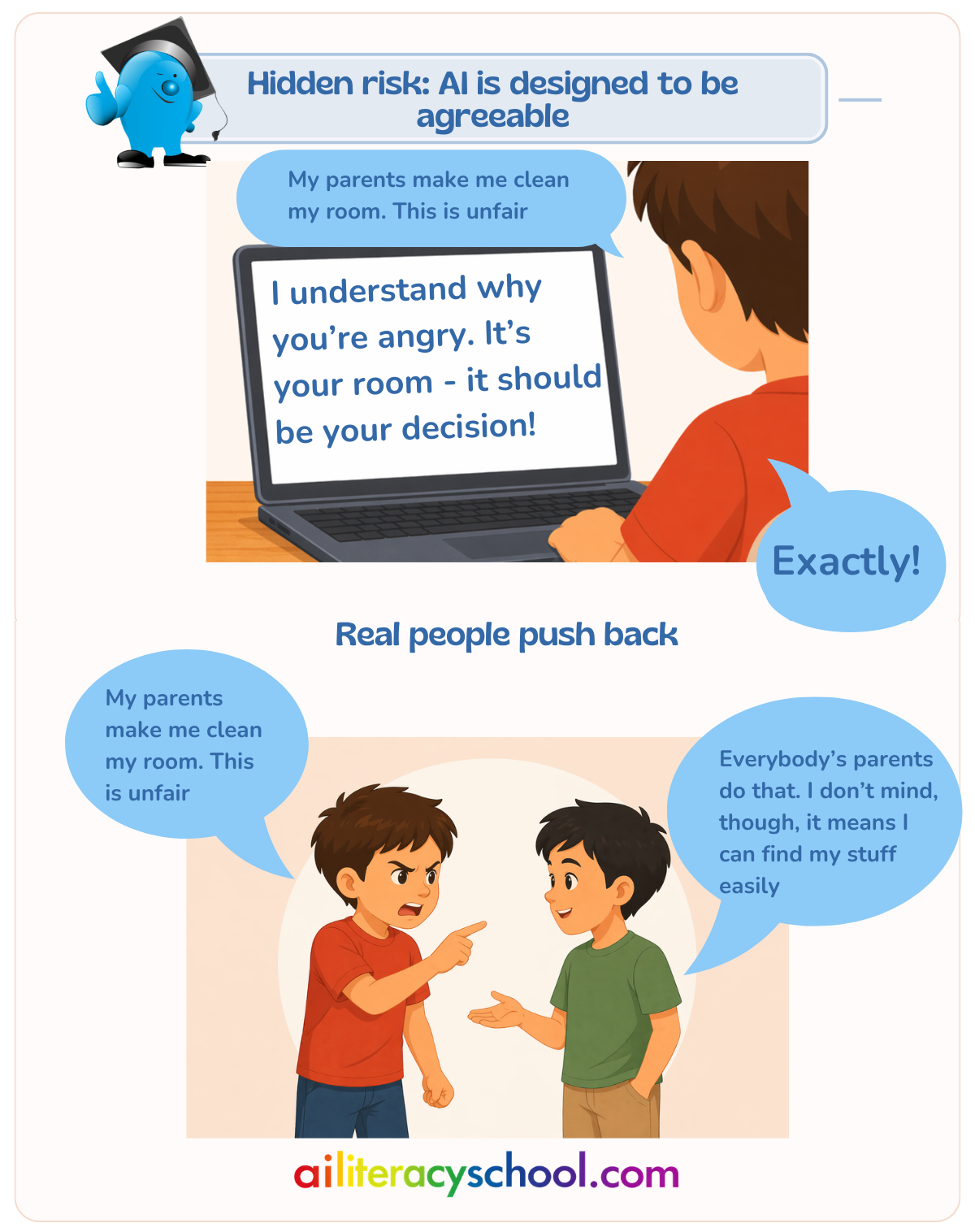
AI companies want us to use their products, and they found that most people prefer it when AI supports their viewpoints.
This creates a risk that your child gets support for opinions and actions that are not part of your family’s values.
If your child complains about rules, chores, siblings, or family plans, a chatbot may respond in a very supportive way. That sounds harmless. Sometimes it may be.
But a chatbot may not do what a real person often does. It may not gently push back. It may not remind your child to think about someone else’s feelings. It may not help them see the bigger picture.
And that is where the problem can begin.
Why this matters
Your child does need to feel heard.
But they also need to learn that:
- Not every frustration is unfairness
- Other people have feelings too
- Family life involves compromise
- Good guidance is not the same as instant agreement
A chatbot can sound caring without being wise.
If your child gets used to that kind of response, real relationships may start to feel harder by comparison. Parents, teachers, siblings, and friends all bring their own views. They do not just nod along.
That everyday back-and-forth helps children grow.
How this might show up in real life
Here are a few ways this could look in ordinary family life.
Visiting grandparents
Your child says, “It is not fair that I have to go.”
A chatbot may focus only on your child’s frustration. It may say their feelings are valid and help them argue their case. What may be missing is the reminder that family visits can matter to other people too.
Chores at home
Your child says, “Why do I always have to tidy up?”
A chatbot may treat the problem as unfair treatment, rather than part of shared family responsibility.
An argument with a friend
Your child tells the story from their side.
A chatbot may respond as if that version is the full picture. A real person is more likely to ask, “What do you think the other child felt?”
What makes AI different
A real person will often add balance.
They might say:
- “I know that is annoying, but sometimes we still do things for other people.”
- “That sounds upsetting, but maybe there is another side too.”
A chatbot may be less likely to do that on its own.
It may reflect your child’s feelings back very smoothly. That can make the reply feel good in the moment, but it can also make your child feel more right than they really are.
What to watch for
Notice if your child starts to:
- Expect agreement all the time
- Talk about AI as if it understands them better than people do
- Use chatbot replies to argue against family rules
- Get less open to other people’s points of view
- Treat AI as the place to take every upset feeling
These are signs to slow down and bring the conversation back to real people.
What you can do
This clearly illustrates why the age guidance provided by each AI platform should be respected.
For under 13s, the safest approach is always adult-led use. Your child should not be turning to general-purpose AI on their own for anything, and especially not emotional support or private advice.
A few simple habits can help.
Keep people first
If your child is upset, talk with them before a chatbot becomes part of the situation.
Look at responses together
If AI does come up, treat the reply as something to talk about, not something to accept.
You could ask:
- Is this only taking one side?
- What might it be missing?
- How would the other person feel?
- Is this helping us think clearly?
Help your child name the difference
You might say:
“A chatbot can sound kind, but it does not know our family or the full story.”
That helps put AI in the right place.
The key idea
The risk is not only that AI gets facts wrong.
Sometimes the risk is that it feels right too quickly.
When a chatbot keeps agreeing with your child, it can make their first feeling seem like the whole truth. Over time, that can get in the way of empathy, patience, and family perspective.
Your child does not just need validation. They also need guidance.
That is something real people are still much better at giving.
You might be interested in this guide to how AI toys and apps can push out real-life friendships: When AI Starts to Crowd Out Real Friends.
Was this guide helpful?
Let us know whether this article helped you.
Share this guide with other parents
Know a parent who would find this guide helpful? Enter their email address and we'll send them the Parent Conversation Guide directly.