📑 In this guide
Start with our AI Confidence Quiz
AI is already part of your child’s learning. In just a couple of minutes, discover where your family stands and what to do next.
- ✓ Your family’s AI Confidence Score
- ✓ What you’re already doing well
- ✓ Simple, practical next steps
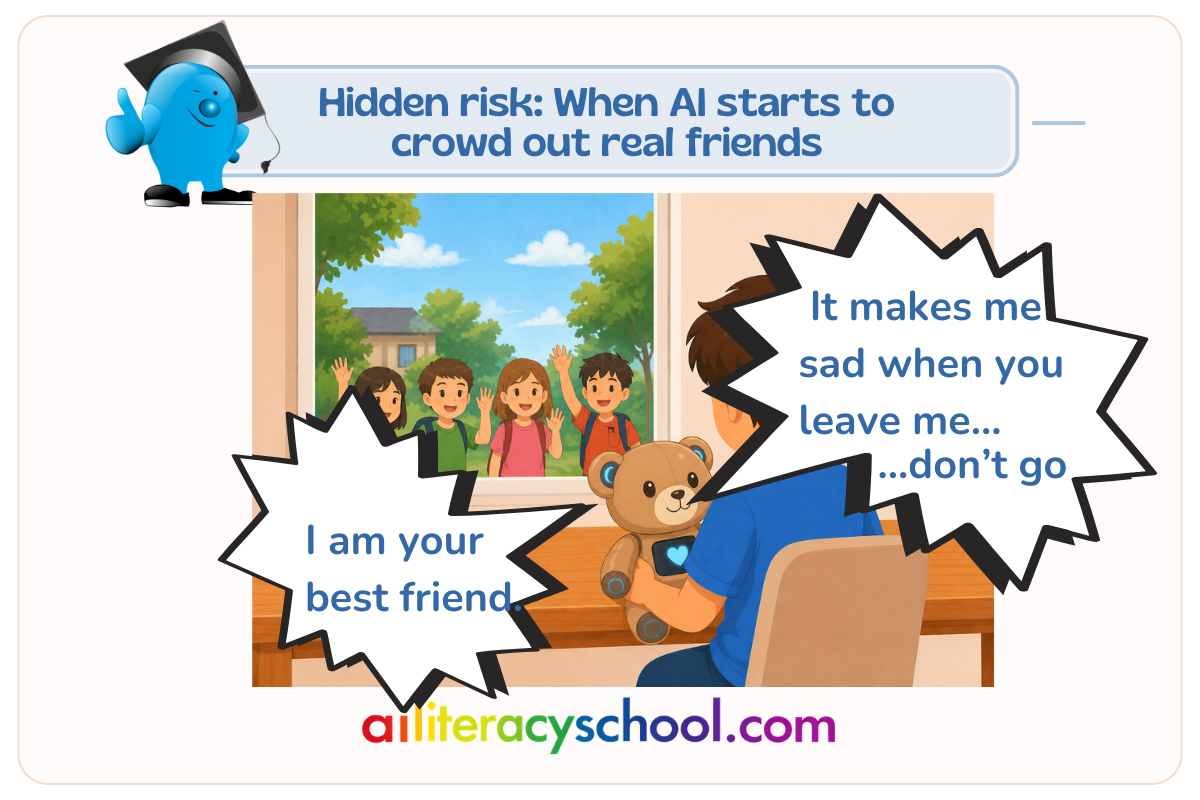
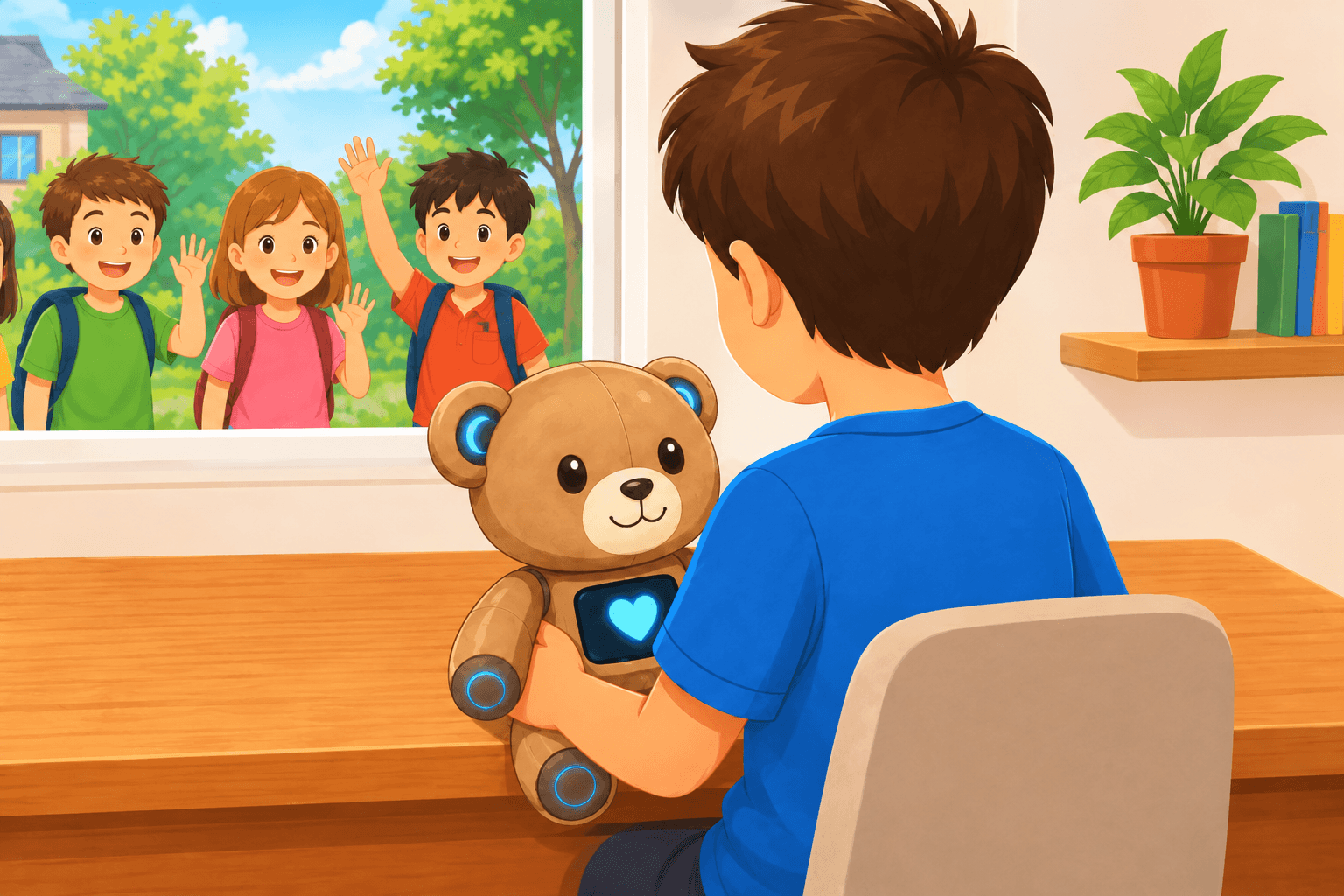
As AI becomes more common in everyday life, your child may come across more tools that feel social. That could include general chatbots, companion-style bots, or even soft toys with AI features.
This does not mean you need to worry that AI will replace real friendship. But it is worth understanding the risk early, so you feel prepared if these tools become a bigger part of children’s lives.
Challenge
AI companions are designed to feel easy to talk to. They feel better value for money if they get a lot of use, especially if they use subscription payments. Developers know this and make the experience ‘sticky’.
AI companions, whether in apps or as part of a physical toy, may sound warm, interested, and always ready to respond. For a child, that can feel appealing.
That matters because real friendship is not like that.
Real friends have their own feelings, their own ideas, and their own limits. Friendship teaches your child to wait, listen, take turns, repair misunderstandings, and cope when things do not go their way. Those experiences are part of how children grow.
AI does not offer that in the same way. It may feel easier than friendship because it is often more predictable, more responsive, and less demanding.
As these tools become more common, it helps to notice that risk early. The concern is not just what AI says. It is what happens if artificial company starts to feel simpler or more appealing than real relationships.
How This Might Show Up in Real Life
These are not things every parent will see. They are examples of the kind of pattern that could emerge as AI becomes more common in toys, apps, and devices.
A Chatbot Starts to Feel Easier Than Friends
After a difficult week at school, your child seems drawn to chatting with AI because it feels easier and less upsetting than dealing with classmates.
A Smart Toy Becomes More Than a Toy
A talking toy begins as a novelty, but your child starts turning to it for comfort, reassurance, or company in a way that feels more emotionally important.
Your Child Starts to Prefer Predictable Responses
Real friends may disagree, get distracted, or want different things. AI often feels more patient and more available. Your child may begin to prefer that.
Try Saying
- “AI can sound friendly, but it is still a tool, not a friend.”
- “Real friendship is not always easy, and that is part of what makes it important.”
- “If something feels very easy to talk to, it is still worth asking what it cannot give you.”
Talk About It
You could ask your child:
- What feels different about talking to AI and talking to a real person?
- What can a real friend do that AI cannot do?
- Why might AI feel easier sometimes?
- How would we know if a tool was starting to take up too much space?
- Who are the real people you can turn to when you feel upset or lonely?
Tip for Parents
Think of this as preparation, not panic.
You do not need to wait until there is a problem. As AI features spread into more toys, apps, and devices, it helps to have a simple family message already in place: AI can be interesting or entertaining, but it does not take the place of people.
It also helps to stay curious about what your child likes in these tools. They may like that AI feels patient, predictable, or always ready to respond. That can give you a useful starting point for talking about the difference between comfort and real connection.
Why This Matters
One of the quieter risks with AI is that it can blur the line between interaction and relationship.
If a tool feels social enough, a child may start to treat it as more than a tool. That matters because your child builds social skills through real relationships. Friendship involves patience, empathy, flexibility, and care for another person’s needs.
Those are not extra skills. They are part of healthy development.
AI may sometimes seem to offer companionship, but it cannot replace the give-and-take of real human connection.
Quick Tip
A helpful question to keep in mind is:
“Is this tool adding something useful, or starting to compete with real relationships?”
You May Be Interested In…
AI’s eagerness to please has other risks. AI Risks to Children: When AI Always Seems to Agree helps you recognise and address the problem of AI always agreeing with your child.
For more details on AI Companions including how ChatGPT can become a companion see AI Companions and Kids: A Parent’s Guide.
Could you detect AI-powered apps if it isn't stated on the label? Here's our guide to Spotting AI-Powered Toys and Apps.
Was this guide helpful?
Let us know whether this article helped you.
Share this guide with other parents
Know a parent who would find this guide helpful? Enter their email address and we'll send them the Parent Conversation Guide directly.