📑 In this guide
Start with our AI Confidence Quiz
AI is already part of your child’s learning. In just a couple of minutes, discover where your family stands and what to do next.
- ✓ Your family’s AI Confidence Score
- ✓ What you’re already doing well
- ✓ Simple, practical next steps
Children may see AI in search tools, homework help, games, videos, chatbots, and apps. Some children are already curious about it. Others may have used it without really knowing what it is. Even children who are too young to use AI on their own see and it in the media and are intrigued by it.
That is why AI should be a topic of conversation at home.
Parents do not need to be experts. In fact, children do not need perfect answers from adults. What they need is a trusted person who will listen, stay calm, and help them think.
Talking about AI helps children feel safer, more confident, and better prepared. It also helps parents guide children towards using AI in ways that are safe, sensible, and kind.
Why This Matters
AI is not just a future topic. It is a now topic.
Children are likely to come across AI before many parents expect. They may hear about it from friends, see it in school, or meet it in tools and apps online. If AI only gets talked about after there is a problem, children may already be confused, worried, or relying on other people for advice.
When parents talk about AI early, children learn that this is something they can ask about.
That matters because AI can be exciting, helpful, confusing, and risky at the same time. A child might enjoy using a tool to generate ideas, but also believe something false it tells them. They might be impressed by an AI image, but not realise it was made up. They might feel upset by something strange or unsettling and not know who to tell.
Open conversations make a big difference.
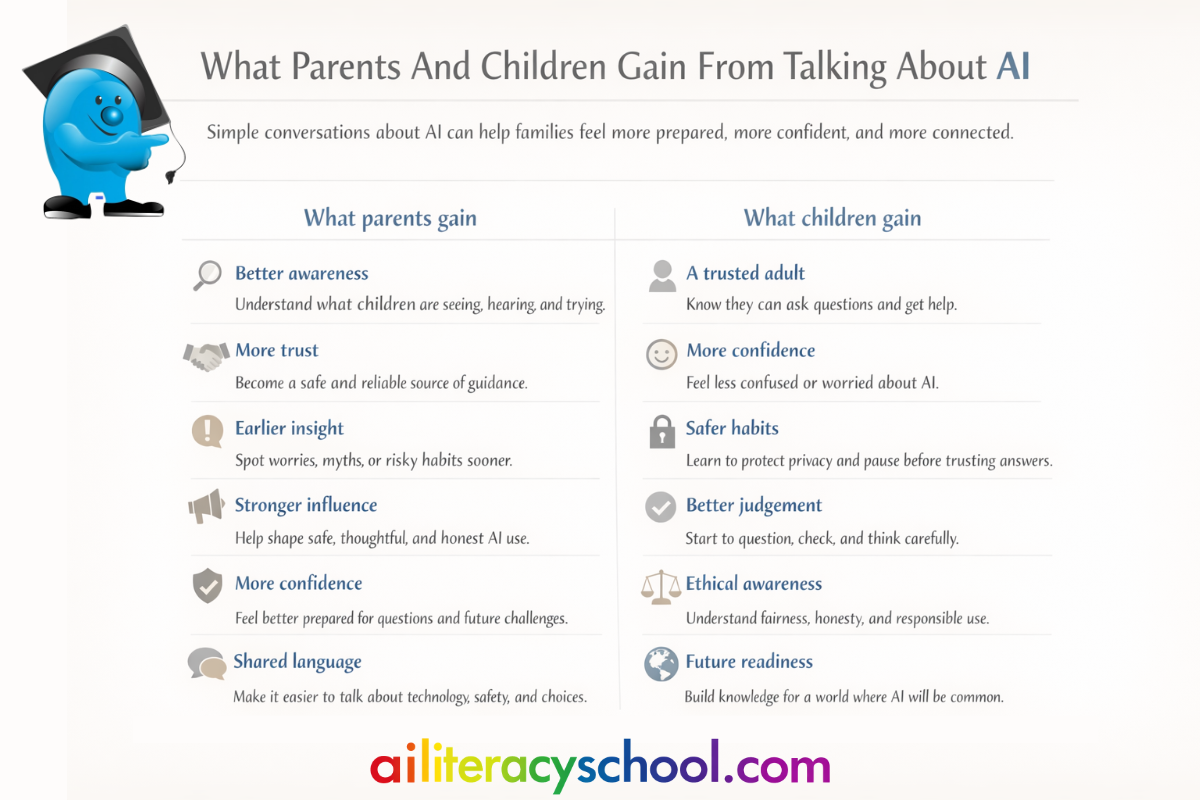
What Children Gain When Parents Talk About AI
Children benefit when AI is not treated as a mysterious subject.
They begin to understand that:
- AI tools are made by people.
- AI does not always get things right.
- Not everything made by AI should be trusted.
- AI should be used in safe and fair ways.
- They can always come to a parent if something feels wrong.
These early ideas help children build good habits.
They learn to pause and think. They learn to question what they see. They learn that being curious is good, but being careful matters too.
Most of all, they learn that they do not have to figure it all out alone.
What Parents Gain From Starting the Conversation
These conversations help parents too.
They give parents a chance to understand what their children are seeing, hearing, and believing. They help parents spot misunderstandings early. They also make it easier to guide children before habits form.
When parents talk about AI regularly, they are more likely to become a trusted source of advice. That matters because children will get messages about AI from many places, including friends, social media, school, and online content. Not all of those messages will be balanced or helpful.
A parent does not need to know everything. They just need to be willing to keep the conversation open.
That alone builds trust.
AI Conversations Are About More Than Technology
When parents talk about AI, they are not just talking about a tool.
They are also talking about:
- Trust
- Truth
- Safety
- Privacy
- Kindness
- Fairness
- Good judgement
For example, a child may need help thinking about whether an AI answer sounds right, whether it is okay to share personal information, or whether using AI to do all their work is really helping them learn.
These are life skills as much as tech skills.
That is one reason these conversations are so valuable. They help children grow into thoughtful users, not just capable users.
Helping Children Feel Safe Speaking Up
One of the most important goals is to help children feel they can come to a parent if AI makes them uncomfortable.
A child might see an upsetting image. They might get a strange answer from a chatbot. They might feel pressured by other children to try something online. They might worry they have done something wrong.
If children believe they will be blamed or dismissed, they may stay quiet.
If they believe a parent will listen and help, they are much more likely to speak up.
That is why tone matters. Calm, open conversations are often more useful than big lectures. Children need to know that if something odd, scary, or confusing happens, they can say so without getting into trouble just for asking.
A simple message can go a long way:
“If anything online or with AI ever feels weird, confusing, or upsetting, you can always come to me.”
Guiding Children Towards Safe, Ethical and Effective Use
As children grow, many will want to try AI tools for learning, creativity, or fun. Parents can play an important role in shaping how they use them.
That means helping children understand that good AI use is not just about what works. It is also about what is safe and right.
Children need support to learn that:
- They should not share private or personal information.
- They should not trust every answer AI gives.
- They should use AI to support learning, not replace thinking.
- They should treat other people fairly and kindly when using it.
- They should ask questions when they are unsure.
These ideas do not need to be taught all at once. They can be built over time through small, regular conversations.
Preparing Children Who Are Not Yet Using AI
Some children in this age group may be too young to use AI tools by themselves. That does not mean the topic can wait.
Children still need preparing for the world they are growing into.
Talking early helps them build a basic understanding before they meet AI more directly. It means that when they do start using AI, the ideas of caution, honesty, privacy, and asking for help are already familiar.
This can make later conversations much easier.
Instead of starting from scratch, parents can build on what their child already knows.
You Do Not Need Expert Knowledge to Start
Many parents worry they do not know enough about AI to talk about it.
That is understandable, but expert knowledge is not the goal.
Children do not need a technical lesson. They need help making sense of what AI is, what it can do, what it cannot do, and how to use it wisely.
It is okay for a parent to say:
- “Let’s figure that out together.”
- “I’m still learning about this too.”
- “I don’t know, but we can think about it.”
- “That doesn’t sound right to me. Let’s check.”
These responses show children something powerful: adults can be thoughtful, honest, and curious without pretending to know everything.
That is a great model to give.
A Good First Step for Parents
The first goal does not need to be teaching everything about AI.
A better first goal is this: make AI feel talkable.
That might mean asking simple questions such as:
- “Have you heard about AI before?”
- “Do you know where people might use it?”
- “What do you think AI can do?”
- “Does anything about it seem exciting or confusing?”
- “If a tool online gave you a strange answer, what would you do?”
Questions like these help parents understand what a child already knows. They also help children practise putting their thoughts into words.
That is often the best place to begin.
Recommended Next Steps
If you are ready to start the conversation with your child, these age-based guides are a good place to begin:
- For ages 7–9: First conversations about AI for ages 7–9
- For ages 10–12: First conversations about AI for ages 10–12
or this guide for families:
Learn how you can support family AI literacy for parents and kids.
If you would like to build your own understanding first, these parent pathways can help:
Was this guide helpful?
Let us know whether this article helped you.
Share this guide with other parents
Know a parent who would find this guide helpful? Enter their email address and we'll send them the Parent Conversation Guide directly.