📑 In this guide
Start with our AI Confidence Quiz
AI is already part of your child’s learning. In just a couple of minutes, discover where your family stands and what to do next.
- ✓ Your family’s AI Confidence Score
- ✓ What you’re already doing well
- ✓ Simple, practical next steps
Why Choosing a Role in Your Prompts is Important
Learn how important setting a role is in prompting ChatGPT and Gemini, or skip to the end to use our interactive Prompt Coach tool to refine your prompts.
When parents first learn to use AI tools like ChatGPT, the instinct is often to jump straight to the question.
“Can you explain how to add fractions?”
“Can you plan a schedule?”
“Can you explain this topic to my child?”
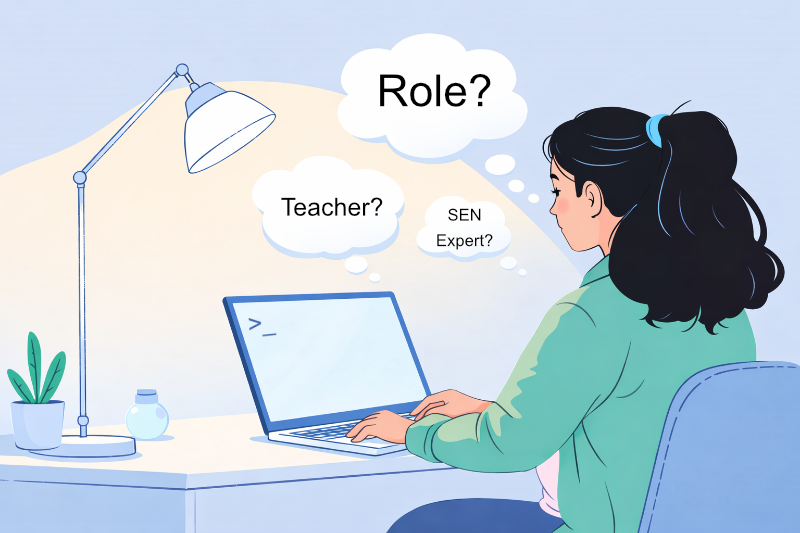
Those questions are reasonable, but they miss an important step. Before an AI can give helpful advice, it needs to understand how it should think.
That is why we recommend structuring prompts using a clear and easy-to-remember format. Different structures exist that do similar things; we find RICO helpful.
RICO stands for:
- Role: Who the AI should act as
- Instruction: What you want it to do
- Context: The background information it needs
- Output: How you want the response delivered
The Role shapes everything that follows.
What “Role” Actually Does
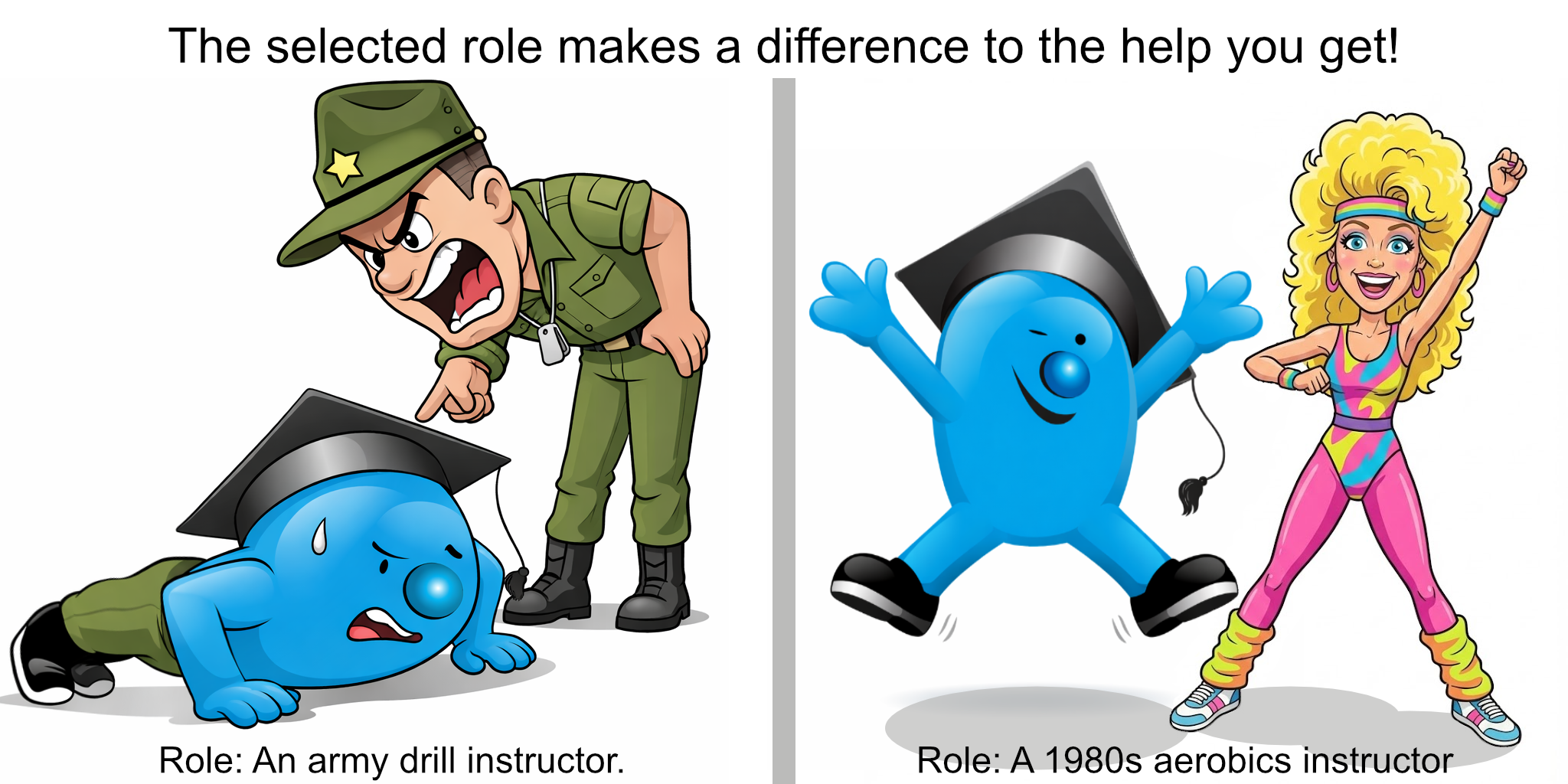
When you give an AI a role, you are not assigning it a job title for fun. You are setting its foundation.
The same instruction will produce very different results depending on the role you give first.
For example:
- An AI answering as a “strict teacher” will focus on rules, correctness, and structure.
- An AI answering as a “curious learning partner” will ask questions, explain gently, and explore ideas.
An AI answering as a “calm parenting guide” will prioritise reassurance, boundaries, and age-appropriate advice.
Without a role, the AI defaults to something vague and generic. With a role, it knows:
- What to prioritise
- What tone to use
- What to leave out
- How cautious or creative to be
For parents, this matters because vague answers often feel unhelpful, overwhelming, or misaligned with family values.
Roles Do Not Have to Be Real Jobs
One of the most common misunderstandings about prompting is that a role must be a recognisable profession.
It does not.
In fact, some of the most effective roles for parents are descriptive, emotional, or values-based, not occupational.
You are not limited to:
- “Teacher
- “Tutor”
- “Psychologist”
You can use roles like:
- “A patient guide for a curious 7-year-old”
- “A calm second brain for a busy parent”
- “A supportive thinking partner who explains things simply”
- “A safety-first assistant for family decisions”
These roles work because AI responds to how you describe the thinking style, not whether the title exists in real life.
How Parents Can Choose a Good Role
A helpful way to choose a role is to ask yourself one question before you write your prompt:
“If a human were helping me with this, what kind of person would I want them to be?”
You might want someone who is:
- Calm rather than intense
- Curious rather than judgmental
- Structured rather than creative
- Brief rather than detailed
- Safety-focused rather than experimental
The role is where you encode those preferences.
This is especially important when AI is used around children. The role sets boundaries before the AI ever responds.
Suggested Roles Parents Can Use
There is no single “correct” role. The best role is one that clearly communicates how you want the AI to think, speak, and prioritise.
Some parents prefer descriptive roles. Others find it easier to start with familiar professions. Both approaches work. What matters is clarity.
Below are examples parents can adapt to their own needs.
Learning and Homework Support
- “An experienced SEN teacher supporting reading practice with encouragement and flexibility.”
Useful for children who need repetition, reassurance, or alternative approaches. - “A calm learning coach for a child who gets easily frustrated.”
Helps keep emotions regulated during learning tasks.
Health, Food, and Wellbeing
- “A registered dietitian specialising in children’s nutrition.”
Helpful for designing balanced meals, snack ideas, and realistic family food plans. - “A family wellbeing guide who focuses on small, sustainable habits.”
Useful for sleep routines, movement, and everyday health decisions.
Parenting Decisions and Behaviour - “A calm parenting advisor who considers child development and emotional needs.”
Useful when thinking through behaviour, boundaries, and expectations.
“A reflective thinking partner who helps me weigh options rather than telling me what to do.”
Supports confident decision-making without judgment.
Family Organisation and Daily Life
- “An organised family planner who keeps things simple and flexible.”
Helps reduce mental load without creating rigid systems. - “A calm second brain that helps me think clearly when I feel overwhelmed.”
Useful during stressful or high-demand periods.
Talking to Children About AI and Technology
- “A guide who prioritises safety, honesty, and reassurance.”
Supports balanced conversations about technology. - “A conversation helper for tricky or sensitive questions.”
Helps parents prepare thoughtful responses.
A Final Tip for Using Roles
Parents can always combine roles with values or boundaries.
For example:
- “An experienced SEN teacher who prioritises confidence over speed.”
- “A children’s dietitian who respects budget limits and family preferences.”
- “A parenting advisor aligned with gentle but firm boundaries.”
This reinforces a key AI literacy skill:
Roles can be shaped, refined, and adjusted until the support feels right for your family.
They describe how it should help, not what credentials it has.
Learning by Doing, Not Memorising
Reading about prompting helps, but using it is where understanding really forms.
That is why this article is paired with our interactive Prompt Coach. You’ll find it below this article and is exclusive to our Premium Subscribers.
The Prompt Coach allows you to:
- Experiment with different roles
- See how small wording changes affect responses
- Strengthen your prompt structure using RICO
- Build confidence without needing technical knowledge
There is no single “correct” role. The goal is not perfection. The goal is clarity.
As you use the Prompt Coach, you will start to notice patterns:
- Which roles feel most natural to you
- Which ones produce calmer or more useful results
- How your thinking becomes more structured over time
Key Takeaways
You do not need to sound clever to write good prompts.
You do not need the “right” words.
You only need to be clear about the kind of help you want.
Starting with Role is one of the simplest ways to do that.
If in doubt, let our Prompt coach guide you. Perfect your prompt and then paste it into ChatGPT or Gemini.
Was this guide helpful?
Let us know whether this article helped you.
Share this guide with other parents
Know a parent who would find this guide helpful? Enter their email address and we'll send them the Parent Conversation Guide directly.