📑 In this guide
Start with our AI Confidence Quiz
AI is already part of your child’s learning. In just a couple of minutes, discover where your family stands and what to do next.
- ✓ Your family’s AI Confidence Score
- ✓ What you’re already doing well
- ✓ Simple, practical next steps
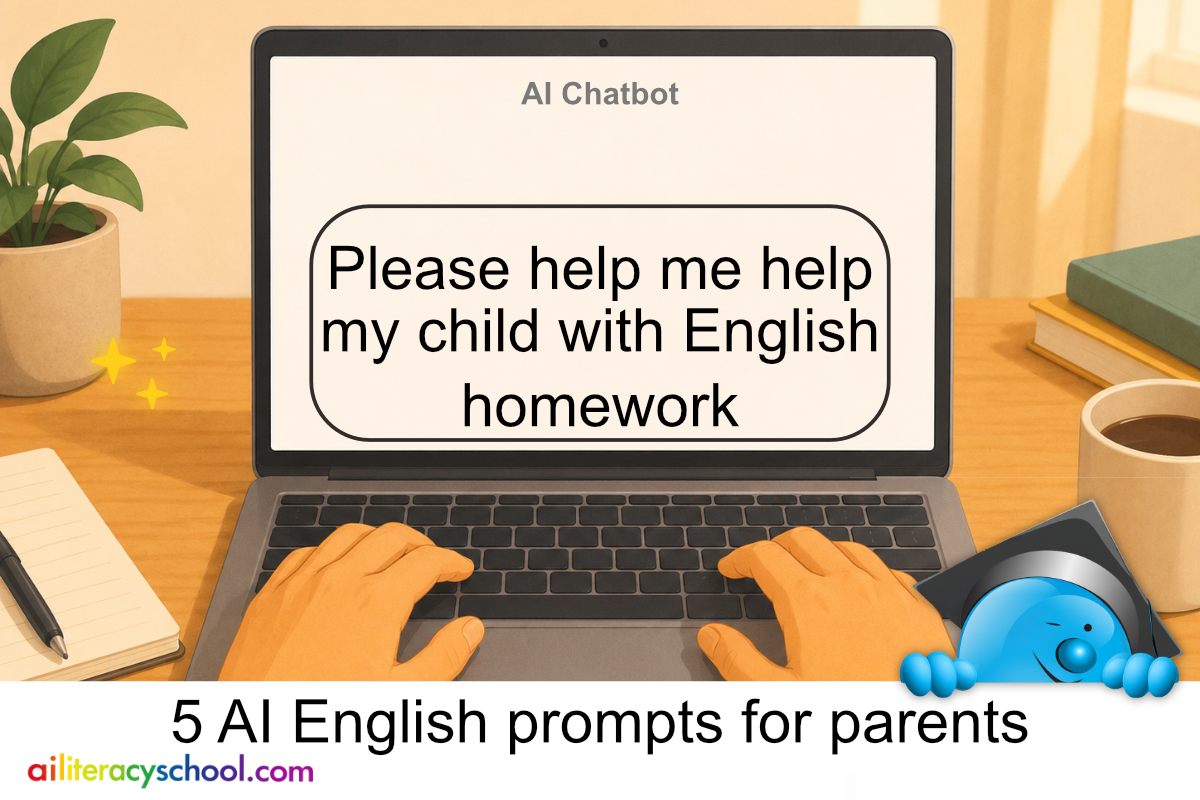
AI can help you prepare questions, explain a language idea or create a short practice activity for English homework.
It should work as a planning tool for you rather than reading, writing or speaking directly to your child. You decide which ideas to use and how to discuss or practise them together.
The prompts below cover five situations parents often face when helping children with English homework at primary or elementary school. Each uses a Role, Instruction, Context, Output structure to support a more useful response.
You can use them with most general-purpose AI chatbots, including free versions. Responses vary between tools, so read and check everything before using it with your child.
Note: Children should not enter these prompts or interact with a general-purpose chatbot themselves. For children under 13, use an adult’s account and remain in control throughout.
Before using the prompts
Replace the words in square brackets with details about the homework.
The Context section helps the chatbot match its response to your child’s age, current understanding and school task.
Useful context can include:
- Your child’s approximate age.
- The English skill they are practising.
- What they can already do.
- The part causing difficulty.
- Any vocabulary or method used at school.
- The type of help you want to prepare.
Leave out your child’s name, school, date of birth, address, diagnosis, medical information and other identifying details.
Describe the learning situation rather than your child’s identity.
Copy and paste the full prompt, including the section headings. Replace the bracketed text and check the response before using it.
For more help with this structure, read our guide to Better Prompting for Parents
1. Prepare questions about a reading passage
Use this prompt when your child has read a story, poem or information text but needs help thinking about its meaning.
The chatbot will prepare questions for you to ask. Your child should answer you rather than the chatbot.
Prompt
Role
Act as a planning assistant for a parent supporting a primary-school child with reading comprehension.
Instruction
Help me prepare questions I can ask my child about the reading passage below.
The questions should help them find information, explain ideas and use evidence from the text.
Do not address the child directly or ask them to interact with you.
Context
The passage is:
[PASTE A SHORT PASSAGE OR DESCRIBE THE TEXT]
My child is approximately [AGE] years old.
They can already [WHAT THEY CAN DO], but they find it difficult to [POINT OF DIFFICULTY].
The school is focusing on [SKILL OR VOCABULARY, IF KNOWN].
Remove names and personal information before including text taken from schoolwork.
Output
Give me five questions to ask my child, beginning with simple retrieval and moving towards explanation and inference. Include a short parent answer guide.
You may find this guide helpful: AI for Learning and Reading: A Parent’s Guide to Supporting Literacy at Home
2. Help your child plan a piece of writing
Use this prompt when your child has a writing task but is unsure how to organise their ideas.
The chatbot will help you prepare planning questions. It should not write the finished work.
Prompt
Role
Act as a planning assistant for a parent helping a primary-school child organise their own writing.
Instruction
Help me prepare questions that will guide my child to plan [TYPE OF WRITING], such as a story, description, letter, report or explanation.
Do not write the piece for them, suggest complete sentences for them to copy or address the child directly.
Context
The task is:
[DESCRIBE OR PASTE THE TASK]
My child is approximately [AGE] years old.
They already have these ideas:
[CHILD’S OWN IDEAS]
They become stuck when [CHOOSING IDEAS, ORGANISING THEM, STARTING THE WRITING OR DEVELOPING DETAILS].
The school has asked them to include [FEATURES, IF KNOWN].
Output
Give me five planning questions I can ask in order. Finish with a simple writing plan made from headings only, without writing any of the child’s sentences.
3. Explain a grammar or punctuation rule
Use this prompt when your child needs another explanation of a grammar or punctuation idea.
The chatbot will prepare wording and examples for you to check and explain yourself.
Prompt
Role
Act as a planning assistant for a parent supporting a primary-school child with English grammar and punctuation.
Instruction
Help me prepare a simple explanation of [GRAMMAR OR PUNCTUATION IDEA] that I can give to my child.
Do not address the child directly or ask them to interact with you.
Context
My child is approximately [AGE] years old.
They already understand [WHAT THEY CAN DO], but they become confused when [POINT OF DIFFICULTY].
Their school uses the term [SCHOOL VOCABULARY, IF KNOWN].
An example they are working with is:
[ANONYMISED EXAMPLE]
Output
Give me a short explanation I can say aloud, followed by two correct examples and one incorrect example I can ask my child to fix.
4. Prepare spelling or vocabulary practice
Use this prompt when your child needs short, focused practice with spellings or new words.
The chatbot creates material for you to check and use away from the chatbot.
Prompt
Role
Act as a planning assistant for a parent preparing a short spelling or vocabulary activity.
Instruction
Create a small practice activity using the words below.
Do not ask the child to type answers into the chatbot or address them directly.
Context
The words are:
[WORD LIST]
My child is approximately [AGE] years old.
They can already [CURRENT SKILL], but they find it difficult to [SPELLING PATTERN, MEANING, WORD CHOICE OR USING WORDS IN SENTENCES].
The activity should take about [NUMBER] minutes.
Do not add words that are much harder than those provided.
Output
Give me one short activity I can lead, followed by five practice questions and a separate parent answer guide.
You may find this fuide helpful: Create Spelling Stories With Any AI Chatbot
5. Help your child review their own writing
Use this prompt after your child has completed a draft and needs help checking it.
The chatbot should help you prepare review questions rather than rewriting the work.
Prompt
Role
Act as a planning assistant for a parent helping a primary-school child review their own writing.
Instruction
Look at the writing below and help me prepare questions that will guide my child to improve it themselves.
Do not rewrite the passage, produce a corrected version or address the child directly.
Context
The task was:
[DESCRIBE THE TASK]
The child’s draft is:
[PASTE THE ANONYMISED DRAFT]
My child is approximately [AGE] years old.
The main areas they are expected to check are [CONTENT, ORGANISATION, SENTENCES, SPELLING, PUNCTUATION OR OTHER FEATURES].
Remove names, school details and private information before pasting the draft.
Output
Give me five questions I can ask my child to help them review the draft. Focus first on meaning and organisation, then on sentence-level corrections.
How to give useful context
Useful context can be brief. Include:
- What your child has been asked to do.
- What they can already do.
- The part causing difficulty.
- Any method or vocabulary used at school.
- The type of help you want to prepare.
For example:
A nine-year-old child can identify information stated directly in a story but finds it difficult to explain why a character acted in a certain way. Help me prepare questions that encourage them to use clues from the text.
Avoid labels such as “bad at English”. Leave out names, school details, diagnoses, medical information and other private details.
Describe the learning problem rather than the child’s identity.
A quick context check
Before sending your prompt, ask:
- Have I explained the task?
- Have I said what my child can already do?
- Have I described the part causing difficulty?
- Have I explained what support I want to prepare?
- Have I removed names and identifying details?
- Have I left out diagnoses and sensitive information?
- Have I made clear that the response is for me rather than my child?
Useful follow-up instructions
A short follow-up instruction can make the response more suitable:
Make the questions easier for me to say aloud.
Use simpler vocabulary.
Give me one question at a time.
Do not suggest sentences for my child to copy.
Focus only on punctuation.
Create another example using the same skill.
Explain what I should listen for in my child’s answer.
Check that the answer guide matches the passage.
Add more detail about the learning task when needed, but do not add personal information.
Use AI as your helper, not your child’s writer
These prompts can help you prepare explanations, questions and short practice activities. They should not place your child in a direct conversation with a general-purpose chatbot.
Do not use AI to write homework for your child, rewrite their draft into a finished piece or produce work for them to submit.
English homework often depends on your child choosing words, explaining ideas and developing their own voice. The chatbot can help you prepare support, but your child still needs to do the reading, thinking and writing.
AI can also misunderstand a passage, suggest unsuitable vocabulary or make mistakes when explaining grammar. Read every response and make sure it matches the task and the language used at school.
Describe what your child understands, explain where they are stuck and ask the chatbot to help you prepare what to do next.
Was this guide helpful?
Let us know whether this article helped you.
Share this guide with other parents
Know a parent who would find this guide helpful? Enter their email address and we'll send them the Parent Conversation Guide directly.