📑 In this guide
Start with our AI Confidence Quiz
AI is already part of your child’s learning. In just a couple of minutes, discover where your family stands and what to do next.
- ✓ Your family’s AI Confidence Score
- ✓ What you’re already doing well
- ✓ Simple, practical next steps
Homework can be hard on parents too. It is not always easy to understand what a teacher wants, explain a topic clearly, or know what to do when your child gets stuck.
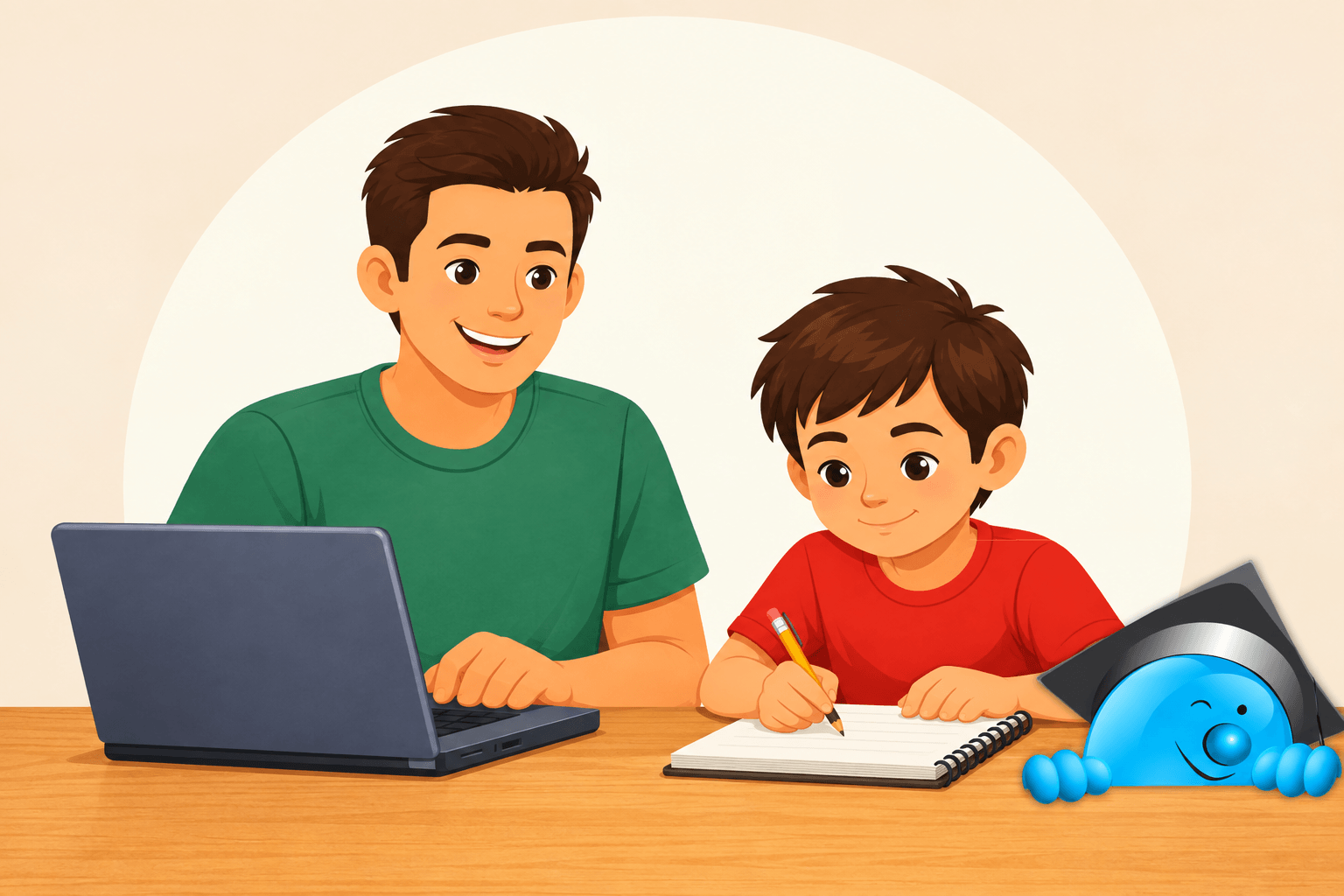
AI can help with that. For parents of young children, its main value is often not helping children work alone, but helping adults support learning better. It can help you understand homework, explain tricky ideas, and find new ways to practise at home.
For elementary-aged children, AI should always be used with direct adult supervision. At this age, it works best as a parent tool first and a child tool second, whether you use it behind the scenes or alongside your child.
The goal is not to hand learning over to a machine. It is to give parents better ways to understand, support, and solve homework problems at home.
You may find these guides to prompting helpful:
5 AI prompts to help you support your child with English homework
5 AI prompts for parents to help children with math
Before You Start: The Rules for Using AI With Young Children
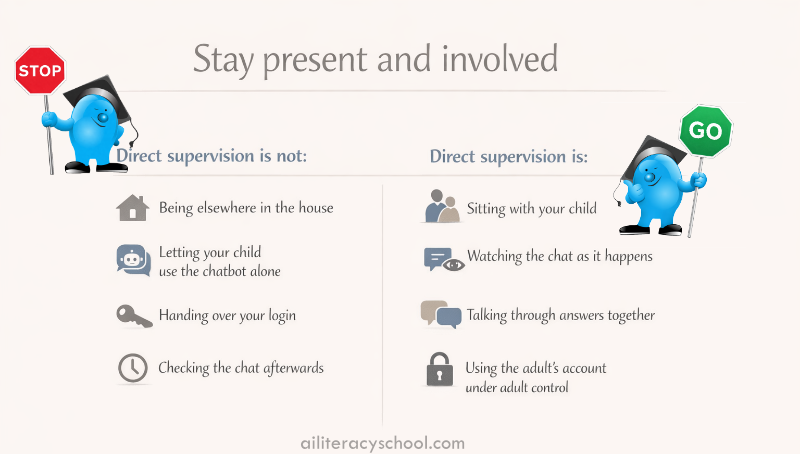
Young children (under 12) should not use AI on their own and you should check the minimum age limit set by the AI provider. Supervised use of chatbots can be a helpful way of supporting your child's AI literacy, but it should be directly supervised.
If you are new to this topic, start with Artificial Intelligence (AI) for Kids, Is AI Safe for Kids?, and AI Privacy Risks for Children: What Parents and Schools Need to Know.
If you want help thinking through the balance, read The AI Shortcut Dilemma: Helping vs. Learning and 4 Essential Lessons for Parents to Teach Kids About Respectful AI Use.
Dedicated AI Learning Apps and General-Purpose Chatbots
Parents often ask whether it is better to use a dedicated AI-based learning app or a general-purpose chatbot like ChatGPT or Gemini. Both can help, but they do different jobs.
Dedicated learning apps are often better for structured practice. They may be designed around reading, maths, spelling, or tutoring. They can feel simpler and more focused for children. General-purpose chatbots are usually more flexible. They can explain a topic in a new way, create practice questions, turn a lesson into a game, or help you tailor support to your child.
For young children, the safest and most useful approach is often this: the adult uses the chatbot, then shares the helpful parts with the child. If you do use an AI tutor or learning app, keep checking whether it is actually helping your child learn rather than just keeping them busy. A good next read is How to Check AI Tutors Are Working for Your Child or AI for Children: Learning to Read.
1. AI Can Help Parents Explain Things More Clearly
One of the most helpful things AI can do is support parents when they are not sure how to explain a piece of homework. A worksheet may use unfamiliar wording, a method may be different from the one you learned at school, or your child may simply need the idea explained in a new way. AI can help parents quickly understand the task and turn it into simpler language, smaller steps, or a more child-friendly example.
Maths
AI can break a problem into steps, explain what each number means, or create a similar example to try first. It can also turn maths into a story or game, which can make practice feel lighter. For a playful example, see Math Adventure Stories With Free AI Tools.
Reading
AI can explain a word, retell a paragraph in simpler language, or help you think of questions to ask while reading together. For more on this, read How can AI tools support learning to read?
Science
AI can explain a science idea using everyday examples, such as plants, weather, magnets, animals, or the human body. This can help a child connect homework with real life.
A useful prompt for parents is: “Explain this for an 8-year-old using simple words, one real-life example, and three short steps.” However, you can get much better results if you understand how to write effective prompts.
If you want to build confidence in giving better instructions to AI, try Crafting Better Prompts: The Parent’s Guide and Why Choosing a Role in Your Prompts is Important for Parents.
2. AI Can Help Parents Make Practice Less of a Battle
A lot of homework stress comes from repetition. Parents often know their child needs more practice, but not how to make that practice feel manageable or engaging. AI can help by giving parents fresh ways to present the same learning: as a quiz, a game, a story, a challenge, or a short activity that feels less heavy than repeating the same task again and again.
Spelling and Vocabulary
AI can create quick quizzes, silly sentences, word games, and short practice activities based on the words your child is learning. For example: AI Guide: Create Spelling Stories With Any AI Chatbot
Times Tables and Number Facts
AI can make short drills, fun questions, and mini challenges. It can also help you vary the practice so it feels fresh without changing the learning goal.
Memorising Key Facts
If your child needs to remember number facts, spellings, topic facts, or short pieces of information, AI can help you plan simple routines, mini-quizzes, and reset moments. For more help with this, read AI Guide For Parents: Helping Children Memorise Material.
3. AI Can Help Parents Guide Research and Thinking Skills
When children are asked to find out information for homework, many parents end up doing more support than they expected. They may need to help a child come up with questions, sort through facts, or decide what information is useful. AI can help parents structure that process. It can suggest better questions, organise ideas into simple headings, and help turn a vague topic into something a child can actually explore.
This is also a good chance for parents to model careful thinking. Rather than treating AI as something that simply gives the answer, families can use it to practise asking questions, checking facts, and talking about whether information sounds right. In that way, AI can support both the homework task and the wider digital and AI literacy skills children need to develop over time.
Research
For younger children, research might mean learning about an animal, a place, a famous person, or a topic from class. AI can help parents turn a broad topic into manageable questions such as: What does it eat? Where does it live? What makes it interesting?
Sorting Information
AI can help group facts into simple sections for a poster, short talk, or homework page. Parents can then help children choose the best facts to keep.
IT and Digital Skills
Children can begin learning simple but important habits: asking clear questions, checking whether answers make sense, and understanding that not every polished answer is correct. For a gentle family framework, see A Simple Weekly Framework for Raising AI-Confident Families.
If you want a simple starting point for talking with your child about what AI is and how it works, read AI Conversation: What Does AI Mean to Your Child?.
4. AI Can Help Parents Solve Homework Problems in the Moment
Sometimes the biggest homework challenge is not the subject itself. It is the mood, the resistance, or the loss of confidence that appears around it. Parents are often left trying to manage tears, frustration, avoidance, or the familiar claim: “I’m just not good at this.” In those moments, AI can be useful behind the scenes by helping parents think more clearly about what to try next.
It can suggest ways to break a task into smaller parts, offer gentler explanations, help you reset the tone, or come up with a different route into the problem. That does not replace parental judgement. It supports it. For many families, this may be one of the most valuable uses of AI: not as a homework machine for children, but as a problem-solving assistant for adults.
A helpful guide here is AI Guide For Parenting Problems: Helping a Child Who Says “I’m Just Not Good at This”. You may also find AI Guide: Creating Stories to Explore Difficult Behaviour useful if emotions around learning are becoming a wider pattern.
5. AI Can Help Parents Model Safe and Responsible Use
Homework is also a chance for parents to show children how to use AI well. Young children learn a great deal from watching what adults do, and AI is no different. Parents can use homework time to model good habits, such as protecting privacy, checking answers, avoiding over-reliance, and using AI to support learning rather than replace effort.
This matters because young children should not be using AI independently. They need adults to guide the process and set the tone. When parents use AI carefully and openly, children begin to learn that these tools can be useful, but they are not always right, they should not be trusted blindly, and they must be used responsibly.
Privacy and Safety
Do not put names, addresses, school details, health information, passwords, or private family stories into AI tools. For more on this, read Simple Steps to Keep Your Child’s Data Safe and AI Privacy Risks for Children: What Parents and Schools Need to Know.
Respectful Use
Children should learn that AI is not for pretending to be other people, copying work, or taking shortcuts that remove the learning. A useful companion guide is 4 Essential Lessons for Parents to Teach Kids About Respectful AI Use.
Choosing the Right Tool
Not every tool described as “AI for kids” is a good choice for homework. Some are designed for learning support. Others are designed for open-ended conversation. Parents need to check whether a tool is safe, age-appropriate, and genuinely helpful. If you are unsure about chatbot-style products aimed at children, see Kids, AI Companions and Safety.
A Simple Way to Decide if AI Is Helping or Hurting
A helpful question for parents is this: after using AI, does my child understand more, or have they simply completed more?
AI helps when your child can explain the idea in their own words, feels more confident, practices more willingly, and still has to think.
AI is getting in the way when your child copies answers without understanding, relies on the tool for every step, becomes less willing to try alone, or finishes work faster but learns less.
If this is a concern in your home, The AI Shortcut Dilemma: Helping vs. Learning is a useful next read.
Final Thoughts
At its best, AI helps parents become calmer, clearer, and more capable supporters of learning at home. It can explain, organise, suggest, and encourage. But it still works best when a parent brings the judgement, the relationship, and the understanding of what their child truly needs.
If your family is just getting started, Everyday AI for Parents is a good place to continue.
Agents are starting to support parents too. See this guide to Muse: Muse AI Agent for Parents: Uses, Benefits and Safety | AI Literacy School
Was this guide helpful?
Let us know whether this article helped you.
Share this guide with other parents
Know a parent who would find this guide helpful? Enter their email address and we'll send them the Parent Conversation Guide directly.